
5th Feb 2026
VHF Radio Range UK: How Far Can a VHF Radio Really Reach?

This guide was written and reviewed by the Baofeng UK technical team — UK-based radio communications specialists with over 10 years of experience in VHF/UHF propagation, amateur radio and practical two-way radio systems. Licensing information reflects current Ofcom guidance on UK amateur radio licensing.
How far can a VHF radio reach?
A handheld VHF radio can communicate from less than a mile in a heavily obstructed location to several miles across clear, open ground. From high ground, through a well-positioned antenna or via an amateur repeater, considerably longer distances can be possible.
There is no single guaranteed VHF radio range. Terrain, antenna height and obstacles usually matter more than the wattage printed on the radio. That is why a 5W handheld on a hilltop can sometimes outperform a higher-powered radio being used at street level behind buildings.
If maximum practical distance is your priority, you can also explore our long-range walkie talkies.
Dense buildings / urban streets: Shortest and most unpredictable range
Open countryside: Several miles may be possible with clear line of sight
Hilltop-to-hilltop: Potentially much farther because both antennas are elevated
Amateur repeater: Can extend communication across a much wider area
Key rule: Terrain, antenna height and obstacles matter more than wattage.
⚡ VHF radio range — key points
- 📏 No guaranteed distance: VHF range varies enormously by terrain, obstacles and antenna position
- 🏔️ Line of sight is critical: A hill between two radios can reduce range more than any power upgrade
- ⚡ More watts ≠ proportionally more range: Doubling power does not double usable distance
- 📡 Elevation helps dramatically: Moving to higher ground often improves range more than changing radio
- 🔁 Repeaters extend coverage: Amateur repeaters can turn a short handheld link into wide-area communication
- 🆚 VHF vs UHF: VHF suits open outdoor environments; UHF is often preferred for buildings
- ⚖️ Licensing applies: Transmitting on UK amateur VHF frequencies requires an appropriate Ofcom licence
📋 Table of Contents
- VHF radio range at a glance
- What is VHF?
- The biggest factor: line of sight
- How far will a 5W handheld VHF radio reach?
- Does more wattage give you more VHF range?
- Why antenna height matters so much
- VHF vs UHF: which gives better range?
- Does VHF work well in hills and woodland?
- How do repeaters extend VHF radio range?
- How to improve VHF radio range
- Do you need a licence to use a VHF radio in the UK?
- Which type of radio should you choose?
- Recommended radios for VHF communication
- Frequently asked questions
VHF radio range at a glance
| Situation | What to expect |
|---|---|
| Dense buildings / urban streets | Shortest and most unpredictable range |
| Woodland or hilly terrain | Variable; hills and dense vegetation can create dead spots |
| Open countryside | Several miles may be possible with clear line of sight |
| Hilltop-to-hilltop | Potentially much farther because both antennas are elevated |
| Vehicle or fixed antenna | Usually better than handheld-to-handheld communication |
| Amateur repeater | Can extend communication across a much wider area |
🎯 Planning note: These are planning expectations rather than guaranteed distances. Two radios with identical power ratings can perform very differently in different locations. For a broader comparison of radio types and use cases, browse our full range of walkie talkies and two-way radios.
What is VHF?
VHF means Very High Frequency and broadly covers the radio spectrum between 30 MHz and 300 MHz. For handheld amateur radio users, one of the best-known VHF allocations in the UK is the 2-metre amateur band at 144–146 MHz.
VHF signals are commonly associated with line-of-sight communication. In practical terms, the clearer the path between the transmitting and receiving antennas, the better your chances of maintaining a reliable signal. A hill, reinforced building or deep valley can therefore have a much greater effect on communication than adding a few extra watts of transmitter power.
⚠️ Important UK licensing point: Being able to tune a radio to a VHF frequency does not mean you automatically have permission to transmit there. UK amateur radio operation requires an appropriate Ofcom Amateur Radio Licence. Ofcom currently provides Foundation, Intermediate and Full amateur licences. If you are buying a programmable VHF/UHF handset for amateur use, see our UK amateur radio collection and read our UK Ham Radio Licence Guide before transmitting.
The biggest factor affecting VHF range: line of sight
Radio range is often marketed as if it were simply a function of transmitter power. It isn't. For normal handheld VHF communication, the radio path between the antennas is critical.
Imagine standing on one hill and being able to see another person on the next hill. There is relatively little terrain obstructing the path between you. Now imagine putting the same two radios on opposite sides of the hill. The power has not changed. The radios have not changed. But the communication path has changed dramatically.
This is why moving only a short physical distance — from behind a building to an open area, or from the bottom of a valley onto higher ground — can sometimes improve reception more than changing radios.
Things that normally help VHF range
Clear line of sight, greater antenna height, suitable antennas, open terrain and lower levels of local radio interference generally improve the chances of successful communication.
Things that normally reduce VHF range
Hills, valleys, reinforced concrete, metal structures, dense buildings, poor antenna positioning and local interference can all shorten the usable distance. If buildings are your main problem, our guide to how walkie talkies work through walls goes into more detail about indoor signal loss.
How far will a 5W handheld VHF radio reach?
There is no trustworthy universal figure. As a rough planning guide, handheld-to-handheld VHF communication can range from under a mile in difficult surroundings to several miles where terrain and line of sight are favourable. Much longer contacts can sometimes occur when one or both operators are on high ground or when an amateur repeater is used.
The important point is that 5W does not equal a particular number of miles. For example:
- A 5W radio used between two people in separate valleys may struggle
- The same radio used from a summit may communicate much farther
- A more powerful handheld at ground level may still lose to terrain
- Connecting through a correctly configured amateur repeater can change the coverage area completely
🔵 For buying guidance: Advertised maximum-range numbers should be treated as best-case figures rather than expected everyday performance. For more buying-focused guidance, read our UK long-range walkie talkie guide.
Does more wattage give you more VHF range?
More transmitter power can help, particularly when the received signal is already close to the minimum level required for understandable communication. But power cannot remove a hill.
Going from a lower-power radio to a higher-power radio does not mean your communication distance increases by the same proportion. For example, doubling transmitter power does not automatically double your usable range. This is one reason buyers should avoid choosing a radio entirely on the basis of a 5W, 8W or 10W headline. For many real-world handheld situations, improving your location or antenna system can be more useful than simply chasing the highest wattage available.
Why antenna height matters so much
Antenna height directly affects how much surrounding terrain and infrastructure blocks the radio path. Consider two operators standing in a built-up area. At waist height, nearby cars, walls, fences and the operators' own bodies may interfere with the signal. Raise the radio into a clearer position and the signal may have a much better path. The effect becomes even more significant with vehicle-mounted or fixed antennas because they can be positioned above many nearby obstructions.
A better antenna can help — but don't expect magic
An antenna matched to the frequency you are using can improve radio performance. Poorly matched, damaged or badly positioned antennas can reduce it. However, claims that a particular replacement antenna will automatically "double your range" should be treated cautiously. The result depends on the radio, frequency, antenna design and environment. Licensed users looking for compatible replacements can browse our walkie talkie and radio antennas.
⚠️ UK compliance reminder: Antenna changes are not appropriate for every radio category. PMR446 equipment used under the licence exemption must meet the applicable technical requirements, including an integral antenna and maximum permitted power.
VHF vs UHF: which gives better range?
The answer depends on where the radios are being used. VHF is often favoured for relatively open outdoor environments because it can provide very effective communication where there is a clear radio path. UHF is widely used in buildings and built-up environments, where its shorter wavelength and practical antenna characteristics can make it a better fit for many indoor communication systems.
But the simple rule of "VHF outdoors, UHF indoors" is only a starting point. Building materials, terrain, antenna placement, interference and the radio system itself all affect the result.
| Factor | VHF | UHF |
|---|---|---|
| Open outdoor environments | Often a strong choice | Also usable |
| Farms / open land | Often well suited | Situation dependent |
| Dense buildings | Can be challenging | Often preferred |
| Hotels / warehouses | Situation dependent | Common choice |
| Antenna size | Typically longer | Can be more compact |
| Amateur handheld use | Common | Common |
| UK licence-free PMR446 | No | Yes — 446 MHz compliant equipment |
🔵 Need both frequency ranges? See our dual-band VHF/UHF radios. For a deeper technical comparison, read VHF vs UHF radios: which frequency should you choose?
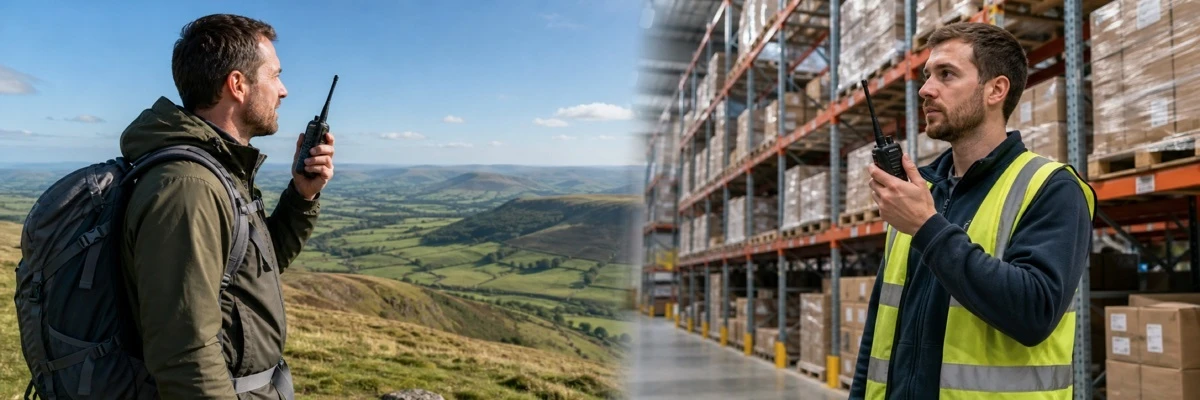 A dual-band VHF/UHF radio gives licensed operators access to both frequency ranges — VHF for open outdoor environments and UHF for buildings and built-up areas — without needing separate handsets.
 Does VHF work well in hills and woodland?
It can, but terrain is usually the deciding factor.
Hills
A ridge directly between two radios may block or severely weaken communication. If possible, moving onto higher ground or around the obstruction can make a major difference. In mountainous or hilly areas, the distance on a map may therefore tell you very little about whether two handhelds will actually communicate.
Woodland
Trees and vegetation can weaken radio signals, particularly when foliage is wet and dense. Uneven woodland terrain can create additional obstruction. For hiking, camping and other outdoor activities, plan your communication system around the terrain rather than assuming a manufacturer's maximum-range claim will apply. You can compare radios designed around outdoor use in our outdoor walkie talkie collection.
How do repeaters extend VHF radio range?
A repeater receives a transmission on one frequency and retransmits it from another location, usually from a much better antenna position. The major advantage is often height. A handheld in a valley may not be able to communicate directly with another handheld many miles away, yet both radios may be able to reach an elevated repeater that can relay the communication.
Depending on the repeater's location and system coverage, this can turn a short direct handheld link into communication spanning a much larger region. Repeaters must be used on authorised frequencies and according to the conditions of your licence. For UK amateur operators, repeater operation forms part of normal licensed amateur-radio use.
How to improve VHF radio range
- Get into a clearer position Before changing settings or equipment, move away from major obstructions. Try higher ground, an upper floor, an open area or a position with a clearer path towards the other station.
- Keep the antenna clear Hold a handheld naturally with the antenna approximately vertical rather than wrapping your hand around it or pressing it against your body.
- Use an appropriate antenna For radios where external antennas are permitted, make sure the antenna is suitable for the frequencies being used and compatible with the radio.
- Check your battery A properly charged radio helps ensure it can operate as intended throughout the communication period.
- Check your radio configuration Make sure both stations are operating on the intended frequency or channel and that settings such as CTCSS/DCS and squelch are not creating an apparent communication problem.
- Consider a repeater where permitted For licensed amateur operators, an available repeater may be a much more effective way of increasing useful coverage than simply choosing a higher-output handheld.
🟢 More troubleshooting ideas: See our guide on how to increase two-way radio range.
 Elevation makes one of the biggest practical differences to VHF handheld range. A radio used from a hilltop with clear line of sight to the horizon can communicate far beyond what the same radio achieves at street level in an urban environment.
 Do you need a licence to use a VHF radio in the UK?
Usually, if you intend to transmit using a programmable VHF amateur radio, yes. UK spectrum use is regulated by Ofcom, and amateur radio transmission requires an Amateur Radio Licence.
For users who simply want short-range radio communication without obtaining an individual radio licence, compliant PMR446 equipment is normally the more appropriate route. PMR446 operates around 446 MHz, so it is UHF rather than VHF. Compliant PMR446 equipment is hand portable, uses an integral antenna and is subject to a maximum effective radiated power of 500 mW.
⚠️ Important distinction: Programming a PMR446 frequency into a higher-powered programmable VHF/UHF radio does not automatically make that radio licence-free. If avoiding licensing complexity is your priority, browse our licence-free PMR446 radios. You can also read our full guide explaining whether you need a licence for a walkie talkie in the UK.
Which type of radio should you choose?
| Your situation | Good starting point |
|---|---|
| Family, campsite or simple short-range communication | Compliant PMR446 radio |
| Licensed amateur radio beginner | VHF/UHF amateur handheld |
| Hillwalking / licensed outdoor amateur use | VHF/UHF handheld suited to outdoor use |
| Hotel, warehouse or building | Consider UHF/site-specific radio requirements |
| Construction or larger workplace | Assess PMR446 versus licensed business radio |
| Need amateur repeater access | Appropriate licensed amateur radio |
| Unsure what is legal | Check the radio category and licence requirement first |
For workplace users, our business two-way radio range provides options for different operational requirements. Construction teams can also browse two-way radios for construction sites.
Recommended radios for VHF communication
The five models below cover the main VHF and dual-band communication needs discussed in this guide — from entry-level licensed amateur handsets to rugged outdoor radios and a simple licence-free option for users who do not need VHF amateur operation.
📻 Baofeng UK VHF/UHF Radios — Matched to Your Communication Needs
Choose by licence situation, environment and range requirements — not by wattage alone.
📡 Licensed VHF/UHF Radios — For Amateur Operators & Long-Range Communication
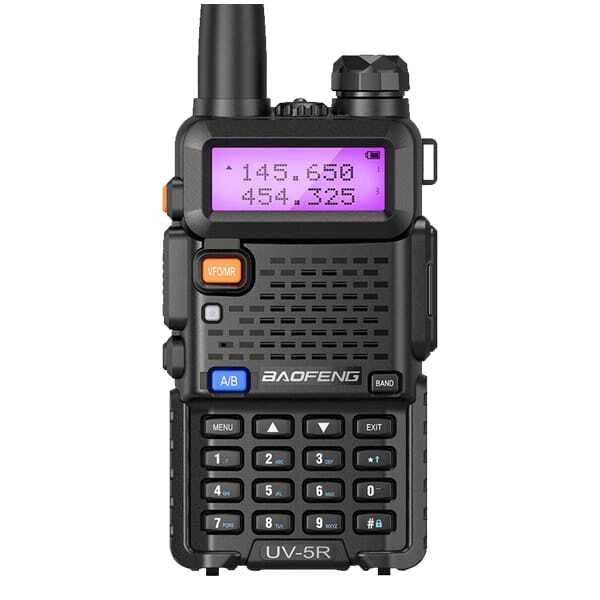
Baofeng UV-5R
Dual-band VHF/UHF · 5W · CHIRP compatible · Earpiece included — the classic entry point for licensed amateur VHF operation. Requires an appropriate Ofcom Amateur Radio Licence to transmit legally in the UK.
View UV-5R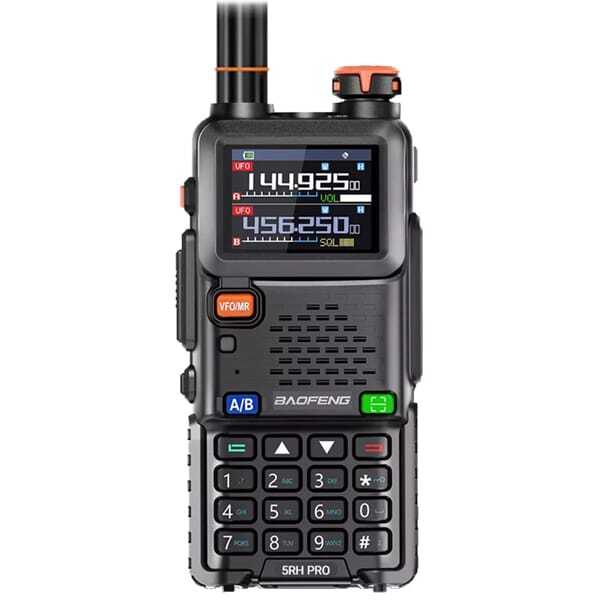
Baofeng UV-5RH Pro GPS
10W · GPS · 640 channels · USB-C · Multi-band — for licensed operators who need maximum output for hilltop-to-hilltop or wide-area VHF/UHF communication. Licence required to transmit.
View UV-5RH Pro GPS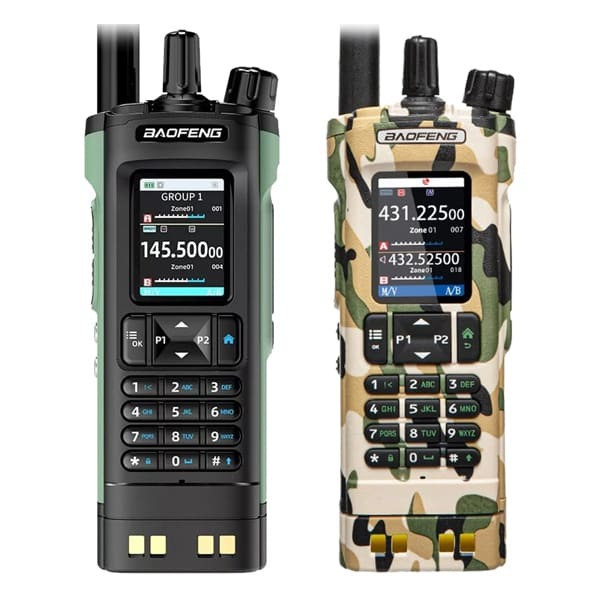
Baofeng UV-32 GPS
10W · GPS · Bluetooth · Multi-band · 1000 channels — long-range dual-band radio for licensed operators needing GPS location alongside VHF/UHF communication capability. Licence required to transmit.
View UV-32 GPS🏔️ Outdoor Rugged & Licence-Free — For Hills, Woodland & No-Licence Communication
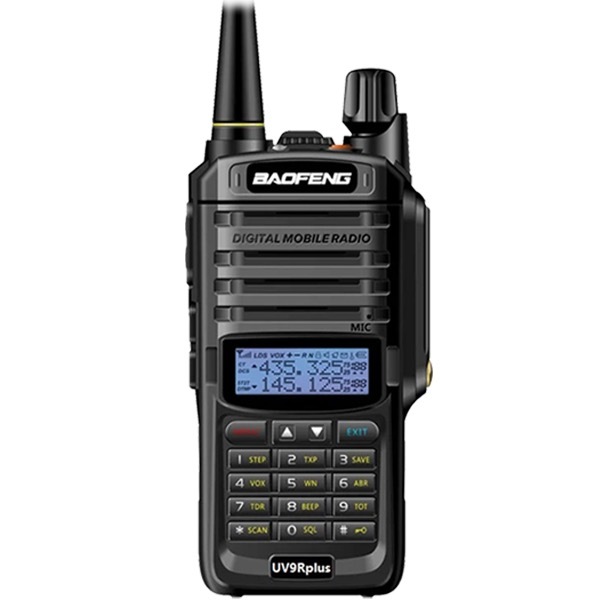
Baofeng UV-9R Plus IP67
IP67 waterproof · 8W · VHF/UHF · Earpiece included — for licensed operators on UK hills, woodlands and outdoor activities where weather protection and durability matter as much as VHF range. Licence required to transmit.
View UV-9R Plus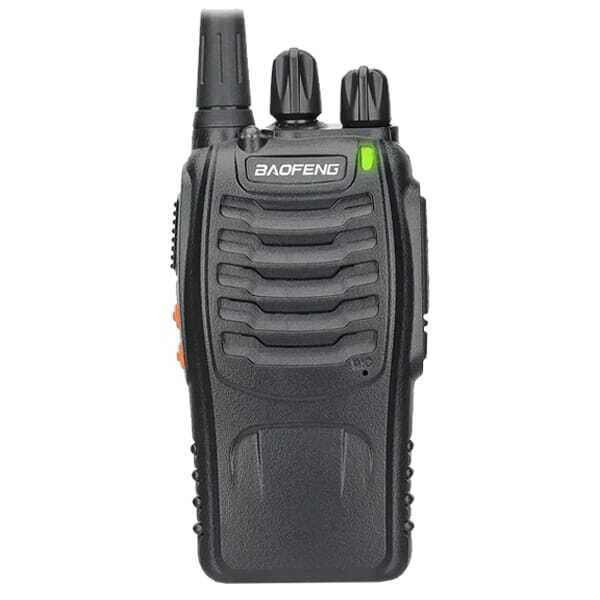
Baofeng BF-888S PMR446
PMR446 (UHF 446MHz) · 0.5W · Fixed antenna · Earpieces included · No licence needed — if you need licence-free short-range communication without VHF amateur licensing, compliant PMR446 is the practical starting point for families and small teams.
View BF-888S PMR446⚠️ BF-888S PMR446 is licence-free when fully compliant. UV-5R, UV-5RH Pro GPS, UV-32 GPS and UV-9R Plus require an appropriate Ofcom Amateur Radio Licence to transmit legally in the UK.
Final answer: what really determines VHF radio range?
If you remember only one point from this guide, make it this: VHF range is determined by the complete radio path — not just transmitter wattage.
Antenna height, terrain, buildings, vegetation, interference and radio configuration all contribute to whether two stations can communicate successfully. For open outdoor communication, VHF can be highly effective. For buildings and dense urban environments, UHF may be the more practical choice. And if you simply need licence-free short-range communication in the UK, compliant PMR446 equipment is usually a better starting point than a programmable VHF handheld.
Before choosing a radio based on a "long range" claim, decide three things first: where you will use it, whether you need licence-free operation, and what obstacles are likely to exist between users.
📋 Related Baofeng UK guides
Frequently asked questions
What is the maximum range of a VHF handheld radio?
There is no fixed maximum practical distance. Obstructed ground-level communication may be very short, while several miles or more can be possible across clear terrain. Elevated antennas and amateur repeaters can extend the useful distance considerably. The terrain, antenna height and obstacles between users matter more than the transmitter output.
How far can a 5-watt VHF radio transmit?
A 5W rating alone cannot predict distance. In difficult urban or hilly terrain, usable range can be less than a mile. In favourable open conditions, several miles may be achievable. Elevation and antenna placement often make a bigger difference than small increases in power.
Is VHF better than UHF for long range?
VHF can perform very well across open outdoor areas, but it is not automatically longer-range in every situation. Terrain, antennas, interference and building construction can outweigh the frequency difference. UHF is often preferred for indoor and built-up environments. For a full comparison, read our VHF vs UHF frequency guide.
Can a VHF radio communicate over a mountain?
Not reliably through the mountain itself. VHF communication normally benefits from a clear or reasonably unobstructed radio path. Moving to higher ground, moving around the obstruction or using an appropriately authorised repeater may solve the problem.
Will a longer antenna increase VHF range?
A properly designed and correctly matched antenna may improve transmission and reception compared with a poor antenna, but length alone does not guarantee better performance. Compatibility, frequency, installation and positioning all matter.
Do I need a licence for a Baofeng VHF radio in the UK?
If you are transmitting on UK amateur VHF frequencies with an amateur transceiver, you need the appropriate Ofcom Amateur Radio Licence. A programmable radio should not be assumed to be licence-free simply because it can be set to a particular frequency.
Is PMR446 VHF?
No. PMR446 operates around 446 MHz and is therefore in the UHF spectrum. It is the main licence-free walkie-talkie option for many UK users when compliant PMR446 equipment is used. For licence-free options, browse our PMR446 licence-free radios.
Find the Right VHF or UHF Radio for Your Needs
From licensed VHF/UHF amateur handsets for outdoor hilltop communication to rugged waterproof radios and licence-free PMR446 options — Baofeng UK has the right radio for your UK licence situation and environment.