
2nd Aug 2026
Licensed vs Unlicensed Radios: What UK Walkie-Talkie Buyers Need to Know
This guide was written and reviewed by the Baofeng UK technical team — UK-based radio communications specialists with over 10 years of hands-on experience advising families, businesses and licensed operators. All licensing information reflects current Ofcom guidance. Regulatory sources: Ofcom Licence-exempt devices (updated 28 May 2026), Business Radio Guidance 2025, Analogue and Digital PMR446 Information Sheet.
Buying a walkie-talkie in the UK should be simple. Pick a pair, charge them and start talking.
Then you encounter terms such as PMR446, UHF, VHF, amateur radio, business radio, 0.5 watts, 5 watts and Ofcom licensing. Suddenly, a straightforward purchase feels like a regulatory exam.
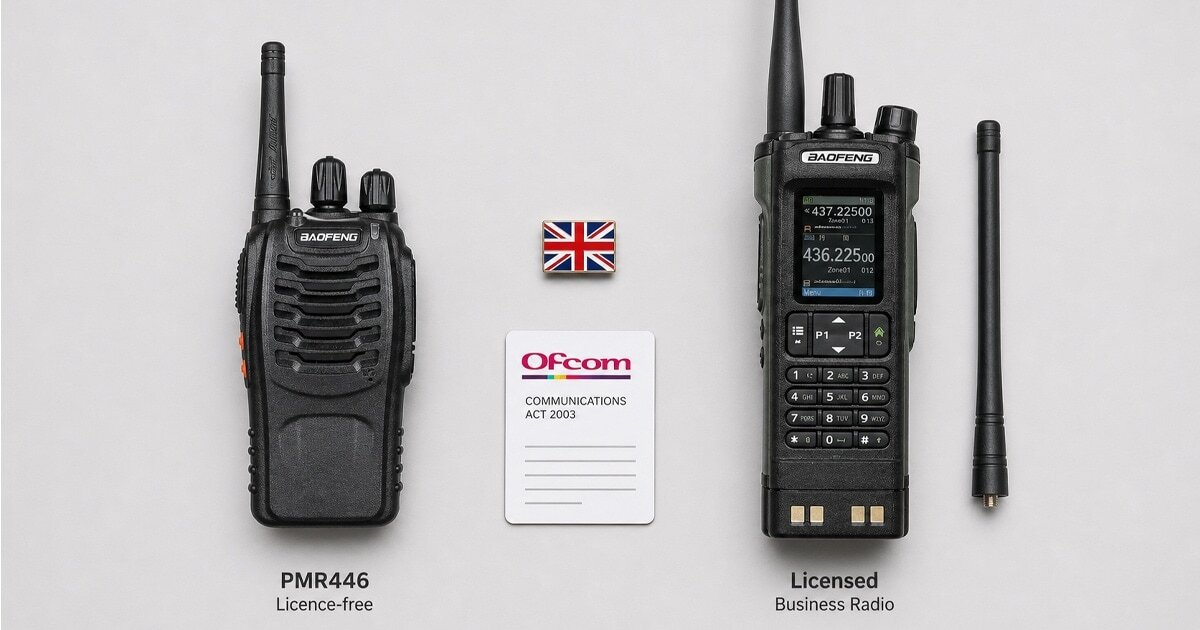
The practical difference is this: licence-free PMR446 walkie-talkies can be used without applying for an individual Ofcom licence, provided the equipment itself meets the UK's PMR446 technical requirements. More powerful, programmable or removable-antenna radios generally need the correct licence and must be operated under that licence's conditions.
That distinction matters whether you are buying radios for a family camping trip, a restaurant, a warehouse, an event team or a new amateur-radio hobby.
⚡ Licensed vs unlicensed radios at a glance
- ✅ Licence-free PMR446: No individual licence needed · 0.5W max · 446 MHz · integral antenna · shared channels · ideal for families, shops and small teams
- 🏢 Licensed business radios: Ofcom Business Radio licence required · up to 5W+ · dedicated frequencies · base stations possible · better for operational teams
- 📡 Amateur radio licence: Exam required · hobby and experimentation use only · cannot be used for routine commercial staff communication
- ⚠️ Key rule: Programming a PMR446 frequency into a high-power radio does not make it licence-free. Equipment compliance matters, not just the selected frequency.
- 🔍 Always verify: Confirm the product is explicitly the PMR446-compliant version before assuming licence-free operation.
📋 Table of Contents
- Licensed and licence-free radios at a glance
- What are "unlicensed walkie-talkies"?
- A programmed frequency does not make a radio licence-free
- UK Radio Licensing Selector
- When are PMR446 radios the sensible choice?
- When should a business consider licensed radios?
- Where do amateur radios fit?
- Does a licensed radio always provide better range?
- How to identify the correct radio before buying
- Common mistakes that create legal or operational problems
- Radios matched to each licence type
- Which option is right for you?
- Frequently asked questions
Licensed and licence-free radios at a glance
Ofcom describes PMR446 as a mobile, short-range, peer-to-peer service suitable for business and non-business users. Compliant PMR446 equipment operates between 446.0 and 446.2 MHz, is limited to 500 mW ERP and uses an integral antenna.
| Feature | Licence-free PMR446 | Licensed business radios | Licensed amateur radios |
|---|---|---|---|
| Individual licence required | No — when equipment and operation meet PMR446 requirements | Yes | Yes |
| Typical user | Families, shops, cafés, schools, small venues and outdoor groups | Construction, security, warehouses, events and larger operational teams | Radio hobbyists and experimenters |
| Permitted purpose | Personal or business short-range communication | Organisational and commercial communication | Personal, technical and hobby activity |
| Equipment | Hand-portable, compliant PMR446 handset | Professionally programmed handheld, mobile or base equipment | Programmable amateur transceiver |
| Power | Maximum 0.5W ERP | Depends on licence — some Light licences permit up to 5W ERP | Depends on licence class, band and conditions |
| Antenna | Integral antenna only | Depends on licensed system | Frequently removable or interchangeable |
| Channel access | Shared with other PMR446 users | Licensed frequencies, often shared or coordinated | Amateur frequency allocations |
| Best reason to choose it | Simplicity and no individual licence application | More dependable operational control | Radio experimentation and access to amateur bands |
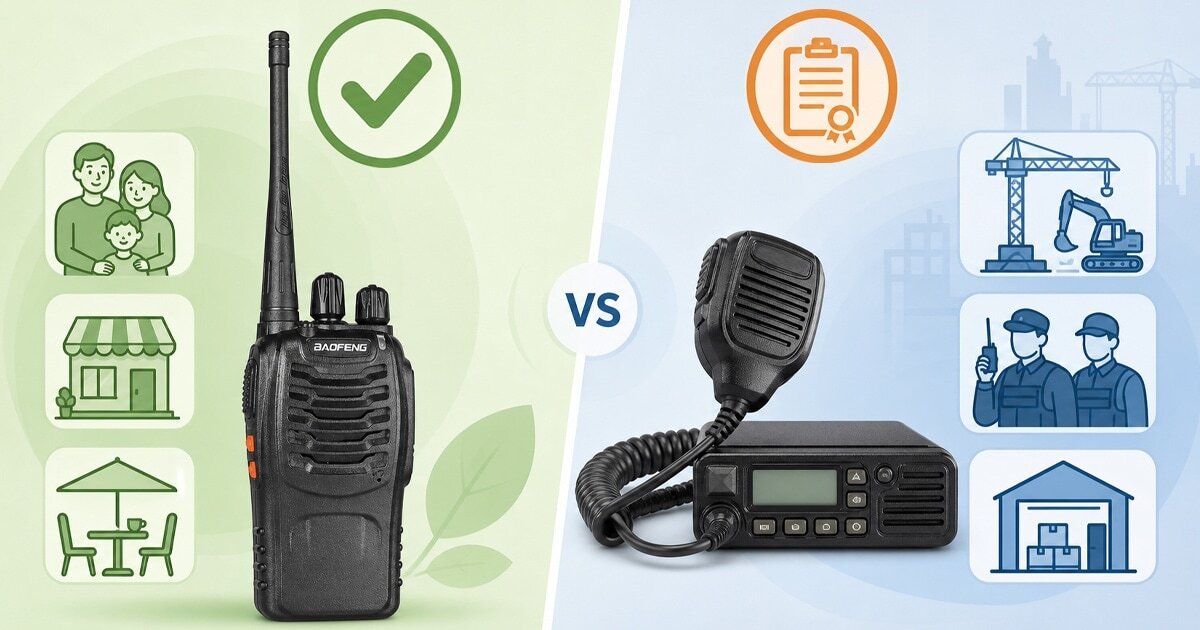
Left: compliant PMR446 licence-free radios for everyday use. Right: licensed business radios for operational teams requiring greater coverage and control.
What are "unlicensed walkie-talkies"?
"Unlicensed walkie-talkies" is a common search term, but licence-free walkie-talkies is usually the more accurate phrase.
The radios are not outside regulation. They are covered by a licence exemption that only applies when the equipment meets specific conditions.
For UK PMR446 use, Ofcom's current guidance states that the equipment must be:
- Hand portable
- Mobile-only, rather than a fixed base station
- Limited to a maximum of 500 mW ERP
- Fitted with an integral antenna
- Operated between 446.0 and 446.2 MHz
- Used on a non-interference, non-protected basis
🔵 What "non-protected" means: You do not own the channel. Another family, shop or event team may be using the same PMR446 channel nearby, and you may need to change channels if you hear interference. For buyers who want straightforward team communication, the easiest route is to choose a clearly identified licence-free PMR446 radio rather than trying to modify or reconfigure a different type of handset.
A programmed frequency does not make a radio licence-free
This is where many UK buyers get caught out.
A programmable radio may be capable of transmitting on a PMR446 frequency. That does not automatically make it a licence-free PMR446 radio.
Lowering the menu setting to 0.5W is also not enough on its own. The licence exemption concerns the design and technical compliance of the equipment as well as the selected frequency and operating power.
A typical high-power handheld with a removable antenna does not become PMR446-compliant simply because somebody:
- Enters a 446 MHz frequency
- Selects "low" power
- Calls the channel PMR446
- Uses it over a short distance
- Programs the same frequencies into every radio
⚠️ Ofcom warning: Equipment operated in the PMR446 range may still be unlawful on a licence-exempt basis when it does not meet the applicable PMR446 requirements. This is why the exact product version matters. Two radios with similar names or cases may have different power, antenna and programming characteristics. Check the product page for a clear statement that the model is the PMR446-compliant version, rather than assuming every version of that model is licence-free.
UK Radio Licensing Selector
Use the tool below to find the most appropriate licence type for your situation. Adjust the inputs and the recommended solution — including the highlighted row in the comparison table — will update automatically.
UK Radio Licensing Selector
| Type | Power Limit | Frequency | Licence Fee |
|---|---|---|---|
| Licence-Free PMR446 | 0.5W | 446 MHz | Free |
| Licensed Business Radio | 5W–25W | VHF/UHF | From £75 / 5yr |
| Amateur Radio Licence | 10W–400W | Multiple | Free (Exam Req) |
Recommended Solution
Licence-Free PMR446
Ideal for simple, short-range team or family communication. No individual Ofcom licence required.
Note: Range calculations are estimates based on typical terrain. Dense urban environments or buildings may significantly reduce actual performance.
When are PMR446 radios the sensible choice?
Licence-free PMR446 radios are often the right choice when convenience matters more than maximum technical flexibility.
Restaurants, cafés and small hotels
A compact PMR446 fleet can help reception, floor, kitchen and maintenance staff communicate without personal phone calls or a lengthy radio-licensing setup. For a typical single-site hospitality business, the appeal is not dramatic long-distance range. It is the ability to press one button and reach the right colleague immediately.
Businesses considering this use case can also read the guide to choosing a walkie-talkie for restaurants.
Retail shops and small warehouses
Staff can use radios for stock checks, customer assistance, deliveries and supervisor calls. PMR446 is designed for short-distance communication and Ofcom identifies offices, factories and building sites as examples of potential environments. Buildings, reinforced concrete, machinery and neighbouring radio users may reduce performance, so realistic on-site testing remains important.
Family and outdoor activities
PMR446 radios can be useful at campsites, parks, festivals and group outings where mobile reception is weak or not everyone has a phone. They should not, however, be treated as a guaranteed emergency service. Terrain, valleys, trees, buildings and the position of each user can substantially change the usable range.
Schools and community groups
Simple controls and no individual licence application can make compliant PMR446 handsets easier to issue to multiple users. The buyer should still consider safeguarding procedures, channel discipline, battery management and whether shared public channels are appropriate for the information being discussed.

Common PMR446 licence-free radio use cases across the UK — from restaurant and hospitality teams to family campsites, retail warehouses and school outdoor activities.
When should a business consider licensed radios?
PMR446 is affordable and convenient, but shared low-power channels will not suit every organisation. A licensed Business Radio system may be more appropriate when a team needs:
- Better control over its radio configuration
- Higher permitted power
- Communication across a larger or more difficult site
- Base-station or repeater capability
- Professionally coordinated frequencies
- A system designed around several buildings or operational areas
- Reduced exposure to congestion from nearby PMR446 users
Ofcom offers several Business Radio licence types rather than one universal "walkie-talkie licence."
- A Simple UK Light Licence permits authorised hand-portable or mobile equipment across the UK using a defined list of frequencies. Ofcom's current guidance lists a maximum of 5W ERP and does not permit base-station use under this licence.
- A Simple Site Light Licence is intended for a system operating within a limited site area and may include base and mobile stations. Ofcom currently lists both Simple UK and Simple Site licences at £75 for five years, although buyers should check the latest official fee before applying.
- Nationally Assigned and Area Defined licences are available for more complex requirements and involve additional frequency planning or coordination.
🎯 Expert note: For a restaurant with ten staff in one building, a business radio licence may be unnecessary complexity. For a construction company, security operation or distribution site where communication failures cause delays or safety concerns, the additional control may be worthwhile.
Where do amateur radios fit?
Radios such as the Baofeng UV-5R family are commonly associated with amateur, or "ham," radio. They offer far more flexibility than a basic PMR446 handset. Depending on the model, features may include programmable VHF and UHF operation, access to amateur repeaters, interchangeable antennas, larger channel memories and computer programming.
⚠️ Business use not permitted: Ofcom states that amateur radio is a personal hobby and technical activity with no commercial or profit purpose. A UK Amateur Radio Licence does not authorise ordinary business communications. A restaurant manager therefore cannot solve a licensing issue by asking one employee to obtain an amateur licence and then using amateur channels for daily staff communication.
Amateur radio is the right route when the real goal is learning about radio, experimenting with equipment and communicating with other licensed amateurs. New hobbyists can start with the UK beginner ham-radio guide and compare programmable models such as the Baofeng UV-5R III.
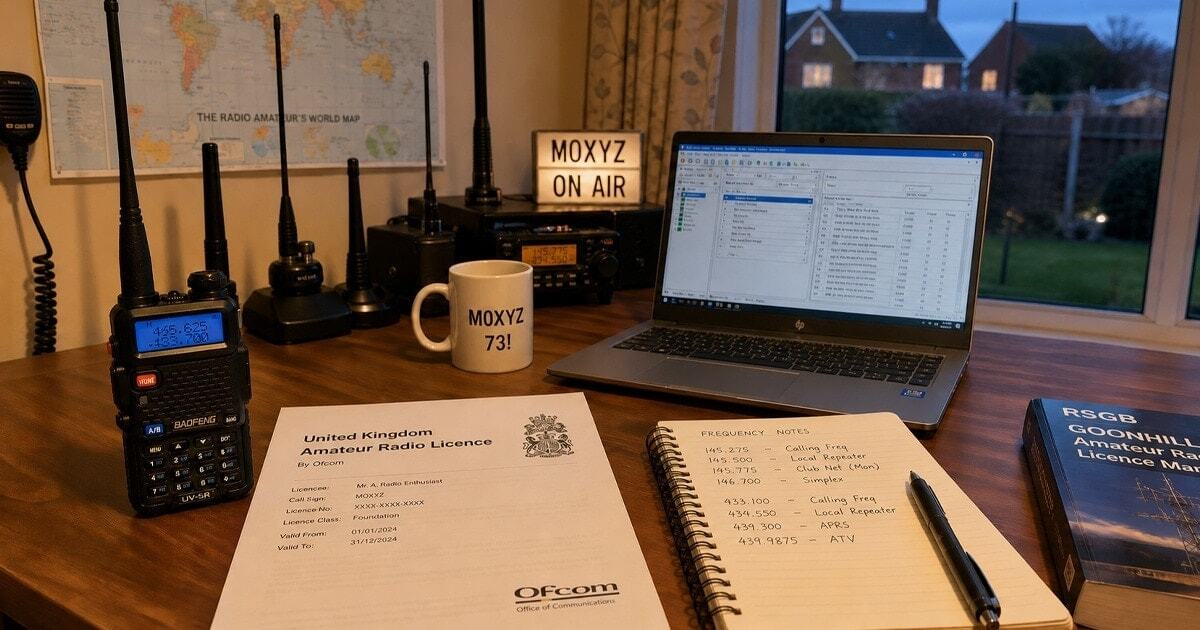
A typical UK amateur radio setup — the hobby requires an Ofcom exam and licence, but opens access to a wide range of frequencies, repeaters and technical experimentation that PMR446 cannot offer.
Does a licensed radio always provide better range?
Not automatically. Licensing can permit different powers, antennas, frequencies and infrastructure, but the licence itself does not bend the laws of physics.
Usable radio range is affected by:
- Buildings and reinforced concrete
- Hills, valleys and woodland
- The height and position of each radio
- Antenna design
- Frequency band
- Interference
- Receiver quality
- Whether a suitable repeater or base station is available
A low-power PMR446 radio may work well across a shop or restaurant yet struggle between two separated buildings. A licensed radio system can provide more options, but it still needs to be selected and configured for the actual site.
The guide to single-band and dual-band walkie-talkies provides more detail on how frequency choice affects different environments.
⚠️ Range claims: Treat any large "maximum range" figure as a best-case laboratory or line-of-sight claim unless the seller explains the test conditions. For most buyers, an honest description of the building, terrain and required coverage is more useful than a number printed on a box.
How to identify the correct radio before buying
Do not rely on the words "UHF," "two-way radio" or "walkie-talkie." Those labels do not confirm whether a handset can be used without a licence.
Choose PMR446 when:
- You want radios that can be issued to ordinary staff or family members
- Your communication area is relatively small
- Shared channels are acceptable
- You do not need a fixed base station
- The product is explicitly confirmed as compliant PMR446 equipment
- The antenna is integral rather than removable
- The specified output complies with the PMR446 limit
Investigate a Business Radio licence when:
- The radios are for commercial or organisational operations
- PMR446 coverage or congestion is inadequate
- You need higher power or a professionally designed system
- You need base stations, repeaters or site-specific coverage
- Communication reliability directly affects operations or safety
Investigate an Amateur Radio Licence when:
- Radio is the hobby rather than merely a staff communication tool
- You want to learn about frequencies, antennas and propagation
- You want to use amateur bands or repeaters
- You understand that amateur privileges cannot be used for routine commercial communication
Common mistakes that create legal or operational problems
- Buying based on power alone More watts may sound attractive, but higher power can move the radio outside the licence-free category. It may also fail to solve coverage problems caused by concrete, steel or terrain.
- Assuming all radios with the same model name are identical Some products are sold in several regional or technical versions. Confirm the precise frequency range, output, antenna type and intended market before purchasing.
- Treating privacy codes as private communication CTCSS and DCS tones can help filter unwanted audio from the speaker, but other users on the same frequency may still receive the transmission. Do not use ordinary walkie-talkies to discuss sensitive personal, payment, medical or safeguarding information.
- Giving programmable radios to untrained staff A user can accidentally change a frequency, power level or channel setting. Licensed business fleets should be programmed consistently, documented and issued with simple operating instructions. Compatible radios can often be configured using Baofeng programming cables, but programming should follow the permissions of the relevant licence.
- Assuming "legal to buy" means "legal to transmit" The important issue is how equipment is installed and used. A product's availability online does not by itself confirm that every transmit mode is authorised for every UK buyer.
Radios matched to each licence type
The models below cover all three main licence categories — from PMR446 licence-free options for families and small teams to digital and high-power radios for licensed operators.
📻 Baofeng Radios — Choose by Licence Type
Matched to PMR446 licence-free, licensed business and amateur-radio use cases.
✅ Licence-Free & Simple — No Individual Ofcom Licence Required
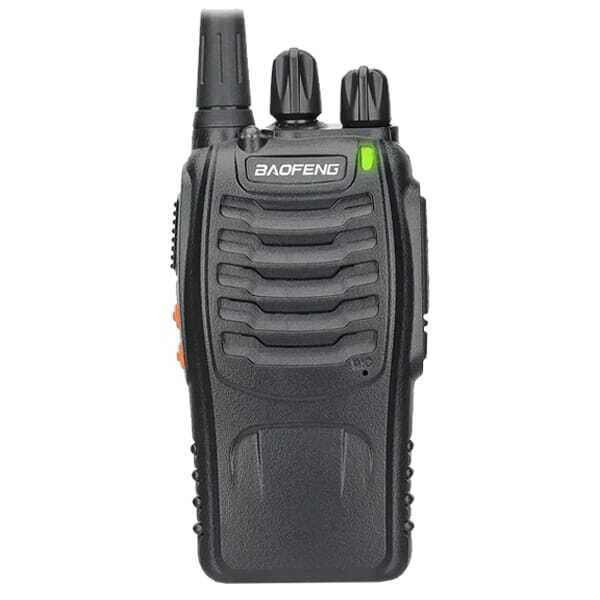
Baofeng BF-888S PMR446
0.5W · 16 PMR446 channels · Fixed antenna · No licence needed — the simplest choice for families, campsites, retail and small teams.
View BF-888S PMR446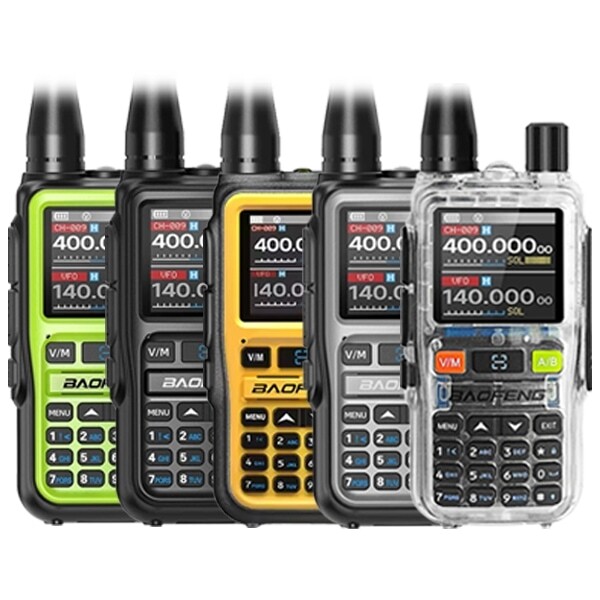
Baofeng UV-5R Mini
Compact dual-band · Bluetooth programming — lightweight programmable radio for licensed hobbyists and travel kits.
View UV-5R Mini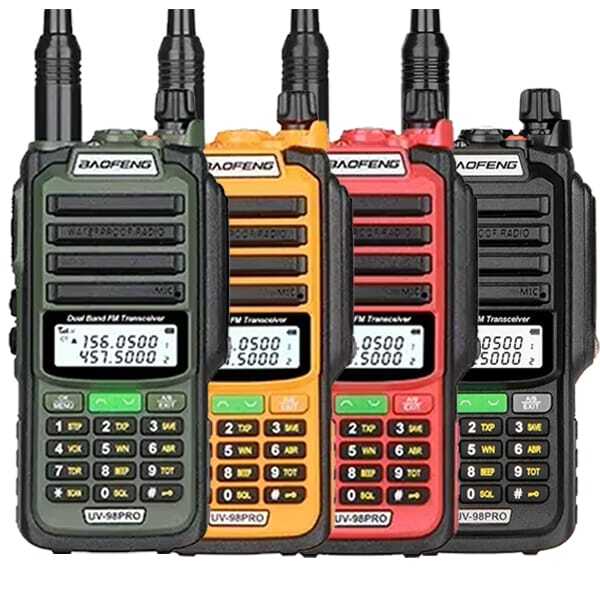
Baofeng UV-98 Pro
IP68 · 8W · Dual-band — maximum waterproofing for outdoor licensed operators in rain, mud and wet environments.
View UV-98 Pro⚡ Licensed High-Power & Digital — For Amateur Operators & Business Teams
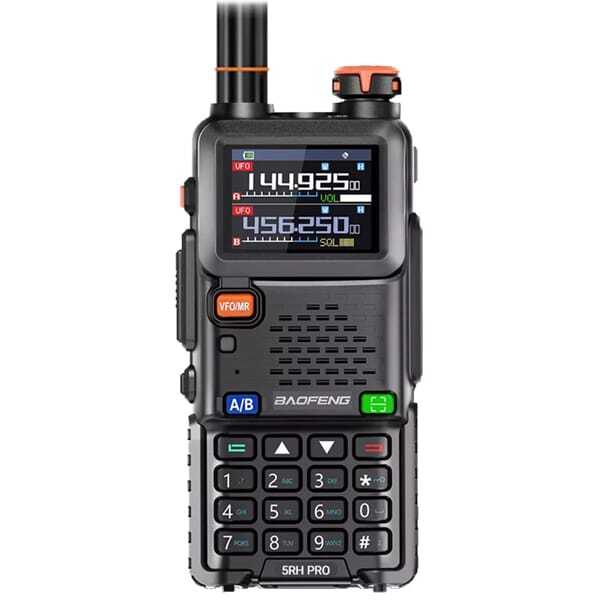
Baofeng UV-5RH Pro GPS
10W · GPS · USB-C · Colour screen — the top all-round pick for licensed amateur operators and advanced outdoor users.
View UV-5RH Pro GPS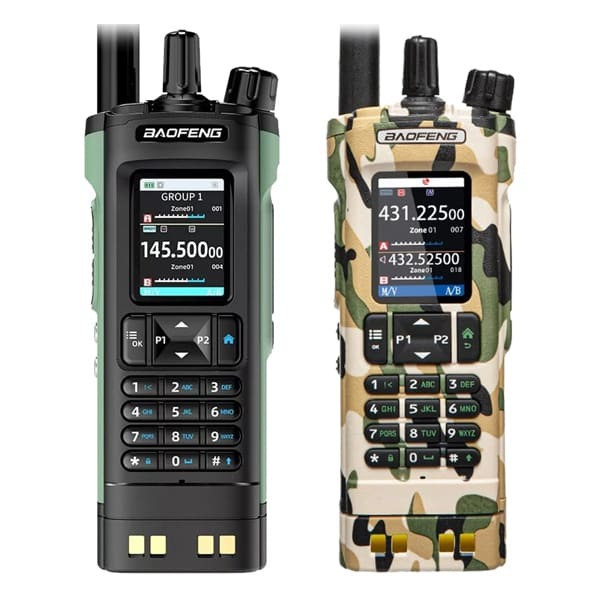
Baofeng UV-32
10W · Enhanced antenna · GPS — high-output handheld for licensed users prioritising range across open and hilly terrain.
View UV-32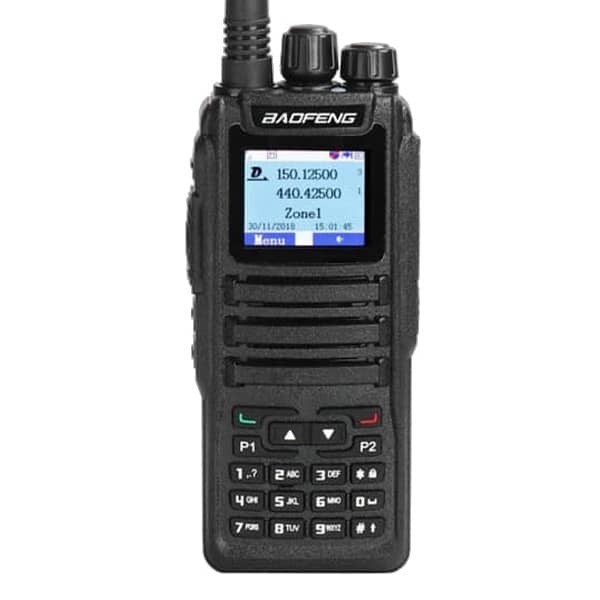
Baofeng DM-1701 Digital
DMR digital · Dual time-slot · Clearer audio — suited to licensed business teams needing structured talk groups and digital voice.
View DM-1701Which option is right for you?
For most families, cafés, small shops and short-range teams, a genuine PMR446 handset is the least complicated answer.
For larger businesses, security operations, construction sites and multi-building facilities, the better question is not "What is the most powerful radio?" It is "What licensed system will reliably cover our site without creating interference or compliance problems?"
For hobbyists, an amateur licence opens a different world: repeaters, technical learning, antenna experimentation and communication with other amateurs. It should not be confused with a business-radio permission.
The cost of choosing badly is not limited to the price of the handset. It can mean unusable range, congested channels, confused staff or transmission outside the applicable rules. Choose the legal route before choosing the feature list.
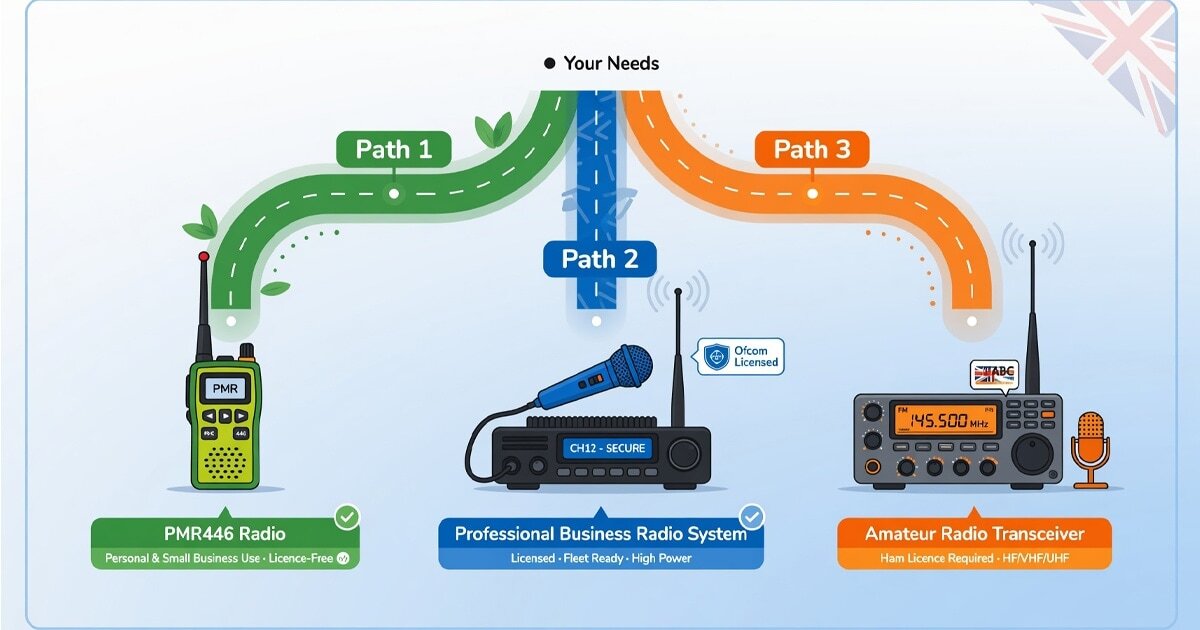
Three clear paths for UK radio buyers — choose PMR446 for simplicity, a Business Radio licence for operational control, or an Amateur Radio Licence for hobby and technical use.
🟢 Final recommendation:
For simple short-range communication, browse clearly identified PMR446 licence-free radios.
For hobby and technical use, learn about the Amateur Radio Licence before purchasing a high-power programmable handset.
For operational business communication that has outgrown PMR446, speak to a competent radio supplier and review the current Ofcom Business Radio licence options.
Sources: Ofcom, Licence-exempt devices (updated 28 May 2026) · Business Radio Guidance 2025 · Analogue and Digital PMR446 Information Sheet · Amateur Radio Licence Guidance for Licensees.
Frequently asked questions
What is the difference between licensed and unlicensed walkie-talkies in the UK?
Compliant PMR446 walkie-talkies can be operated without an individual Ofcom licence because they fall under a licence exemption. They must use an integral antenna, operate between 446.0 and 446.2 MHz and not exceed 500 mW ERP. Higher-power, programmable or removable-antenna radios operate outside this exemption and require an appropriate licence — typically an Amateur Radio Licence or an Ofcom Business Radio licence — before transmitting.
Can I make a programmable radio licence-free by setting it to a PMR446 frequency?
No. Programming a 446 MHz frequency into a high-power radio with a removable antenna does not make it PMR446-compliant. The licence exemption applies to equipment that meets all of Ofcom's PMR446 technical requirements by design, not simply to radios tuned to a PMR446 frequency. Ofcom has specifically flagged this as a common misunderstanding.
Can a business use an employee's amateur radio licence for staff communication?
No. Ofcom states that the UK Amateur Radio Licence is for personal hobby and technical use. It explicitly excludes commercial or business communication. A business that needs radios for staff coordination should obtain the appropriate Ofcom Business Radio licence rather than relying on an amateur licence held by one employee.
Do CTCSS and DCS privacy codes make a conversation private?
No. CTCSS and DCS tones prevent the radio speaker from opening when a transmission does not match the selected tone, which can reduce unwanted audio. However, other users monitoring the same frequency without that filter can still hear the conversation. These codes reduce interference noise rather than encrypting or securing communication.
What is the maximum power allowed for a PMR446 licence-free radio?
Ofcom specifies a maximum of 500 mW effective radiated power (ERP) for compliant PMR446 equipment. Any radio that exceeds this limit — even when physically capable of operating at a PMR446 frequency — falls outside the licence exemption and requires appropriate authorisation to transmit.
How much does a Business Radio licence cost in the UK?
Ofcom currently lists both the Simple UK Light and Simple Site Light Business Radio licences at £75 for five years. Nationally Assigned and Area Defined licences may involve additional planning or coordination fees. Buyers should check the current Ofcom fee schedule before applying, as charges can change.
Does a more powerful radio automatically provide better communication range?
Not necessarily. Usable range depends on terrain, buildings, antenna position, frequency, receiver quality and interference — not just output power. A higher-power radio can help in some open environments, but it will not overcome a concrete wall, a hill or dense woodland. Testing at the actual site before deploying a radio fleet is far more reliable than relying on a maximum-range figure from a product listing.
Find the Right Radio for Your Licence Type
From compliant PMR446 licence-free handhelds for families and small teams to digital and high-power radios for licensed operators — Baofeng UK has the right model for every use case.
Shop PMR446 Licence-Free Radios