
17th Mar 2026
Baofeng BF-888S Review UK: Range, Programming & Licence Guide
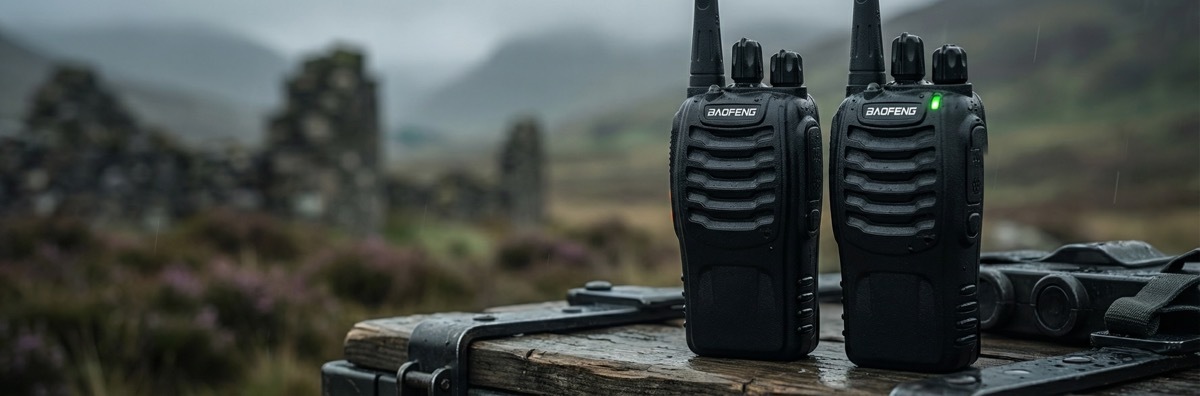
The Baofeng BF-888S is an affordable UHF two-way radio designed for straightforward push-to-talk communication. With 16 programmable channels, a compact screen-free design, rechargeable battery and earpiece compatibility, it can be a practical choice for radio enthusiasts and appropriately licensed teams.
But is the Baofeng BF-888S any good? How far can it really transmit? And, most importantly, is the Baofeng BF-888S legal to use in the UK?
The short answer is that the standard BF-888S can be a useful budget radio, but it is not licence-free. UK buyers should distinguish between the standard programmable UHF model and the BF-88E PMR446 version, which is designed for licence-exempt use.
This review covers the BF-888S features, realistic range expectations, battery life, programming, UK Ofcom regulations and how it compares with other Baofeng walkie talkies.
Review methodology: This guide is based on published product specifications, radio operating principles and Ofcom's Business Radio Guidance. The range and battery figures discussed are not presented as independently verified field-test results.
1. Baofeng BF-888S Review: Key Features at a Glance
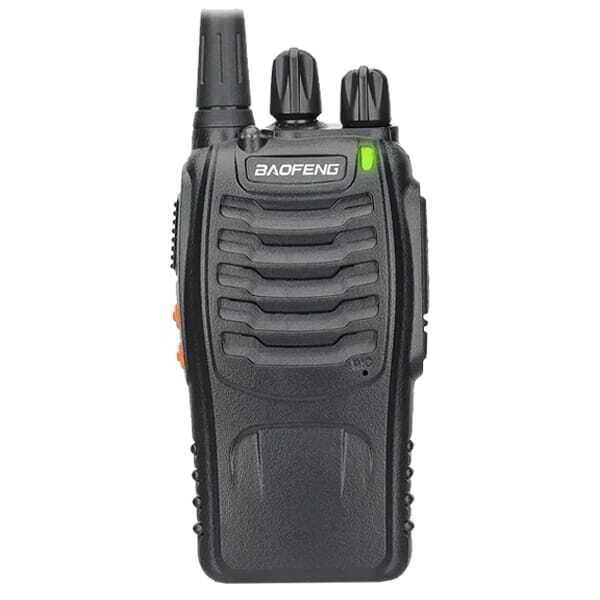
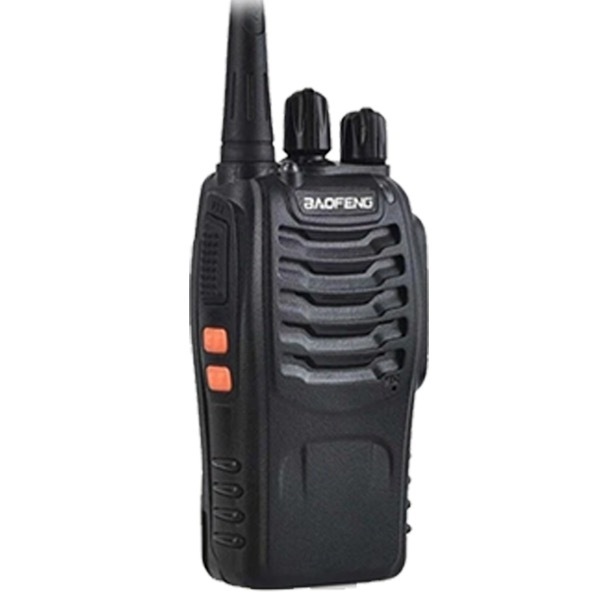
The BF-888S focuses on simplicity rather than advanced features. Unlike more sophisticated handheld radios, it has no digital display or keypad. Users select a programmed channel using the rotary control and press the Push-to-Talk (PTT) button to communicate.
| Feature | Standard Baofeng BF-888S UHF |
|---|---|
| Radio type | Analogue UHF two-way radio |
| Frequency range | 400–470 MHz, model dependent |
| Channel capacity | 16 programmable channels |
| Rated output | Commonly listed as approximately 3W |
| Battery | 1500mAh lithium-ion |
| Battery life | Approximately 8–12 hours advertised, depending on use |
| Display | None |
| Controls | Rotary channel selector and PTT |
| VOX | Supported on applicable configurations |
| Programming | Compatible programming cable and software |
| Antenna | Removable |
| Other features | LED torch, voice prompts, squelch and CTCSS/DCS |
| UK licence | Appropriate authorisation required to transmit |
Note: Specifications can vary between versions and suppliers. Check the exact product documentation before purchase. For currently available models and pack sizes, explore the Baofeng BF-888S UHF radio range.
2. What Makes the Baofeng BF-888S a Good Budget Walkie Talkie?
1. Simple Push-to-Talk Communication
One of the biggest advantages of the BF-888S is its straightforward design. There is no complicated menu to navigate during normal operation. Once the channels are correctly configured, users can select the required channel, hold the PTT button, speak and release the button to listen.
This makes it potentially useful for environments where staff need consistent communication without adjusting technical settings throughout the day. In a licensed warehouse radio system, supervisors might use separate channels for receiving deliveries and coordinating operations. Configuring the radios in advance reduces the need for employees to make changes.
2. Compact Design for Everyday Use
The BF-888S is small enough to carry on a belt or keep in a work jacket. The included belt clip on typical packages makes it accessible during a shift. Its screen-free design removes a common point of potential damage, although that does not mean the handset is waterproof or drop-proof.
If you work outdoors, check whether your chosen model has a documented IP rating. The standard BF-888S should not be assumed to offer the same weather resistance as a purpose-built waterproof radio.
3. Rechargeable Battery and Convenient Charging
The BF-888S is commonly supplied with a 1500mAh lithium-ion battery and a desktop charging cradle. Published battery-life estimates are often around 8–12 hours, but real performance depends on how the radio is used.
Battery life is affected by:
- How frequently users transmit
- The duration of each transmission
- Battery age and condition
- Power-saving settings
- Temperature and charging practices
For a security or event team, battery planning matters more than an advertised maximum figure. Charge handsets before shifts and consider spare batteries where continuous communication is important.
4. Earpiece and Hands-Free Communication Options
Compatible earpieces can make the BF-888S more convenient in workplaces where users need discreet or less disruptive communication. The radio also supports VOX functionality on applicable configurations, allowing voice-activated transmission without continuously pressing the PTT button.
However, VOX can be triggered accidentally by background noise. In busy restaurants, warehouses or events, a properly fitted PTT earpiece may provide more predictable control.
3. Baofeng BF-888S Range: How Far Can It Really Transmit?

There is no single guaranteed BF-888S range. The actual communication distance depends on terrain, buildings, antenna position, interference and other operating conditions. Product listings commonly advertise ranges of approximately 2–4 km under favourable conditions. These should be treated as indicative marketing figures rather than a guaranteed distance.
Indoor and Urban Range
The BF-888S uses UHF frequencies, which can be practical for communication within buildings and built-up environments. However, dense concrete, steel structures, basements, lifts and multiple floors can substantially weaken the signal.
A small retail store may present a relatively straightforward coverage requirement, while a multi-storey hotel or large warehouse may need more careful testing.
Outdoor and Open-Countryside Range
Outdoor communication can benefit from a clearer path between radios. Two users standing in open fields with minimal obstacles may achieve better results than colleagues separated by thick walls or several buildings. Hills, valleys, woodland and changes in elevation can all affect the signal.
How to Improve BF-888S Communication Range
Before purchasing multiple radios, consider these practical steps:
- Test coverage at the actual premises or outdoor location.
- Keep the radio upright and away from large metal objects.
- Avoid blocking the antenna with your body.
- Check battery condition before use.
- Use correctly programmed and authorised frequencies.
- Test difficult locations such as stairwells, loading bays and basements.
Expert buying tip: More transmission power does not automatically mean reliable communication across an entire site. For large workplaces, proper radio-system planning can be more valuable than simply purchasing a higher-powered handset. For a broader comparison, read our best long-range walkie talkies UK buyer’s guide.
4. Is the Baofeng BF-888S Legal in the UK?
Yes, the standard BF-888S may be used for transmission where the operator has appropriate authorisation and the equipment meets the applicable licence and technical requirements. It is not a licence-free PMR446 handset. This distinction is especially important for UK consumers, small businesses and outdoor users.
UK licence-exempt PMR446 operation is subject to equipment and operating requirements, including:
- Operation within the 446.0–446.2 MHz PMR446 frequency range
- A maximum effective radiated power of 0.5W
- Compliance with the applicable antenna and equipment requirements
- Handheld, mobile operation under the relevant exemption conditions
The standard BF-888S has a removable antenna and is normally rated for substantially higher transmit power. Programming its frequency to a PMR446 channel does not automatically make it licence-exempt.
Using the BF-888S with an Ofcom Business Radio Licence
Businesses considering the standard BF-888S should first determine which type of Ofcom Business Radio licence suits their operations. One option is the Business Radio Simple UK Light Licence.
According to Ofcom's December 2025 guidance, this licence:
- Costs £75 for five years
- Allows authorised hand-portable or mobile radio use across the UK
- Provides access to specified shared business-radio frequencies
- Requires users to coordinate with other licensees
- Permits a maximum of 5W effective radiated power
Importantly, the licence does not guarantee that every BF-888S variant is suitable. Users must confirm radio equipment compliance, frequency compatibility, output power and all relevant licence conditions. For detailed information, refer to Ofcom's Business Radio Guidance.
Can You Use a BF-888S with an Amateur Radio Licence?
An appropriately licensed UK amateur radio operator may be able to use a suitable BF-888S on authorised amateur frequencies, subject to licence conditions. However, amateur radio is for non-commercial purposes. An amateur radio licence cannot be used to authorise routine business communication between security staff, warehouse employees or event workers. For additional licensing information, read our UK amateur radio licence guide.
5. BF-888S vs BF-88E PMR446: Which Is Better for UK Buyers?
The standard BF-888S and the BF-88E PMR446 version look similar, but they serve different needs.
| Feature | BF-888S UHF (Standard) | BF-88E PMR446 |
|---|---|---|
| Frequency operation | Programmable UHF | PMR446 |
| Transmit power | Approximately 3W | Maximum 0.5W ERP |
| Channels | 16 programmable | 16, depending on exact variant |
| Antenna | Removable | Fixed |
| UK licence | Appropriate authorisation required | Licence-exempt when compliant |
| Setup | Programming needed for authorised use | Typically preconfigured |
| Suitable users | Licensed radio users and appropriately equipped business teams | Families, schools, hospitality and small teams |
| Main benefit | Configuration flexibility | Simple, licence-free operation |
- Choose the Standard BF-888S If: You already have the appropriate radio authorisation, require a small number of programmable UHF channels and can confirm that the equipment meets the technical requirements for your intended use.
- Choose the BF-88E PMR446 If: You want straightforward communication without applying for a radio licence and do not need higher-power transmission or extensive channel configuration.
For many UK buyers, including restaurants, schools, retail shops and family groups, a compliant PMR446 version will be easier to manage. Browse the Baofeng BF-888S PMR446 and BF-88E walkie talkies to compare licence-free options.
Important: A product advertised as BF-888S or BF-88E should not be assumed compliant based on its name alone. Confirm the exact equipment specifications and UK compliance documentation before use.
6. How to Program a Baofeng BF-888S
The standard BF-888S has no keypad, so most channel configuration is completed using a computer and compatible programming software. Programming allows you to configure authorised transmit and receive frequencies, channel settings, squelch and supported signalling features.

- Step 1: Obtain a Compatible Programming Cable
The BF-888S commonly uses a two-pin programming connection. Choose a cable confirmed as compatible with your exact version, such as the Baofeng BF-888S USB programming cable. Check the connector and driver requirements before purchasing. - Step 2: Install the Appropriate Programming Software
Depending on the handset version, the radio may be supported by manufacturer programming software or CHIRP. Visit the Baofeng programming software and drivers centre to check available downloads and model compatibility. - Step 3: Read and Back Up the Radio Configuration
Connect the handset using the programming cable, then select the correct radio model and communication port in your software. Read the existing configuration from the radio and save a backup before making changes. This gives you a recovery point if a setting is changed incorrectly. - Step 4: Configure Your Authorised Channels
Enter only frequencies and settings permitted by your licence or other applicable authorisation. You may need to configure receive and transmit frequencies, channel bandwidth, CTCSS or DCS settings, squelch, transmit time-out, and other supported functions. Do not assume factory-programmed frequencies are authorised for use in the UK. Confirm your configuration before transmitting. - Step 5: Save and Verify the Configuration
Write the settings to the radio and confirm they have been saved correctly. Test communication using authorised channels and appropriately configured equipment. For a fleet, check that all radios have consistent channel assignments before distributing them to users.
Do BF-888S Privacy Codes Make Conversations Private?
No. CTCSS and DCS are signalling systems used primarily to control when a radio's speaker opens. They do not encrypt your conversations. Another radio operating on the same frequency can potentially receive your transmissions even if it uses a different privacy-code setting.
These features are useful for reducing unwanted audio from other users on shared channels, but they should not be mistaken for secure or confidential communication. Read our detailed guide to CTCSS and DCS walkie talkie privacy codes to understand how they work.
7. Baofeng BF-888S vs UV-5R: Which Should You Choose?
Another common comparison is between the BF-888S and the Baofeng UV-5R. Both offer affordable access to programmable radio features, but the user experience is quite different.
- BF-888S (Better for Simple Channel-Based Operation): The BF-888S is more suitable for users who need a straightforward radio with a limited set of preconfigured channels. Its compact design and lack of a display make day-to-day operation simple.
- UV-5R (Better for Amateur Radio Enthusiasts): The UV-5R offers a screen, keypad and dual-band VHF/UHF capability. These features are useful for licensed amateur radio operators who want greater flexibility to explore authorised frequencies and configure their radios. However, more advanced controls also mean a steeper learning curve.
Neither the standard BF-888S nor the UV-5R should be treated as a licence-free PMR446 handset. You can explore more options in the Baofeng UV-5R series collection.
8. Who Should Buy the Baofeng BF-888S?
Security and Event Teams
With the appropriate business-radio authorisation and a suitable equipment configuration, a standard BF-888S may be considered for simple team communication. However, coverage, audio clarity, earpiece compatibility, battery performance and interference management should all be evaluated before deployment.
Warehouses and Construction Sites
A compact radio can be useful where employees need to communicate without repeatedly using mobile phones. For larger facilities, site-specific testing is essential. Metal shelving, heavy machinery and concrete walls can affect coverage.
Licensed Amateur Radio Enthusiasts
The BF-888S can be a low-cost option for amateur operators who need simple UHF channel-based communication. It is less convenient than a keypad-equipped handheld for users who regularly change frequencies or experiment with multiple settings.
Families, Schools and Hospitality Teams
For these users, a compliant BF-88E PMR446 model is generally the more straightforward recommendation. It removes the need for an individual radio licence while providing basic short-range voice communication.
Buying BF-888S Walkie Talkies in Multi-Packs
If you need radios for several people, purchasing a multi-pack may be more convenient than ordering individual handsets. Before selecting a pack, check whether it contains standard UHF radios or compliant PMR446 models, the number of batteries/chargers included, earpiece compatibility, and whether all handsets can use the same authorised channel configuration.
For larger purchases, start with the Baofeng two-way radio multi-pack collection to compare quantities and product types. Remember that buying ten radios instead of two does not change the licence requirements.
9. Baofeng BF-888S Pros and Cons
| Advantages | Limitations |
|---|---|
| Affordable entry-level radio | Standard model is not licence-free |
| Simple push-to-talk operation | No display or keypad |
| 16 programmable channels | Programming cable/software needed |
| Compact, screen-free design | No verified waterproof rating for the standard model |
| Rechargeable battery | Battery endurance varies by use |
| Compatible earpiece options | Limited advanced functionality |
| Suitable for appropriately licensed systems | Range varies with terrain and obstacles |
10. Final Verdict: Is the Baofeng BF-888S Worth Buying in the UK?
The Baofeng BF-888S remains an appealing budget option for users who want a simple UHF two-way radio without unnecessary menus or advanced controls. Its strengths are affordability, straightforward operation, programmable channels and compatibility with practical accessories.
However, the standard BF-888S is not the right choice for everyone. If you require a programmable radio for an authorised UHF system, it may be worth considering after checking compatibility, equipment conformity and real-world coverage. If you simply want licence-free walkie talkies for a family trip, restaurant, retail shop or school, a compliant BF-88E PMR446 is likely to be the easier choice.
Our recommendation: Choose your radio based on lawful operation, the communication environment and your team's needs—not on advertised maximum range or transmission power alone. Compare the standard BF-888S UHF models and licence-free BF-88E PMR446 alternatives before purchasing.
11. Frequently Asked Questions About the Baofeng BF-888S
1. Is the Baofeng BF-888S legal in the UK?
The standard BF-888S can be used for authorised radio communication when the relevant licence and equipment requirements are met. It is not a licence-free PMR446 handset. UK buyers seeking licence-exempt communication should choose equipment specifically designed and compliant for PMR446 operation.
2. What is the maximum range of the Baofeng BF-888S?
Product listings commonly advertise approximately 2–4 km under favourable conditions. Actual range can be considerably shorter in buildings, urban environments or uneven countryside. There is no guaranteed maximum communication distance for every location.
3. Do you need a licence for a Baofeng BF-888S?
Yes, appropriate authorisation is required to transmit using the standard programmable UHF BF-888S. This might involve an Ofcom Business Radio licence for professional use or an amateur radio licence for permitted non-commercial amateur operation. The BF-88E PMR446 version is different and can be licence-exempt when compliant.
4. Can you use the Baofeng BF-888S on PMR446 channels?
You should not transmit on PMR446 using a standard BF-888S while treating it as licence-exempt. Changing the frequency does not resolve its higher-power and equipment-compliance differences. Choose a compliant PMR446 handset instead.
5. How long does the Baofeng BF-888S battery last?
The BF-888S commonly uses a 1500mAh lithium-ion battery, with advertised endurance around 8–12 hours depending on the variant and usage pattern. Frequent transmissions, battery age and environmental conditions can reduce operating time.
6. How do you program a Baofeng BF-888S?
Connect the radio to a computer using a compatible USB programming cable, then use software supported by the exact model. Read and back up the existing settings before entering authorised frequencies and writing the configuration back to the handset. Always verify the settings before transmitting.
7. Can a Baofeng BF-888S communicate with other walkie talkies?
It may communicate with compatible analogue radios when both are configured for the same authorised frequency, channel bandwidth and suitable signalling settings. Technical frequency overlap alone does not establish permission to transmit between different radio services.
8. Is the Baofeng BF-888S waterproof?
The standard BF-888S is not generally advertised with a verified waterproof IP rating. Buyers who need dependable communication in heavy rain or wet working conditions should choose a radio with a documented ingress-protection rating suitable for that environment.
9. What is the difference between BF-888S and BF-88E?
The standard BF-888S is a programmable, higher-power UHF radio requiring appropriate transmission authorisation in the UK. The BF-88E PMR446 is a lower-power, fixed-antenna version intended for licence-exempt PMR446 communication when the exact handset meets the applicable requirements.
10. Is the Baofeng BF-888S good for beginners?
It can be easy to operate once correctly configured, thanks to its simple controls. However, the standard BF-888S requires users to understand programming and UK radio licensing. For beginners who want to communicate without applying for a licence, a compliant BF-88E PMR446 is usually more suitable.
Further reading and product information
- Baofeng BF-888S UHF Radios
- Baofeng BF-88E PMR446 Licence-Free Radios
- UK Ham Radio Licence Guide
- Baofeng Programming Software
- Baofeng Two-Way Radio Multi-Packs
Regulatory information: Based on Ofcom's published Business Radio and Amateur Radio guidance. Always check current regulations and the precise radio model's conformity documentation before transmitting. This article is informational and does not replace regulatory or legal advice.