
17th Mar 2026
Best Walkie Talkies UK: A Practical Buying Guide
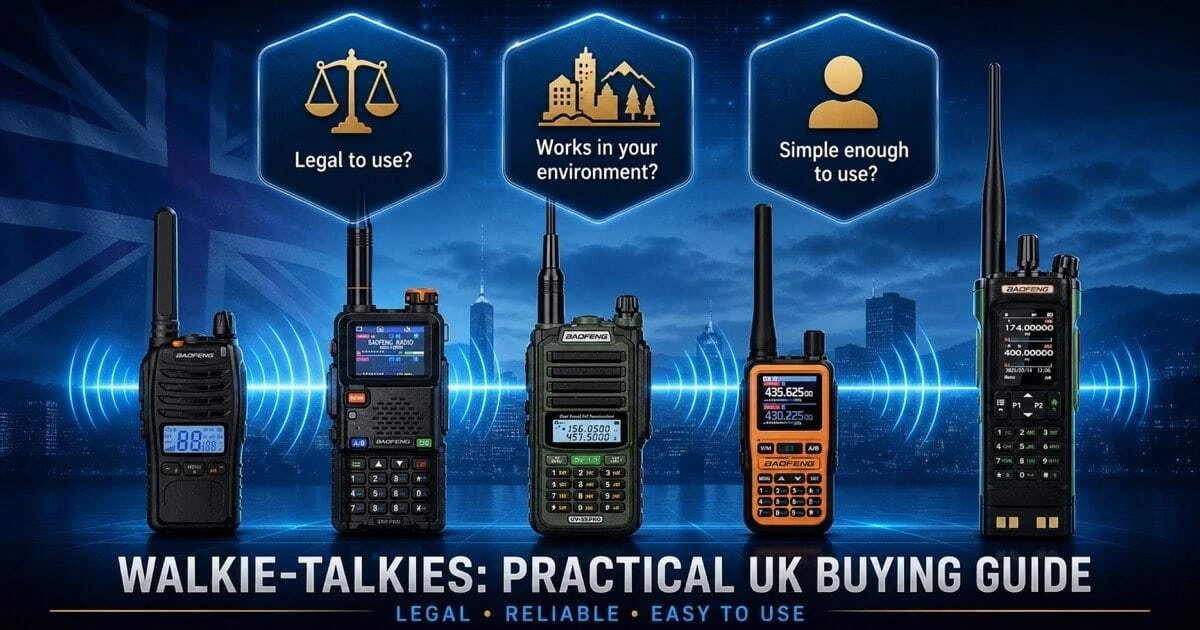
This buying guide was produced and reviewed by the Baofeng UK technical team — UK-based radio communications specialists with over 10 years of experience helping families, businesses and licensed operators choose the right two-way radio. All licensing information reflects current Ofcom guidance. Product specifications are based on current Baofeng UK product information and should not be interpreted as guaranteed real-world performance figures.
Finding the best walkie talkies UK buyers can rely on is not simply a matter of choosing the radio with the highest power or biggest advertised range.
For most UK buyers, three questions matter more:
- Can I legally use this radio without a licence?
- Will it work in my actual environment?
- Is it simple enough for the people who need to use it?
For families, schools, hospitality teams and small businesses wanting straightforward short-range communication, a compliant PMR446 walkie talkie is usually the simplest option. Licensed amateur users may prefer programmable radios such as the Baofeng UV-5RH Pro GPS, while businesses needing greater control, repeaters or professionally managed coverage should consider an appropriate Business Radio system.
If you want to browse the wider range before deciding, see our Baofeng walkie talkies and handheld two-way radios.
For most ordinary UK buyers: Start with a compliant PMR446 radio — no individual licence required, simple to use, works immediately.
If you need higher power, programmable frequencies, repeaters or more advanced radio features: Work out the correct licence category before choosing the handset.
⚡ Best walkie talkies UK — at a glance
- ✅ Best licence-free: BF-88ST Pro PMR446 — no individual licence required for compliant PMR446 use, simple controls, 16 channels
- 🏆 Best for licensed outdoor users: UV-5RH Pro GPS — up to 10W listed, GPS, 2500mAh, USB-C
- 🌧️ Best waterproof: UV-98 Pro IP68 — rugged, dual-band, 8W listed
- 🎒 Best compact licensed radio: UV-5R Mini — compact, USB-C, Bluetooth app programming
- 📲 Best digital: DM-32 DMR — digital operation, GPS, APRS, structured talk groups
- ⚠️ Key rule: Programming a PMR446 frequency into a higher-power radio does not make it licence-free
- 📏 Range reality: Advertised distance figures are best-case; terrain, buildings and position matter far more than wattage
📋 Table of Contents
- Best walkie talkies UK: quick comparison
- Do you need a licence for a walkie talkie in the UK?
- What is a PMR446 walkie talkie?
- PMR446 vs licensed two-way radios
- Best licence-free walkie talkie UK
- Best walkie talkie for long range
- How far do walkie talkies really work in the UK?
- How does terrain affect walkie talkie range?
- Best waterproof walkie talkie
- Best walkie talkies for hiking and camping
- Best walkie talkies for business
- Shop recommended radios
- VHF vs UHF: which is better?
- How much battery capacity do you need?
- Which accessories are actually useful?
- When a Baofeng radio is not the right choice
- Best walkie talkies UK: our decision guide
- Frequently asked questions
Best walkie talkies UK: quick comparison
| Radio | Best For | Key Features | UK Licence |
|---|---|---|---|
| BF-88ST Pro PMR446 | Families, hospitality, schools and small teams | PMR446, 16 channels, 1200mAh battery, integrated antenna | No individual licence required when used as the compliant PMR446 model |
| UV-5RH Pro GPS | Licensed amateur users | Up to 10W listed output, GPS, 2500mAh battery, USB-C | Appropriate licence required to transmit |
| UV-98 Pro | Wet-weather and rugged use by licensed users | IP68, dual-band, 8W listed output | Appropriate licence required to transmit |
| UV-5R Mini | Licensed users wanting a compact programmable radio | Compact design, USB-C, app programming | Appropriate licence required to transmit |
| DM-32 DMR | More advanced digital-radio users | DMR digital operation, GPS, APRS, large channel capacity | Correct licence and programming required |
Do you need a licence for a walkie talkie in the UK?
Not every walkie talkie requires a licence in the UK. Compliant PMR446 radios can be used without obtaining an individual Ofcom radio licence. Ofcom describes PMR446 as a low-power, short-range radio service operating between 446.0 and 446.2 MHz. PMR446 equipment is limited to a maximum of 500 mW ERP and must meet the relevant licence-exemption conditions.
That makes PMR446 particularly attractive for families, campsites, small shops, restaurants and cafés, hotels, schools, small events and short-range staff communication.
⚠️ Important: Programmable radios such as many Baofeng UV-series models fall into a different category. Being able to enter a PMR446 frequency into a programmable radio does not automatically make that radio licence-free. This distinction catches many first-time UK buyers out.
For a more detailed explanation, read our UK walkie talkie licence guide or our guide to licensed vs licence-free walkie talkies.
What is a PMR446 walkie talkie?
PMR446 is the main licence-free walkie talkie system used by consumers and many small organisations in the UK. It is designed for relatively short-range, direct radio-to-radio communication. The biggest advantage is simplicity.
You do not need to sit an amateur-radio examination or apply for an individual Business Radio licence just to use compliant PMR446 equipment. For a family going camping or a restaurant issuing radios to six staff members, that can be much more useful than owning a technically more powerful radio that requires licensing and programming knowledge.
The Baofeng BF-88ST Pro PMR446, for example, is listed with:
- 16 PMR446 channels
- 0.5W output in PMR446 configuration
- Integrated non-removable antenna
- 1200mAh rechargeable battery
- VOX hands-free operation
- Dual Watch
- USB desktop charging
🟢 Browse licence-free options: If licence-free operation is your priority, see our PMR446 licence-free radios.
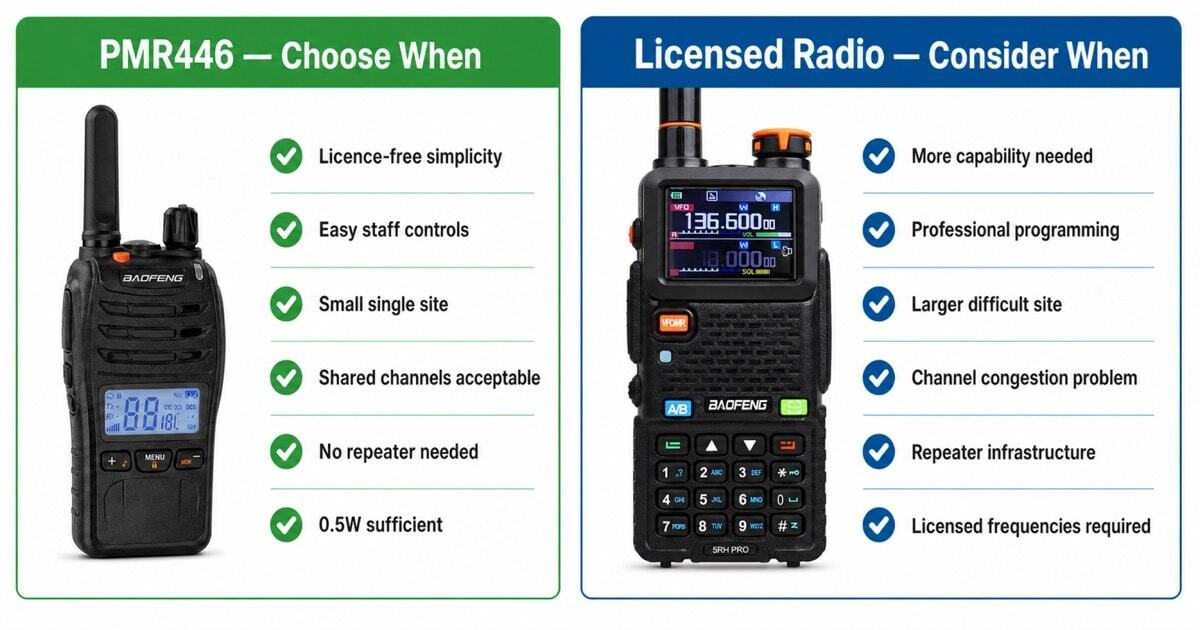 The decision between PMR446 and licensed radios comes down to six practical criteria — not simply which radio has the higher wattage. Matching the radio category to the actual job is always the more important question.
 PMR446 vs licensed two-way radios
The useful question is not simply "Which radio is more powerful?" It is "Which type of radio actually fits the job?"
- You want licence-free simplicity
- Staff or family members need easy controls
- Communication is mainly around one small site
- Shared PMR446 channels are acceptable
- You do not need a repeater
- 0.5W PMR446 operation is sufficient
- You need capabilities beyond PMR446
- Your radios need professional programming
- You operate across a larger or difficult site
- Channel congestion is becoming a problem
- You need repeater or base-station infrastructure
- Your licensed system requires different permitted power or frequencies
🎯 Key point: A more powerful handset is not automatically a better purchase. For many small businesses, easy operation and legal certainty are more important than having hundreds of channels or adjustable transmit power.
Best licence-free walkie talkie UK
For buyers who want straightforward communication without obtaining an individual radio licence, the Baofeng BF-88ST Pro PMR446 is one of the clearest options in the current range. Its most useful feature is not enormous transmit power — it is that it is specifically designed to operate within the PMR446 category.
Best for
Families · Restaurants and cafés · Hotels · Retail teams · Schools · Small warehouses · Campsites · Small events
Not ideal for
Users expecting guaranteed communication over several miles · Large multi-building sites · Users who need repeater infrastructure · Amateur-radio experimentation · Organisations requiring professionally managed frequencies
⚠️ Privacy codes — a common misunderstanding: CTCSS and DCS tones can stop your speaker opening for transmissions using a different tone, but another receiver listening to the same frequency may still hear the transmission. Do not use ordinary walkie talkies to communicate sensitive personal, financial, medical or safeguarding information.
Best walkie talkie for long range
"Long range" is one of the most misleading phrases in the walkie talkie market. A radio advertised with a range of several miles may achieve impressive distances in ideal line-of-sight conditions but perform very differently between buildings, behind hills or inside woodland.
For appropriately licensed amateur users looking for more technical capability, the Baofeng UV-5RH Pro GPS is a stronger option than a basic PMR446 handset. The current model is listed with up to 10W transmit output, 2500mAh battery, GPS, USB-C charging, large channel memory and multi-band receive capability.
⚠️ Licensing reminder: A UV-5RH Pro should not be treated as a more powerful licence-free PMR446 handset. Appropriate authorisation is required before transmitting.
If range is your main concern, see our dedicated long range walkie talkies collection and UK long range walkie talkie buying guide.
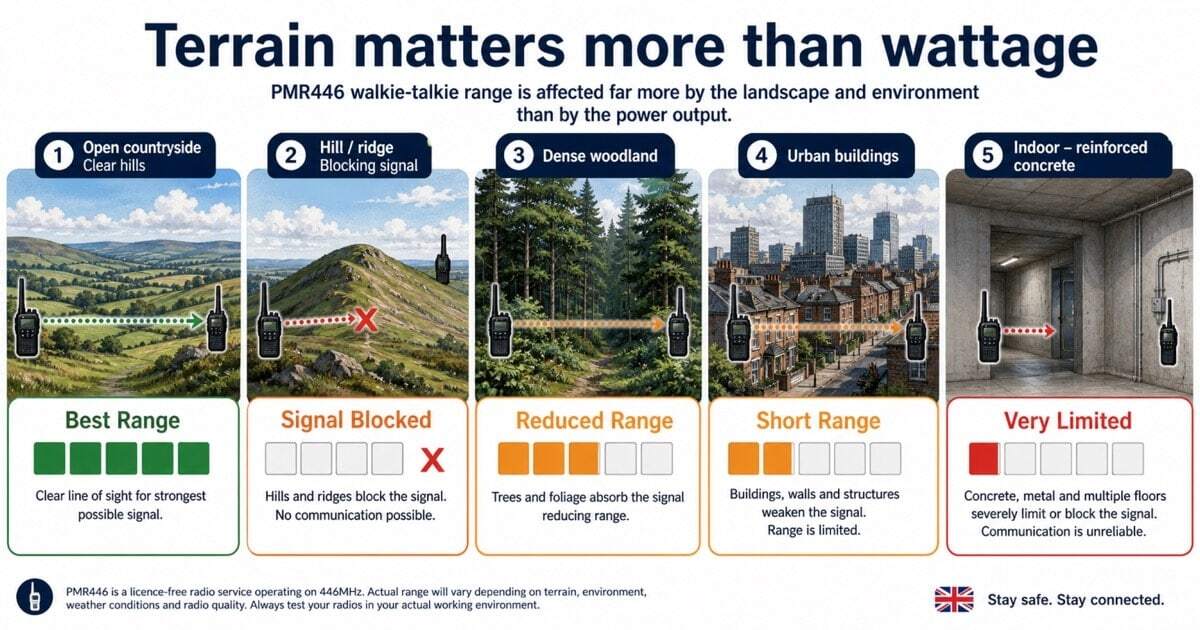 Real walkie-talkie range in the UK depends on terrain far more than transmitter power. The same radio that communicates clearly across open countryside may struggle across a hill, through woodland or between floors of a concrete building.
 How far do walkie talkies really work in the UK?
There is no honest single answer. Real-world walkie talkie range depends on factors including buildings, reinforced concrete, hills and valleys, trees and dense vegetation, antenna position, frequency, interference, radio height, transmit power, receiver performance and whether there is clear line of sight.
Imagine two people communicating across open countryside from elevated positions. Their radios may work over a considerably greater distance than the same handsets used on opposite sides of a multi-storey concrete building. A hill between two users can be more important than several extra watts of transmitter power.
🎯 Practical advice: If coverage is critical to your business, testing radios in the actual environment or arranging a professional site assessment is more useful than choosing by the largest distance printed on a product page. Advertised maximum range should be treated as a best-case figure rather than a promise.
How does terrain affect walkie talkie range?
Terrain often determines whether a radio link works.
- Open countryside: Clear line of sight usually gives handheld radios their best opportunity to communicate over longer distances.
- Hills and valleys: A ridge between two radios can block or weaken the signal significantly. Moving higher may sometimes improve communication more effectively than simply increasing power.
- Woodland: Trees, wet vegetation and uneven ground can reduce usable range.
- Urban environments: Buildings, vehicles, steel structures and other radio users can all affect communication.
- Indoors: Reinforced concrete, basements, lifts, plant rooms and metal shelving can be particularly challenging.
🔵 Key insight: There is no universally "best long range walkie talkie" for every UK location. The best radio for an open farm may not be the best radio for a hotel, warehouse or construction site.
Best waterproof walkie talkie
For users regularly working outdoors in British weather, waterproofing deserves more attention than another mile of advertised range. The Baofeng UV-98 Pro is currently positioned as a rugged option with an IP68 rating and manufacturer-listed 8W output.
IP ratings are more useful than vague descriptions such as "weather resistant". That does not make a radio indestructible — users should keep accessory covers correctly closed, inspect seals for damage, follow the manufacturer's immersion conditions and avoid assuming every connected accessory is equally waterproof.
⚠️ Practical note: Buying IP68 simply because the number looks better adds little value if the radio never leaves a dry indoor environment. Match the IP rating to your actual working conditions. Licensed users working around rain, mud and demanding outdoor environments are the ideal fit — not someone who only needs a simple licence-free radio for a café or family trip.
Best walkie talkies for hiking and camping
Outdoor users often approach walkie talkies with one concern: "What happens when there is no mobile signal?" A two-way radio can be useful for keeping a group coordinated when people become separated, but choosing one still depends on licensing and terrain.
For casual family camping and group walks, PMR446 provides the simplest route. For licensed radio amateurs who understand the equipment and want additional functionality, programmable radios can provide more options. Water resistance and battery life should also move higher up the priority list for outdoor use.
🔵 Dedicated outdoor guide: Because hiking has its own search intent, see our Best Walkie Talkies for Hiking UK guide for a more detailed outdoor comparison. A walkie talkie should be treated as one part of an outdoor communication plan, not as a guaranteed substitute for emergency communication, navigation equipment or appropriate trip planning.
Best walkie talkies for business
Business buyers have a different problem from hobbyists. A restaurant manager, school administrator or warehouse supervisor probably does not care whether the radio can store hundreds of frequencies. They care whether an employee can pick it up, press PTT and immediately reach the right colleague.
For smaller single-site operations, PMR446 can therefore be attractive. Typical applications include front-of-house to kitchen communication, stockroom assistance, hotel reception and maintenance, school playground supervision, small warehouse teams, event marshals, retail security and car park coordination.
Browse our industry-specific walkie talkies for more use-case guidance. Schools can also see the dedicated walkie talkies for schools and education range.
When should a business consider licensed radios?
PMR446 is convenient, but it does not suit every organisation. A business should consider a professionally planned licensed system when it needs greater control over radio configuration, coverage across a large or difficult site, base stations, repeaters, more structured frequency use or communication across several operational areas.
⚠️ Important distinction: An Amateur Radio Licence is not a business-radio licence. UK amateur radio exists for personal, technical and hobby purposes and is not intended for routine commercial staff communication. A business should choose the licensing route based on its operational requirements rather than buying amateur equipment and assuming an employee's amateur licence solves the problem.
Shop recommended radios
The five models below cover the main use cases discussed in this guide — from simple licence-free PMR446 for most families and small businesses to advanced licensed radios for experienced operators.
📻 Baofeng UK — Best Walkie Talkies for Every Use Case
Choose by licence situation and environment — not by headline wattage or advertised range.
✅ Licence-Free & Outdoor — Best for Families, Small Businesses & Outdoor Licensed Users
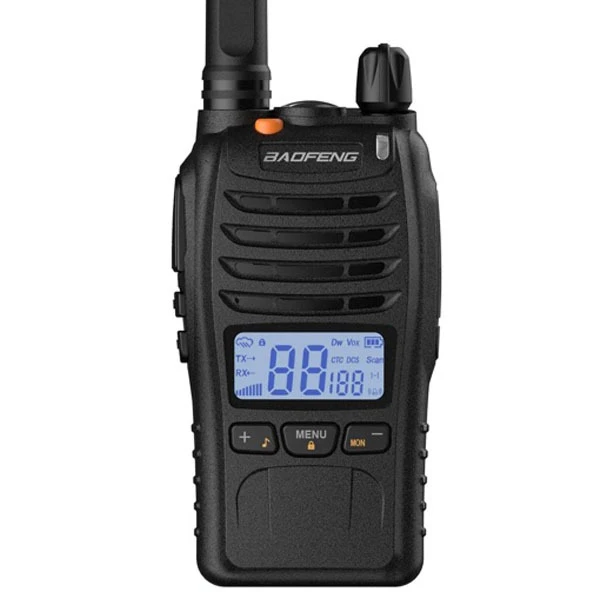
Baofeng BF-88ST Pro PMR446
PMR446 compliant · 16 channels · 1200mAh · VOX · USB charging · No licence needed — the simplest and most practical starting point for families, restaurants, schools and small teams.
View BF-88ST Pro PMR446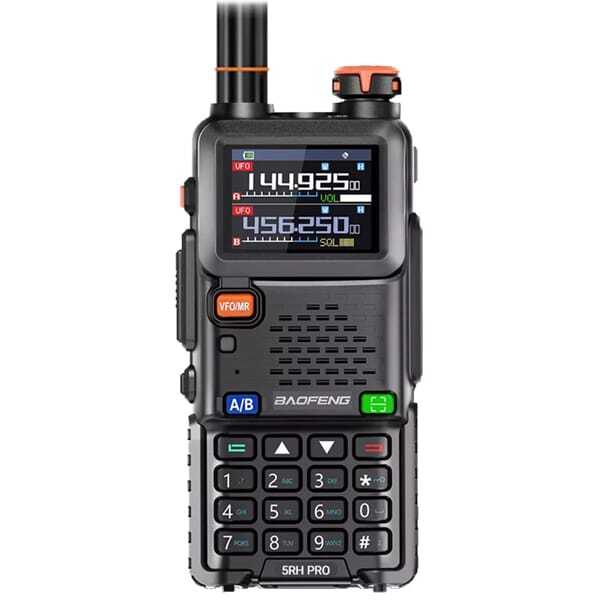
Baofeng UV-5RH Pro GPS
Up to 10W listed · GPS · 640ch · 2500mAh · USB-C · Multi-band receive — for licensed amateur users who need high output, GPS positioning and long battery life. Licence required to transmit.
View UV-5RH Pro GPS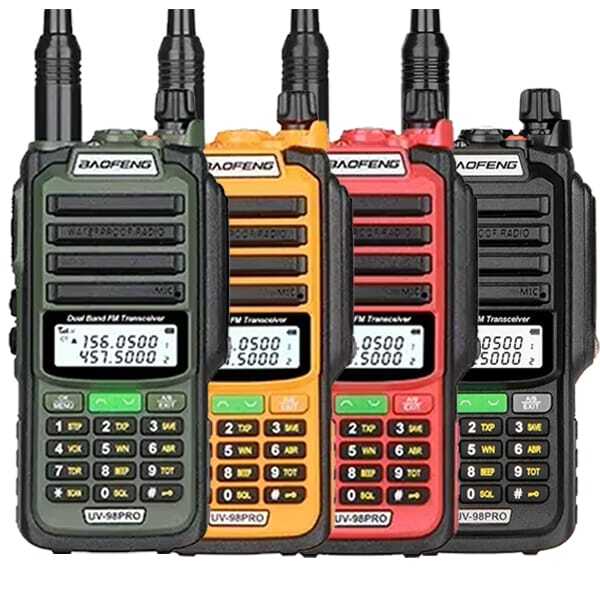
Baofeng UV-98 Pro IP68
IP68 waterproof · 8W listed · Dual-band — maximum weather protection for licensed operators working in rain, mud and demanding outdoor British conditions. Licence required to transmit.
View UV-98 Pro📲 Compact & Digital — For Licensed Beginners & Advanced Operators
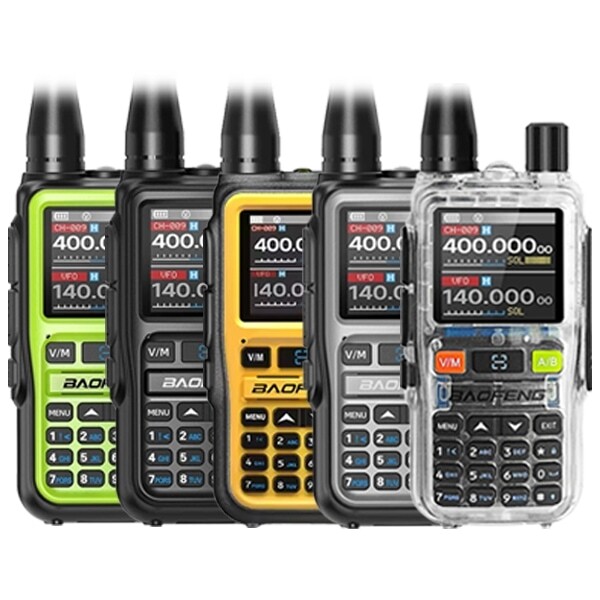
Baofeng UV-5R Mini
Compact · USB-C · Bluetooth app programming · Airband receive · Multi-band — for licensed users who want programmable capability in the smallest possible form factor. Licence required to transmit.
View UV-5R Mini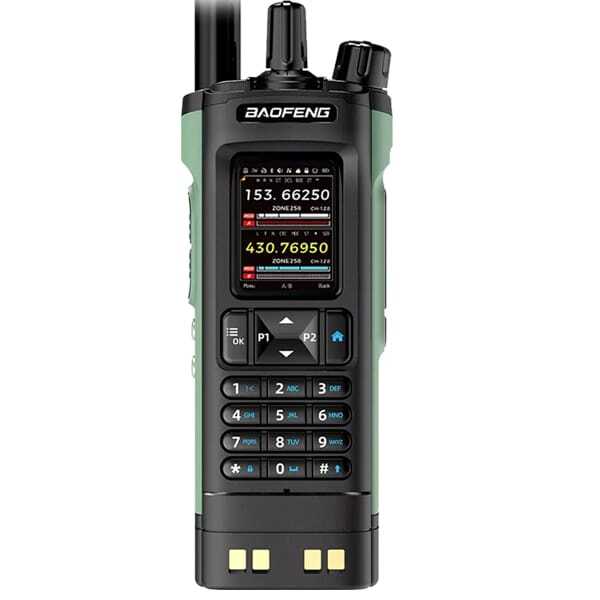
Baofeng DM-32 DMR
Digital DMR · GPS · APRS · Digital & analogue modes · Large channel capacity — for advanced licensed users needing structured talk groups, digital voice quality and professional-grade communication.
View DM-32 DMR⚠️ BF-88ST Pro PMR446 is licence-free when fully compliant. All other models require an appropriate Ofcom licence to transmit legally in the UK.
VHF vs UHF: which is better?
For most people buying a licence-free UK walkie talkie, this decision is already largely made — PMR446 operates in the UHF 446 MHz band. VHF versus UHF becomes more relevant when choosing equipment for authorised amateur or business-radio operation.
You will often see simple rules such as "VHF is better outdoors" and "UHF is better around buildings". These are useful starting points, but they are not universal laws. Actual performance depends on frequency, building materials, terrain, antenna design, radio placement, interference and the licensed system being used.
🔵 For professional sites where communication failures matter, selecting a frequency band from a generic internet rule is not a substitute for proper coverage planning.
How much battery capacity do you need?
Battery capacity matters, but mAh alone does not tell you how long a walkie talkie will operate. Actual battery life depends on how often the radio transmits, selected transmit power, receive time, standby time, GPS or other features, temperature, battery condition and battery age.
🎯 Better question for businesses: "Can every radio reliably complete a shift?" That may mean choosing spare batteries, multi-unit charging or USB-C charging rather than simply buying the radio with the largest capacity number. Do not convert published mAh capacity directly into guaranteed operating hours.
Which accessories are actually useful?
Walkie talkie accessories should solve real problems rather than simply add more items to the order.
- Speaker microphone — useful when the radio stays attached to a belt or jacket
- Earpiece — helpful for hospitality, events and security situations where users do not want every message playing loudly through the radio speaker
- Spare battery — often more valuable than choosing a radio with dozens of additional features
- Multi-unit charger — useful for businesses managing a fleet of radios at the end of each shift
- Programming cable — relevant for compatible programmable radios, but unnecessary for many ordinary PMR446 users
- Replacement antenna — potentially useful on radios designed for interchangeable antennas, but remember that PMR446 licence-free equipment has specific technical requirements. Do not assume changing the antenna on a radio is compatible with licence-free PMR446 operation
For compatible models and current software downloads, visit the Baofeng programming software and driver hub.
⚠️ Reminder: Programming a frequency into a radio does not give you permission to transmit on that frequency. Licensing and equipment requirements still apply.
When a Baofeng radio is not the right choice
Choose something simpler when you want zero licensing complexity
If a family or small team just wants to switch on two radios and talk, a compliant PMR446 handset makes more sense than a high-power amateur radio.
Consider a managed professional system for large fleets
A large warehouse, hospital, multi-building campus or major security operation may need professionally managed channels, infrastructure, maintenance and coverage planning. Buying dozens of inexpensive handheld radios without planning the system can create more problems than it solves.
Use certified equipment where the environment demands it
Certain industrial environments may require intrinsically safe equipment designed and certified for potentially explosive atmospheres. A normal rugged or waterproof radio should never be assumed to meet those requirements.
Do not buy purely by wattage
More watts cannot remove a mountain, reinforced wall or poorly positioned antenna. Range is a system problem, not just a transmitter-power specification.
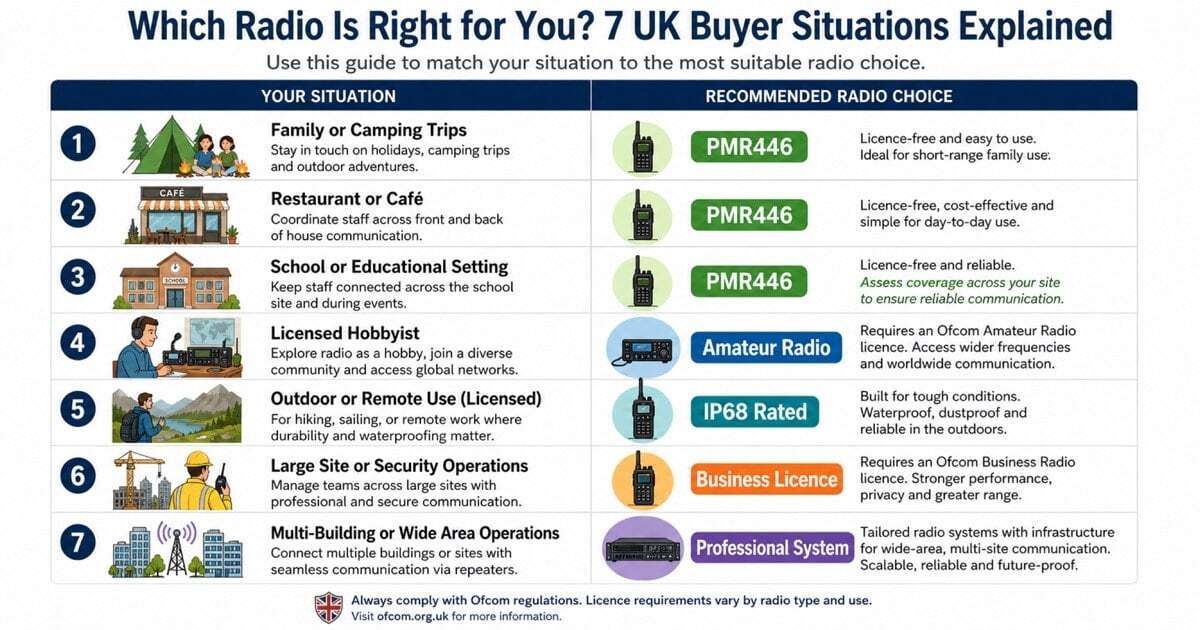 Seven UK buyer situations mapped to the right radio starting point — from a simple PMR446 for family camping to a professionally planned licensed system for multi-building operations.
 Best walkie talkies UK: our decision guide
Before buying, work through these questions:
Start with a compliant PMR446 model — no exam, no application needed.
Work out whether PMR446 provides enough coverage. If not, investigate an appropriate Ofcom Business Radio licence.
An Amateur Radio Licence opens access to amateur frequencies, repeaters and more advanced equipment.
Prioritise weather protection, practical battery life and charging over maximum advertised range.
Do not assume the largest advertised range is meaningful. Think about concrete, steel, floors and site layout.
You may need a professionally designed licensed radio system rather than ordinary licence-free walkie talkies.
| Your Situation | Best Starting Point |
|---|---|
| Family, camping or casual group use | PMR446 licence-free radio |
| Restaurant, café or small shop | PMR446 licence-free radio |
| School or small single-site team | PMR446 first; assess actual coverage |
| Licensed amateur-radio hobbyist | Programmable amateur handheld |
| Outdoor licensed user needing weather resistance | Rugged IP-rated programmable radio |
| Large construction, security or warehouse operation | Assess Business Radio licensing and coverage |
| Multi-building or repeater requirement | Professionally planned licensed radio system |
The best walkie talkie is therefore not necessarily the model with the biggest battery, highest wattage or longest product title. It is the radio that matches your environment, legal requirements and the people actually using it.
Browse our full walkie talkie collection to compare available options. If your priority is specifically distance, go directly to long range walkie talkies. If you are interested in what Baofeng models UK customers are currently buying, browse the Baofeng best-selling walkie talkies.
Helpful related guides
Frequently asked questions
Are walkie talkies legal in the UK?
Yes — walkie talkies are entirely legal in the UK. However, the type of radio and how it is used determines whether you need a licence. Compliant PMR446 radios can be used licence-free when they meet all applicable technical requirements. Higher-powered programmable radios require an appropriate Ofcom licence — either a Business Radio licence for commercial use or an Amateur Radio Licence for hobby use — before transmitting legally.
What is the best walkie talkie for UK families?
For most families, a compliant PMR446 model such as the BF-88ST Pro PMR446 is the most practical choice. It requires no individual Ofcom licence, arrives with 16 pre-programmed channels, uses a fixed integral antenna and is straightforward enough that any family member can use it without radio training. It is not designed for large distances, but for keeping a group coordinated at a campsite, festival or during a family walk it is well-suited.
What does PMR446 mean?
PMR446 stands for Personal Mobile Radio, operating within the 446 MHz UHF frequency band. It is the designated licence-free short-range radio standard across the UK and the European Union. Compliant PMR446 equipment is limited to a maximum of 500 mW ERP, uses a fixed integral antenna and operates between 446.0 and 446.2 MHz. These restrictions keep it within safe, short-range communication distances without interfering with other radio services.
Do I need a licence for a Baofeng UV-5RH Pro GPS?
Yes. To transmit legally using a UV-5RH Pro GPS in the UK, you must hold an appropriate Ofcom licence — either an Amateur Radio Licence for personal hobby use or a Business Radio Licence for commercial or professional use. The UV-5RH Pro GPS has a higher listed transmit power and a removable antenna, meaning it does not meet the criteria for licence-free PMR446 operation. You can receive without a licence, but transmitting requires authorisation.
What is the realistic range of a PMR446 walkie talkie?
In open countryside with a clear line of sight, PMR446 radios may communicate over a usable distance, but conditions vary enormously. Inside buildings, in woodland, behind hills or in a busy urban area, usable range is typically much shorter. Manufacturer maximum-range figures are based on ideal open-air conditions and should not be treated as a reliable guide for typical UK environments. For a restaurant, school or campsite, the range is usually adequate — for a large warehouse or multi-building site, it may not be.
Can I use a UK PMR446 radio in Europe?
PMR446 is harmonised across EU member states and EEA countries, so compliant PMR446 equipment can generally be used in most European countries without an individual licence. However, always check local regulations before travelling internationally with radio equipment, as rules in non-EU countries may differ. PMR446 should not be confused with US FRS or GMRS systems, which use different frequencies and regulations.
What should a business do if PMR446 is not enough?
If PMR446 cannot provide adequate coverage, channel control or operational flexibility for a business, the next step is to investigate an appropriate Ofcom Business Radio licence. Options include Simple UK Light and Simple Site Light licences. A business should not use an employee's personal Amateur Radio Licence for routine commercial staff communication — amateur radio is for personal hobby use and does not authorise commercial business communication. For larger or more complex operations, professional radio-system design may be the appropriate solution.
Find the Best Walkie Talkie for Your UK Needs
From simple PMR446 licence-free handhelds for families and small businesses to advanced licensed radios for outdoor operators and hobbyists — Baofeng UK has the right radio for every situation.