
25th Nov 2026
UV-5RM Plus vs UV-5RH Pro GPS: Which Fits Your Needs?
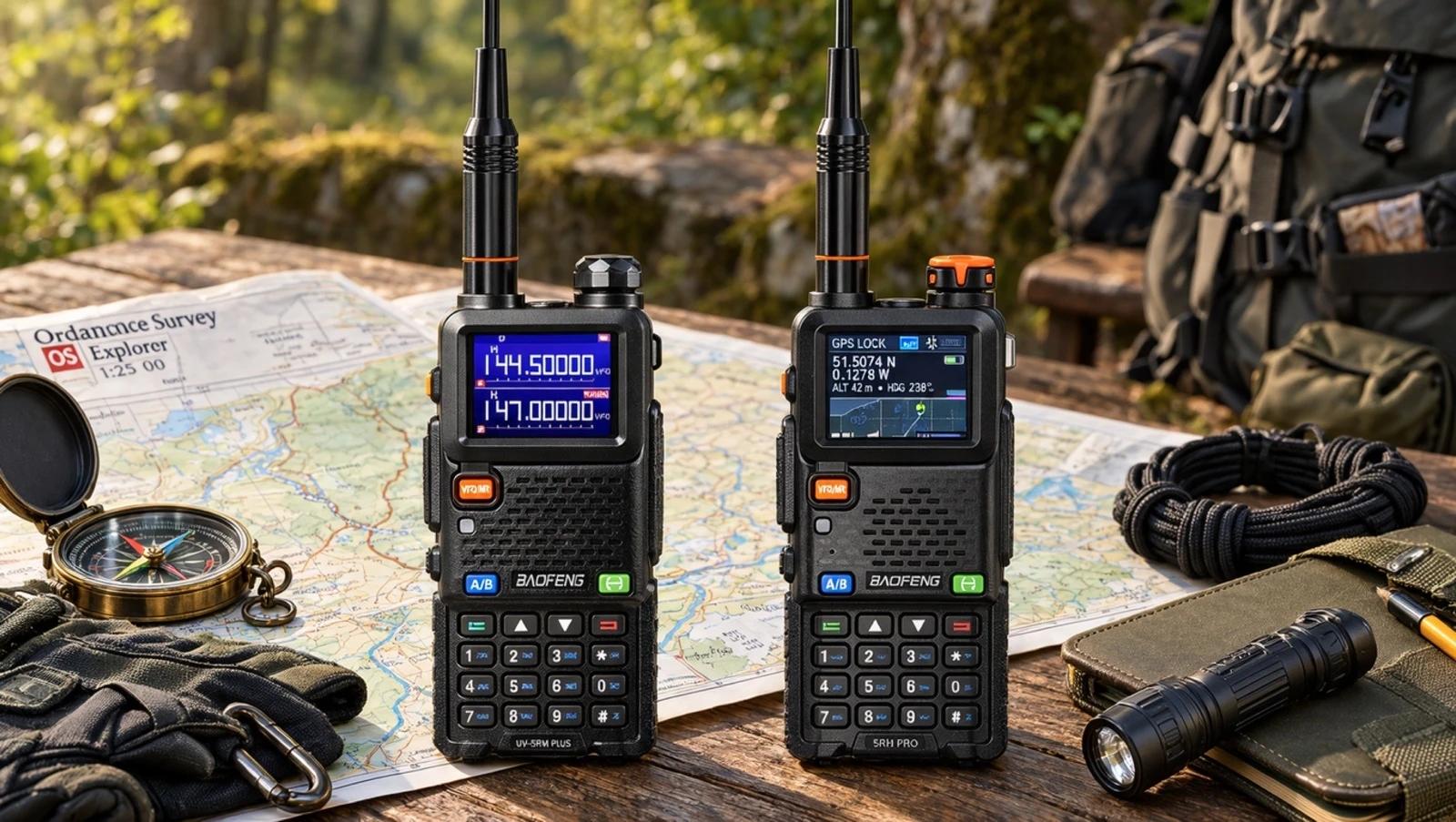
Compiled by the Baofeng UK technical department. This side-by-side analysis compares firmware architecture, DTMF positioning data, channel memory bank layouts, and current Ofcom regulatory guidance for UK radio operators. All technical figures reference official factory specifications.
When comparing the Baofeng UV-5RM Plus vs UV-5RH Pro GPS, start with positioning and channel storage.
The standard UV-5RM Plus offers 999 memory channels without GPS; the UV-5RH Pro GPS adds satellite positioning and organises 640 channels across 10 distinct zones. The better choice depends on which functions you will actually use in the field.
ℹ️ Scope of this comparison: This comparison covers the standard, non-GPS UV-5RM Plus and the UV-5RH Pro GPS sold directly by Baofeng Radio UK. It does not compare the standard UV-5RH, a different regional version, or a GPS-labelled UV-5RM Plus variant. Always check the complete model name when following reviews or ordering accessories.
📋 Table of Contents
- UV-5RM Plus vs UV-5RH Pro GPS: Key Differences
- GPS and Location Sharing: What Does the UV-5RH Pro Add?
- Match Channel Storage to Your Actual Programme
- UV-5RM Plus vs UV-5RH Pro GPS: Range and Battery Life
- Compare the Complete Setup Before Comparing Cost
- Check the UK Operating Requirements
- Side-by-Side Product Options
- Which One Should You Buy?
- FAQs About the UV-5RM Plus and UV-5RH Pro GPS
UV-5RM Plus vs UV-5RH Pro GPS: Key Differences
While both handsets share Baofeng's modern multi-band architecture and rugged form factor, their internal firmware priorities differ significantly:
| Listed Feature | UV-5RM Plus (Non-GPS) | UV-5RH Pro GPS |
|---|---|---|
| Satellite Positioning | No | Yes (Built-in GPS receiver) |
| Memory Channels | 999 Channels | 640 Channels across 10 Zones |
| Advertised Maximum Power | 10W | 10W |
| Listed Battery Capacity | 2500mAh | 2500mAh |
| Battery USB-C Charging | Yes (Direct battery port) | Yes (Direct battery port) |
| Display Screen | 1.77-inch Colour TFT | 1.77-inch Colour TFT |
| AM Airband Reception (RX) | Yes (108–136 MHz) | Yes (108–136 MHz) |
| Position Sharing | Not supported | DTMF Coordinate Exchange |
GPS and Location Sharing: What Does the UV-5RH Pro Add?
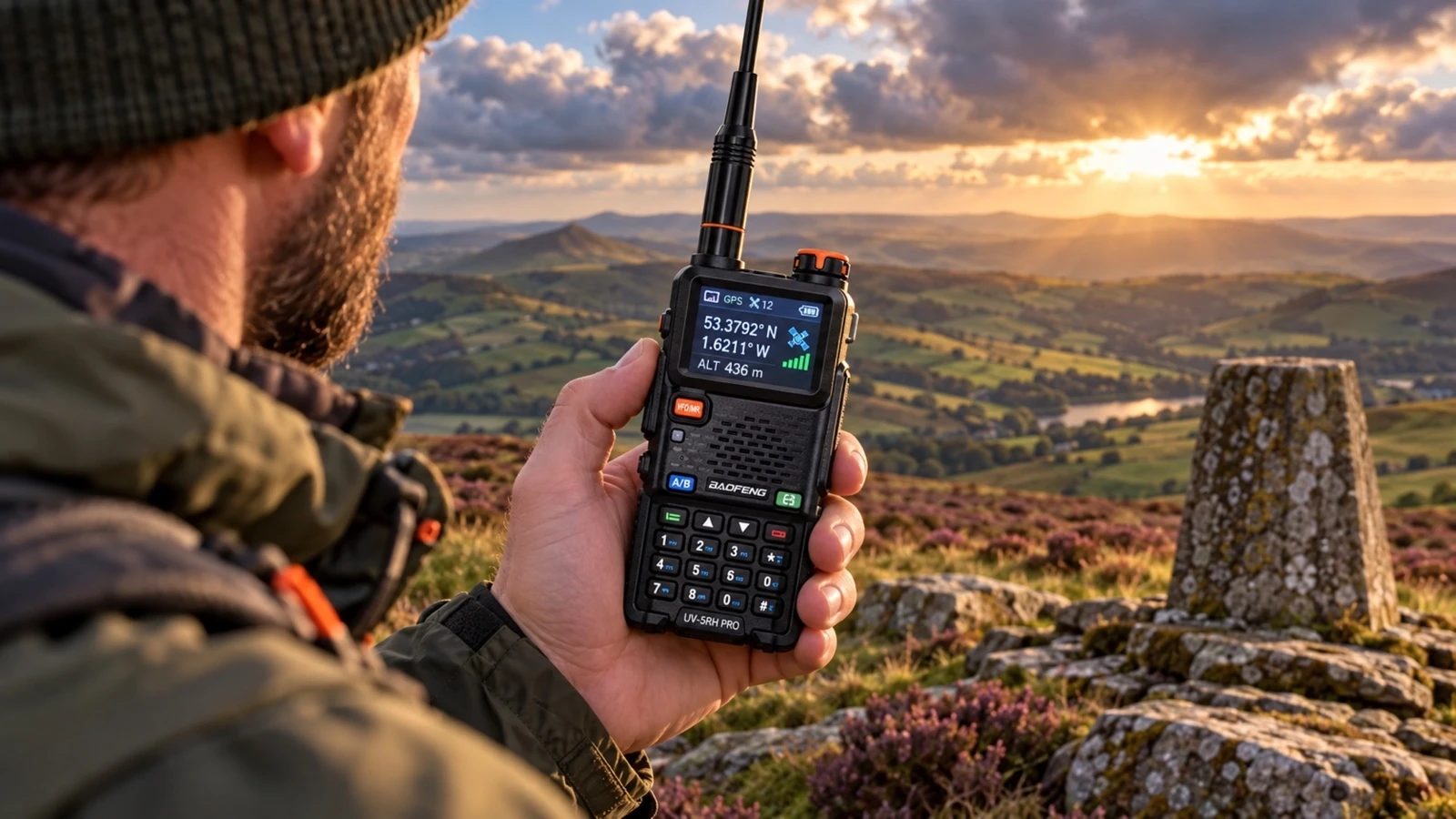
The UV-5RH Pro GPS listing describes built-in positioning and coordinate exchange with compatible radios. The standard UV-5RM Plus listing explicitly excludes GPS. That makes the Pro GPS the relevant candidate if you want position information available directly on the handset.
However, finding your own position and sending that position to somebody else are separate tasks:
- Standalone Coordinate Reading: A satellite fix establishes your exact real-time latitude, longitude, and altitude on screen without cellular coverage.
- Transmitting Coordinates: Sharing those coordinates requires a supported radio function, compatible receiving equipment, and appropriate configuration. The person receiving your location also needs to understand the information being sent.
⚠️ How Position Sharing Actually Works: The Pro user manual describes position sharing as a DTMF-based function. Participating radios must use the same frequency or channel on the main band, with the relevant calling IDs pre-configured. Furthermore, the manual states that normal voice calls require leaving GPS mode. This makes position exchange a manual, configured operating task rather than automated APRS-style continuous tracking on every nearby radio.
Match Channel Storage to Your Actual Programme
The advertised memory capacity differs substantially between the two handsets:
- Baofeng UV-5RM Plus: Features 999 memory channels in a flat, sequential structure.
- Baofeng UV-5RH Pro GPS: Provides 640 memory channels neatly partitioned across 10 distinct zones (up to 64 channels per zone).
Memory channels store programmed settings, repeater offsets, CTCSS tones, and labels; they do not represent additional frequencies that you are automatically authorised to use.
For a short list of local repeaters and simplex channels, either capacity is ample. A larger programme makes organisation more important: the Pro GPS zones can separate entries by geographical area (e.g., Zone 1 for Greater Manchester repeaters, Zone 2 for Peak District simplex, Zone 3 for marine channels) or by activity. Conversely, the UV-5RM Plus offers a higher total capacity for users loading extensive national repeater databases. Choose according to the channel plan you will actually maintain.
UV-5RM Plus vs UV-5RH Pro GPS: Range and Battery Life
Both models advertise an output rating of up to 10W, but this shared figure does not identify an automatic range winner.
In real-world VHF/UHF transmission, line-of-sight terrain, surrounding buildings, antenna elevation, atmospheric conditions, and the receiver sensitivity of the other station dictate whether a contact succeeds far more than output wattage alone. For regular use along a particular route, a field coverage check in that specific environment is infinitely more informative than a theoretical maximum-distance claim.
Likewise, their identical 2500mAh listed battery capacities do not guarantee identical field operating endurance:
- GPS Power Draw: Actively powering a satellite receiver chip on the UV-5RH Pro GPS increases background power consumption compared to the non-GPS UV-5RM Plus.
- Operating Habits: Transmit duty cycle (PTT time), screen brightness timeout, dual-watch monitoring, and audio volume directly determine battery life.
Both units feature integrated USB-C charging ports directly on their battery casings, allowing easy top-ups from power banks, in-vehicle 12V adapters, or USB wall blocks during long outings.
Compare the Complete Setup Before Comparing Cost
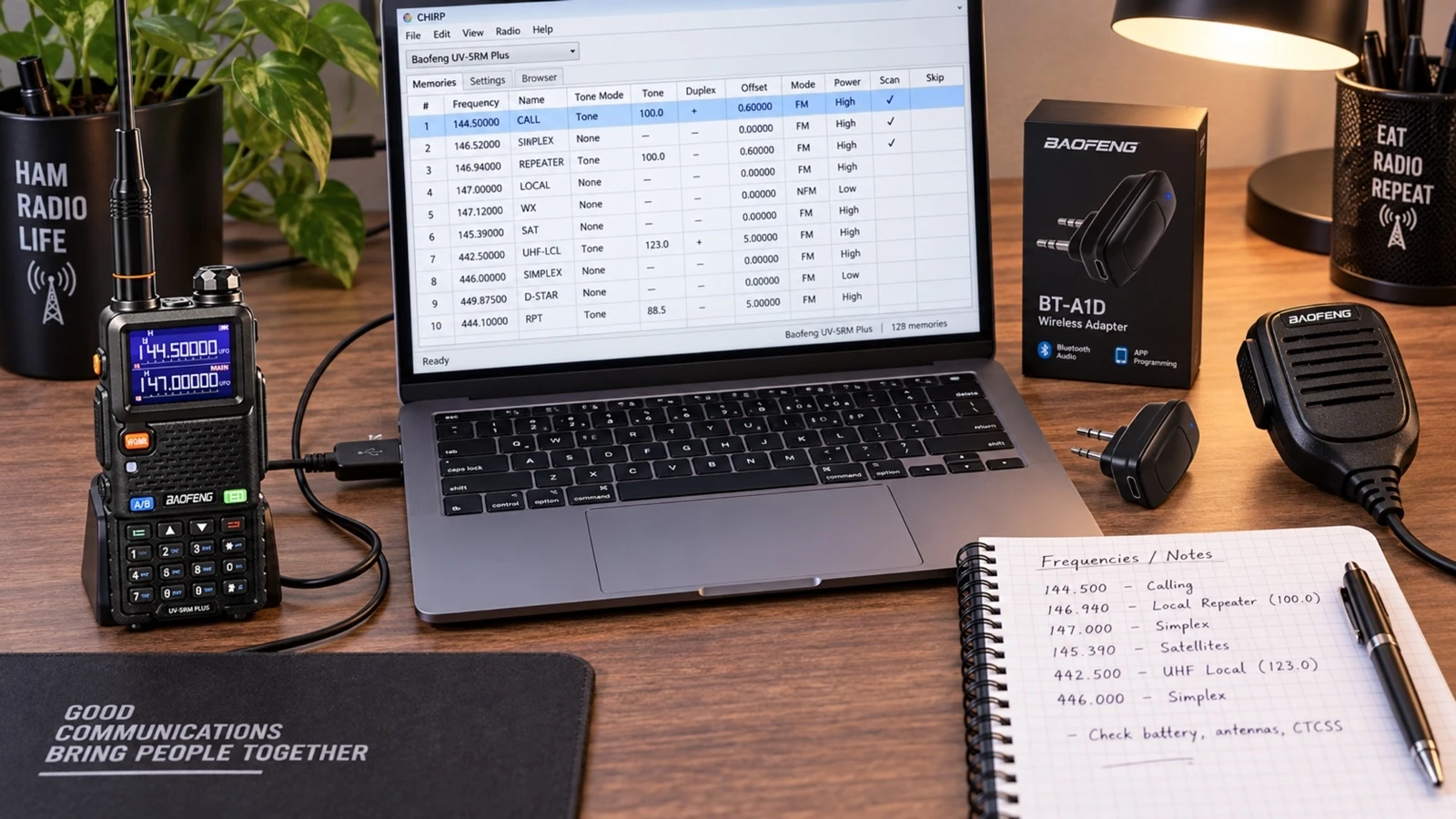
When assessing value, evaluate the complete bundle rather than comparing base handset prices alone. A radio supplied with a Baofeng USB programming cable or an external PTT speaker microphone represents a different setup from a bare handset package.
Both models support computer programming and can utilise the optional Baofeng BT-A1D wireless Bluetooth adapter paired with the Ola Radio app for smartphone programming:
ℹ️ Bluetooth Clarification: The BT-A1D adapter provides a wireless data connection strictly for programming frequencies and settings from a smartphone. It does not provide built-in Bluetooth audio for wireless commercial earbuds or motorcycle helmets.
For PC setup, always use the correct manufacturer software or verified CHIRP build matching the exact model architecture. To see how these transceivers compare with the rest of the ecosystem, read our broader Baofeng UV-5R series guide.
Check the UK Operating Requirements
Both the UV-5RM Plus and the UV-5RH Pro GPS are programmable handheld transceivers, not licence-free PMR446 radios.
⚠️ Mandatory Ofcom Regulatory Warnings:
- Licence Obligation: Transmitting on UK amateur frequency allocations (such as 144–146 MHz VHF and 430–440 MHz UHF) requires an appropriate UK Ham Radio Licence (Foundation, Intermediate, or Full) issued by Ofcom.
- No Business Use Under Ham Licences: An amateur radio licence does not authorise routine business or commercial communications. Commercial enterprises must obtain dedicated Ofcom Business Radio licensing.
- Frequency Span vs Lawful Use: The wide frequency coverage indicated on technical specification sheets does not grant permission to transmit on emergency, marine, aviation, or public service frequencies. Furthermore, under UK law, receiving capability does not authorise the interception of non-broadcast communications.
To explore equipment compliant with licensed hobby communication, browse our full amateur radio collection.
Side-by-Side Product Options
📻 Featured Comparison Handsets
Choose between zoned satellite positioning or massive linear memory storage.
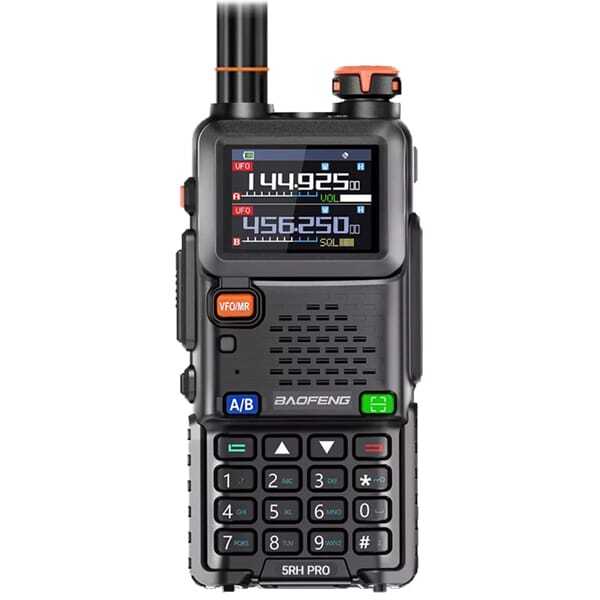
Baofeng UV-5RH Pro GPS
10W · 640 Channels across 10 Zones · Integrated GPS receiver · DTMF coordinate sharing · Type-C direct charge.
View UV-5RH Pro GPS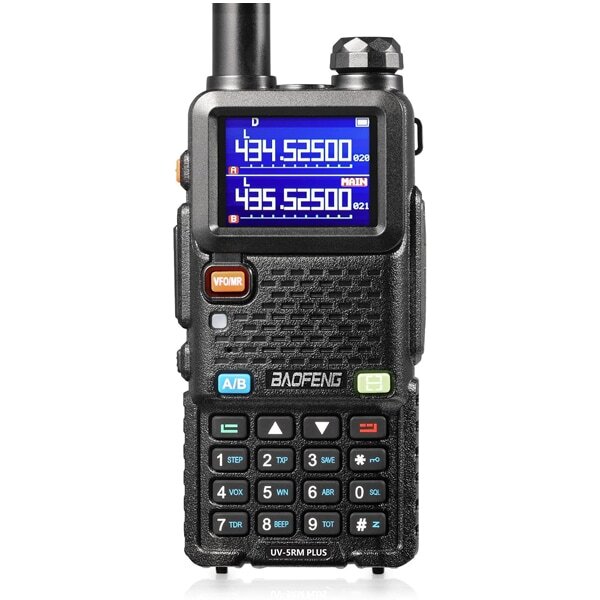
Baofeng UV-5RM Plus
10W · Massive 999 Memory Channels · AM Airband RX · 1.77-inch colour display · Type-C direct charge.
View UV-5RM PlusWhich One Should You Buy?
1. If You Mainly Make Local Amateur Voice Contacts
For a licensed operator communicating through a modest list of local repeaters and simplex calling channels, either model provides more than enough storage. The UV-5RM Plus options represent a sensible choice when satellite coordinates have no role in your operating routine. Compare equivalent bundles before deciding; an included programming cable or spare battery can easily alter total value.
2. If You Want Position Information on the Handset
The UV-5RH Pro GPS options deliver distinct practical value when you need to view real-time coordinates in the field or exchange position data with compatible, pre-configured radios (e.g., amateur group field exercises, SOTA hill climbs, or outdoor events). Factor in the operational requirement to exit GPS mode for standard voice communications to ensure this workflow suits your team.
3. If You Already Own One and Are Considering Switching
Identify the specific operational problem your current handset fails to solve:
- Upgrading from the non-GPS UV-5RM Plus to the UV-5RH Pro GPS makes sense strictly if you need on-screen coordinate referencing or DTMF position exchange.
- Moving from the Pro GPS to the UV-5RM Plus only makes sense if your custom channel list legitimately exceeds 640 memory entries.
Neither switch is justified by expectations of greater signal distance or longer battery endurance, as their headline RF ratings and battery cells are effectively identical. If your existing radio comfortably handles your programmed repeaters, there is no pressing technical reason to replace it.
FAQs About the UV-5RM Plus and UV-5RH Pro GPS
1. Can the UV-5RM Plus and UV-5RH Pro GPS talk to each other?
Yes. Both radios support standard analogue FM voice communication. As long as both transceivers are programmed to the same transmit/receive frequencies, channel bandwidth (wide/narrow), and matching CTCSS/DCS tones, they will communicate seamlessly. Simply matching channel numbers is not sufficient if the underlying frequencies differ, and both operators must be licensed for the frequencies used.
2. Does the UV-5RH Pro GPS need a SIM card to determine its position?
No. Its internal satellite receiver locks onto orbital GPS signals autonomously without requiring a SIM card, mobile network connection, or data subscription. However, transmitting that location data to another operator uses direct RF signalling, meaning transmission remains strictly dependent on line-of-sight radio range and proper DTMF ID configuration.
3. Can I copy a complete programming file directly from one model to the other?
No. Do not flash a complete memory image (.img or codeplug) from one model into the other; differing memory architectures (999 channels vs 640 zoned channels) can corrupt radio firmware. Instead, read each radio using its specific factory software or CHIRP profile, export your channel lists to a CSV file, and import that list into the other radio's layout before writing.
4. Can either of these radios be used legally on PMR446 channels without a licence?
No. In the UK, PMR446 licence-exempt operation strictly requires purpose-built equipment with a non-detachable integral antenna and a maximum effective radiated power of 0.5W. Because both the UV-5RM Plus and UV-5RH Pro GPS have detachable antennas and output up to 10W, they cannot be lawfully operated on PMR446 channels under Ofcom licence-exempt regulations.
Editorial note: This technical comparison references published factory specifications, product user manuals, and UK regulatory frameworks administered by Ofcom. It does not claim destructive lab testing. Always verify current firmware configurations, bundle inclusions, and local licensing compliance before operating.