
25th Mar 2026
Best Walkie Talkies for UK Road Trips, Car Convoys & 4x4s
This guide was produced by the Baofeng Radio UK Product Team — UK-based radio communications specialists with over 10 years of experience helping drivers, outdoor groups and families choose the right two-way radio for their journey. Licensing guidance reflects current Ofcom requirements. UK Highway Code references are accurate as of publication date — always check current GOV.UK guidance.
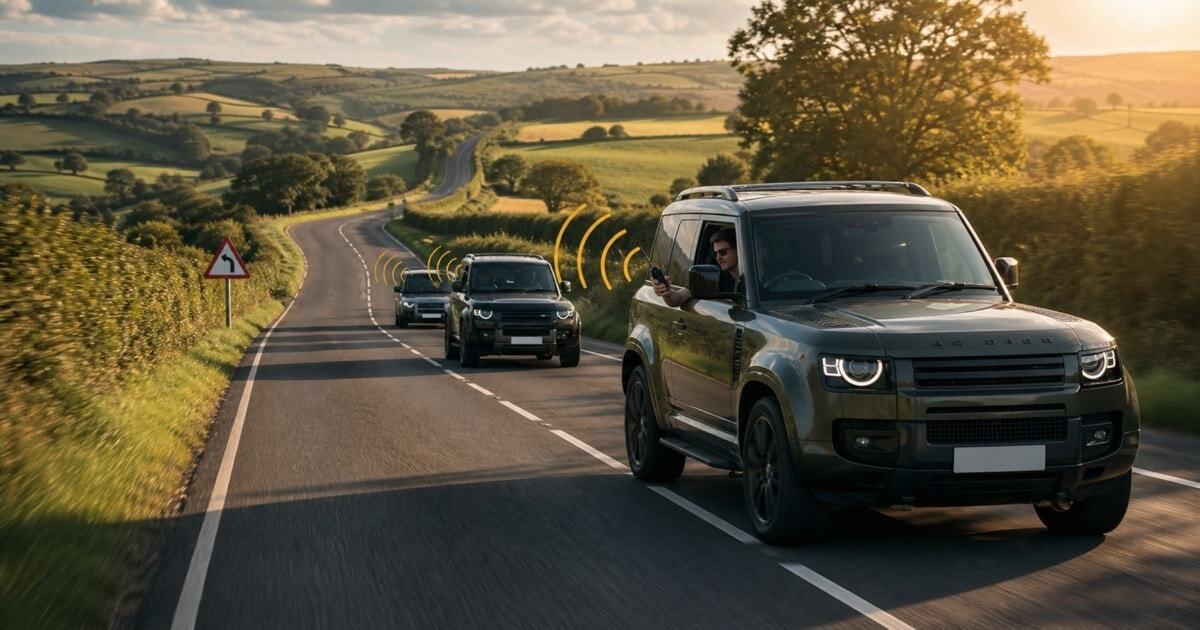
A road trip becomes surprisingly complicated when three cars reach the same roundabout and only two take the correct exit.
Mobile phones can solve the problem, but calling individual drivers is slow, group messages may not be noticed immediately, and rural mobile coverage can disappear exactly when the convoy becomes separated.
For many UK road trips, a walkie talkie offers a simpler alternative: press Push-to-Talk, send one short message and everyone using the same channel can hear it.
The difficult part is choosing a radio that is legal for your situation, practical inside a vehicle and suitable for the people who will actually use it.
For a normal family road trip, motorhome holiday or casual multi-car convoy, a PMR446-compliant walkie talkie is usually the most straightforward choice. Compliant PMR446 equipment can be operated in the UK without an individual Ofcom radio licence.
A practical starting point: The Baofeng BF-888S PMR446 / BF-88E — designed for straightforward licence-free communication rather than advanced amateur-radio operation.
⚡ Best road-trip walkie talkies at a glance
- ✅ Most family convoys: PMR446 licence-free radio — simple, legal, no individual licence required for compliant equipment
- 🏆 Best overall PMR446 choice: BF-88ST Pro PMR446 — upgraded licence-free model for road trips
- 👫 Two-vehicle trips: PMR446 twin pack — matched radios, one per vehicle, ready to go
- 📡 Licensed amateur operators: UV-5R III or UV-5RH — more flexibility, but licence required to transmit
- ⚠️ Key rule: Programming any handheld to 446 MHz does not automatically make it a compliant licence-free PMR446 radio
- 🚗 Road safety first: Make the radio the passenger's job — the UK Highway Code advises against using a hand-held microphone while driving
📋 Table of Contents
- Road-trip situation comparison table
- Why walkie talkies work well for car convoys
- Can you use a walkie talkie while driving in the UK?
- Do you need an Ofcom licence for road-trip walkie talkies?
- How far will walkie talkies work between cars?
- Can you use an external antenna with a road-trip radio?
- Best Baofeng walkie talkies for different road trips
- What actually matters in a road-trip walkie talkie?
- How to set up walkie talkies for a car convoy
- What should a 4x4 or green-laning group consider?
- Shop road-trip walkie talkies
- PMR446 or a higher-power radio: which should you choose?
- Key takeaways
- Frequently asked questions
Road-trip situation comparison table
| Road-trip situation | Sensible radio choice | Licence position | Main reason |
|---|---|---|---|
| Family road trip | PMR446 | No individual licence for compliant equipment | Simple for everyone to operate |
| Two-car convoy | PMR446 twin pack | No individual licence for compliant equipment | Fast car-to-car updates |
| Motorhome or caravan group | PMR446 | No individual licence for compliant equipment | Easy group coordination |
| Casual 4x4 convoy | PMR446 | No individual licence for compliant equipment | Least complicated option |
| Licensed amateur operators | Amateur handheld | Appropriate amateur licence required | More programming flexibility |
| Commercial or organised fleet | Suitable business radio system | Depends on system and frequencies | Better suited to operational comms |
🎯 Key point: Buying the radio with the largest power number is not automatically the best choice. For most leisure convoys, legal simplicity and ease of use matter more than headline wattage.
Why walkie talkies work well for car convoys
Anyone who has travelled in a group knows the familiar problems. The lead car sees a turning too late. Someone needs fuel. The last vehicle gets trapped behind a slow lorry. One driver stops, while the rest of the convoy continues for another five miles before noticing.
A two-way radio turns those situations into short messages: "Lead to convoy — fuel stop at the next services." Everyone hears the same update almost immediately.
Unlike WhatsApp or a group phone call, conventional handheld two-way radios communicate directly and do not depend on a mobile network. That can make them particularly useful on rural routes and outdoor trips where mobile coverage is inconsistent.
They are also useful beyond the vehicle. Once you reach the campsite, trailhead or activity area, the same radios can help group members stay in contact. For equipment intended for hiking, camping and similar environments, explore Baofeng UK's outdoor two-way radio range.
⚠️ Important: A walkie talkie is still only a communication tool. It does not replace navigation, normal journey planning, a mobile phone for contacting emergency services or a sensible plan for what happens if vehicles become separated.
Can you use a walkie talkie while driving in the UK?
Convenience must take second place to road safety. The UK Highway Code requires drivers to remain in proper control of their vehicle. Rule 149 also advises drivers not to use a hand-held microphone while driving.
For a convoy, the most practical arrangement is therefore to make the radio the passenger's job. If you are travelling alone, stop somewhere safe before making a transmission rather than trying to operate a handheld radio while controlling the vehicle.
⚠️ Safety first: Hands-free equipment can reduce the need to hold the device, but any conversation or communication system can still distract a driver. Keep transmissions brief and stop safely if a message requires explanation or route planning. The radio should make the journey easier, not give the driver another task to manage.
A sensible convoy procedure:
- Nominate passengers as radio operators where possible
- Keep transmissions brief
- Agree on common phrases before setting off
- Avoid long conversations over the radio
- Stop safely if a message requires explanation or route planning
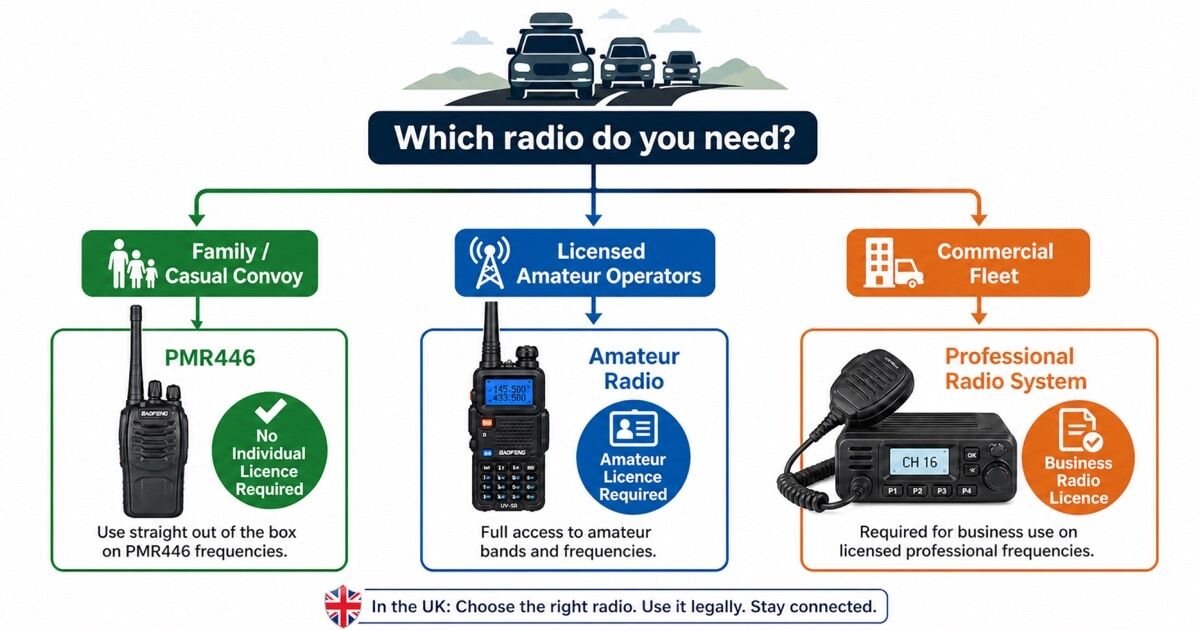 Three clear licence paths for UK road-trip radio buyers — PMR446 licence-free for most family and leisure convoys, amateur radio for appropriately licensed operators, and business radio for commercial fleet communication.
 Do you need an Ofcom licence for road-trip walkie talkies?
Not always. What matters is the type of radio equipment, not simply the frequency displayed on its screen.
PMR446: The Easy Option for Most Families
PMR446 is designed for short-range, peer-to-peer radio communication. When equipment complies with the applicable PMR446 technical requirements, it can be used on a licence-exempt basis in the UK.
You can browse licence-free PMR446 walkie talkies or read Baofeng UK's detailed guide on whether you need a licence for a walkie talkie in the UK before choosing a model.
A Programmable Radio Is Not Automatically PMR446
This catches out buyers because two radios can look almost identical. A programmable handheld may be technically capable of being tuned to a frequency within the PMR446 range, but that does not automatically turn it into a compliant licence-free PMR446 radio. A higher transmitter output, removable antenna or other equipment characteristics can place the radio outside PMR446 licence-exempt conditions.
⚠️ Important rule: If your priority is simply to give one radio to each family member and start communicating, buy equipment specifically designed and identified for compliant PMR446 use. If you are unsure, start with the Baofeng UK licence-free PMR446 radio range.
What About Amateur Radios?
Models such as the Baofeng UV-5R III and Baofeng UV-5RH offer considerably more programming flexibility than a basic PMR446 handset. But these radios should not be treated as licence-free substitutes for PMR446 equipment. Transmission must take place on frequencies and under conditions permitted by the relevant licence.
If amateur radio is what you actually want to explore, read the UK Ham Radio Licence Guide before buying a radio simply because it advertises more transmitter power.
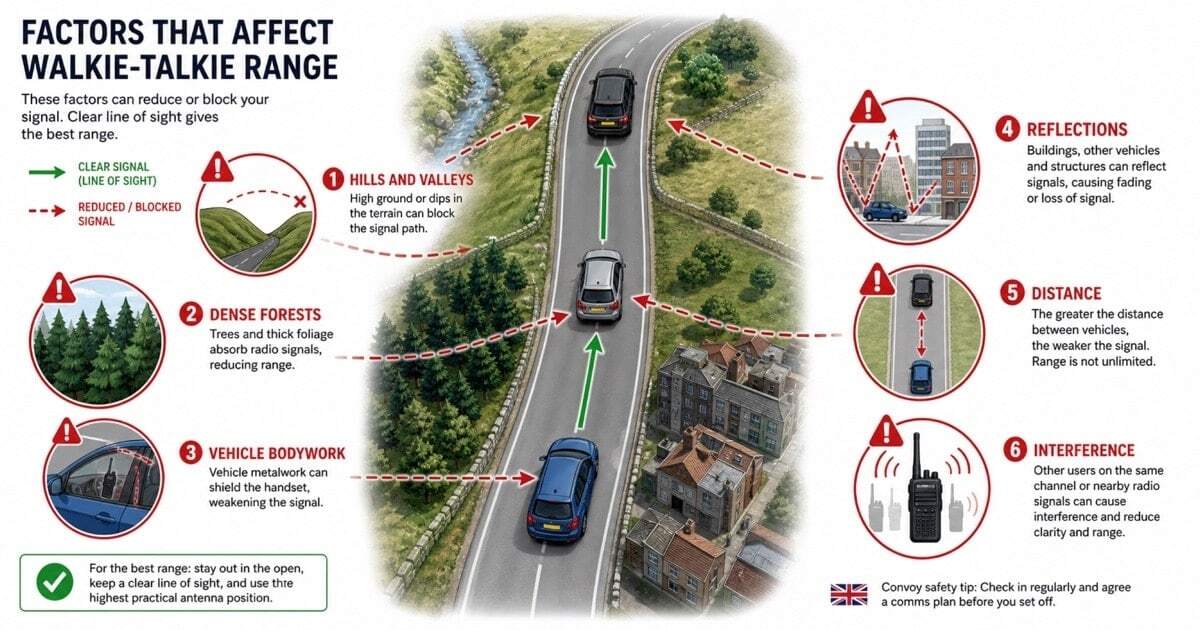 Six factors that affect car-to-car walkie-talkie range on a UK road trip — and none of them is solved simply by buying a more powerful radio. Terrain, vehicle bodywork and line of sight often matter more than wattage.
 How far will walkie talkies work between cars?
There is no single road-trip range figure that can be guaranteed. A radio used across open countryside with clear line of sight can perform very differently from the same handset when both users are inside vehicles surrounded by hills, buildings and trees.
| Factor | What happens |
|---|---|
| Hills and valleys | Terrain can block the radio path |
| Buildings | Signals may be absorbed, reflected or obstructed |
| Dense woodland | Vegetation can reduce usable range |
| Vehicle bodywork | Metal surrounding the handset can affect signal performance |
| Radio position inside the vehicle | Where the radio sits inside the vehicle can matter |
| Distance between vehicles | Reliability normally falls as separation increases |
| Local radio activity | Shared channels can experience interference |
🔵 Realistic expectation: An advertised "5 mile" or "10 mile" figure should not be treated as a promise that two moving cars will communicate reliably at that distance. For a deeper explanation, see the Baofeng UK long-range walkie talkie buying guide. For a normal convoy, good organisation often matters more than chasing extreme range.
Can you use an external antenna with a road-trip radio?
That depends on the radio and licence category. For licence-free PMR446 equipment, an integral antenna forms part of the relevant technical requirements. Modifying a compliant PMR446 handset to accept an external vehicle antenna should not be treated as a harmless range upgrade while assuming the radio remains licence-free.
Licensed radio installations are different — appropriate mobile antennas may form part of systems where the equipment, frequencies and licence conditions permit them. Advice intended for licensed amateur or professional radio installations should not automatically be applied to a PMR446 handset.
Best Baofeng walkie talkies for different road trips
Rather than declaring one radio "best" for every driver, it is more useful to match the equipment to the group using it.
Baofeng BF-888S PMR446 / BF-88E — Best Fit for Most Family Convoys
PMR446 · Licence-Exempt · Simple Push-to-Talk · No Programming Needed
Best for: family holidays, two- or three-car road trips, caravans, motorhomes and casual leisure groups.
The biggest advantage of the BF-888S PMR446 / BF-88E is simplicity. The PMR446 version is intended for straightforward licence-free operation. For a family convoy, that removes one of the biggest sources of confusion before the trip even starts: nobody needs to understand VHF/UHF band plans or programme amateur frequencies.
Charge the radios, put every vehicle on the same channel, perform a test and explain how Push-to-Talk works.
Baofeng UV-5R III — For Licensed Amateur-Radio Users
Tri-Band · Programmable · Licence Required · Amateur Radio Flexibility
Best for: licensed amateur operators travelling together who want a compact programmable handheld.
The Baofeng UV-5R III provides considerably more configuration flexibility than a simple PMR446 handset. That can make it attractive to radio enthusiasts who already understand frequencies, programming and licence requirements.
But that extra capability is precisely why it belongs in a different buying category. Do not choose it for an unlicensed family convoy simply because the specification appears more powerful.
Baofeng UV-5RH — More Capability for Appropriately Licensed Users
10W · 2500mAh · Multi-Band · Licence Required
Best for: experienced licensed users who value additional radio features and battery capacity.
The Baofeng UV-5RH provides substantially more functionality than an entry-level licence-free handset. That may make it useful for experienced operators on longer outdoor or road trips. Higher transmitter power, however, should never be confused with guaranteed car-to-car range. A hill between two vehicles can matter more than the wattage number printed on a product specification.
What actually matters in a road-trip walkie talkie?
Buyers naturally notice wattage and advertised range first. Inside a moving vehicle, several less glamorous features may matter more.
Easy Controls
If your convoy includes people who rarely use two-way radios, complicated menus become a liability. A radio that lets everyone select the agreed channel and control the volume without constantly checking a manual is usually easier to live with.
Battery Life and Charging
A radio with no power halfway through a journey is simply extra luggage. Check the charging method before departure and make sure it works with the power available in your vehicle or accommodation. Baofeng UK also maintains a separate walkie talkie charger range for compatible charging equipment.
🔵 Battery note: Battery capacity is useful, but the mAh figure alone does not tell you exactly how many hours a radio will operate. Transmit time, speaker volume, power settings, battery condition and temperature can all affect runtime.
Clear Speaker Audio
Tyre noise, ventilation, music and passengers all compete with a handheld radio speaker. Set the volume before setting off and make sure short messages are understandable without the driver having to reach for the radio.
Compact, Secure Storage
The handset needs somewhere sensible to live. It should not roll into the footwell, obstruct vehicle controls or encourage a driver to search around the cabin while moving.
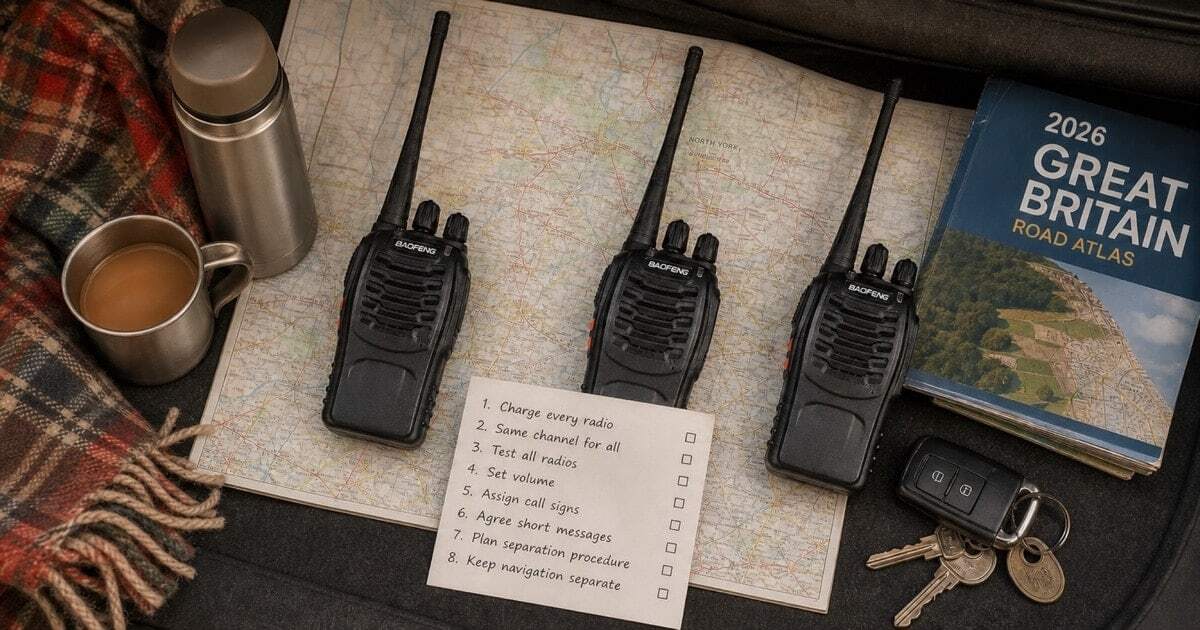 A five-minute pre-departure radio check in the car park can prevent a surprising amount of confusion on the road. Running through eight simple steps before setting off ensures every vehicle in the convoy is connected from the start.
 How to set up walkie talkies for a car convoy
A five-minute radio check in the car park can prevent a surprising amount of confusion later.
Before departure:
- Charge every radio fully
- Put every handset on the same channel
- Test transmission and reception between all vehicles
- Set a comfortable speaker volume
- Give each vehicle a simple call sign
- Agree on a few short messages
- Decide what happens if somebody loses radio contact
- Keep navigation and emergency arrangements separate from the radio system
🟢 Simple call signs work best: Lead, Car Two and Tail work perfectly well. Then keep messages simple: "Tail to Lead — we are through the junction." "Lead to convoy — next stop is the services." This is where walkie talkies genuinely earn their place in a convoy.
If you are using an appropriately licensed programmable Baofeng model, configure and test it before the journey. Baofeng UK provides a central Baofeng programming software and driver download page covering multiple radio models. Do not attempt to programme frequencies while driving.
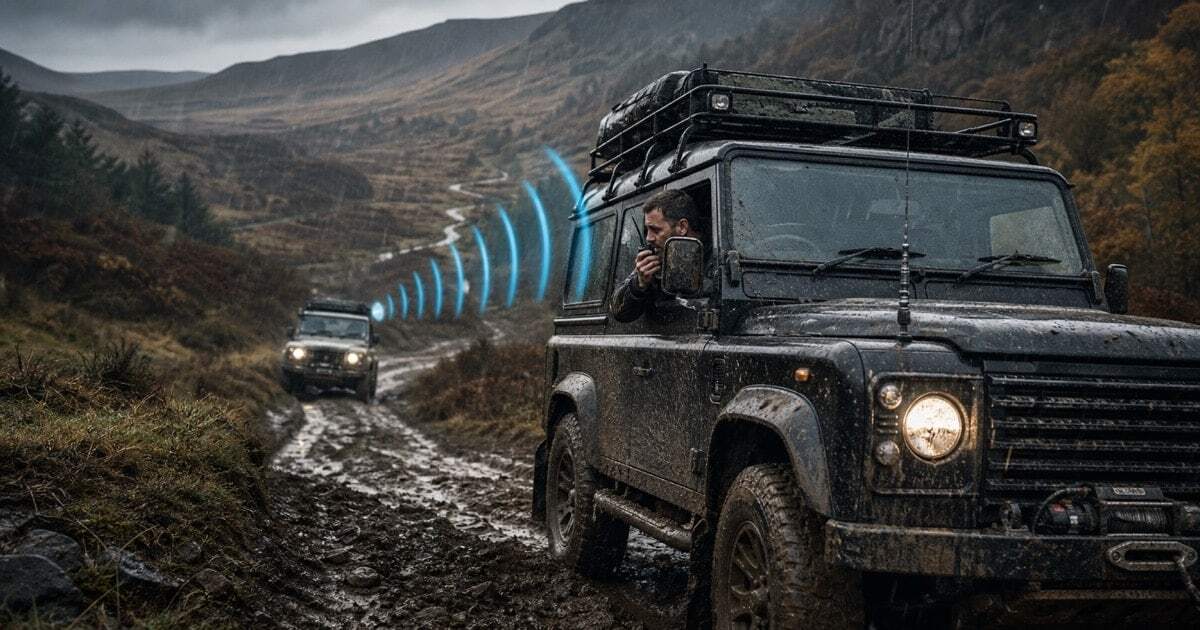 Off-road terrain creates all the same range challenges as a road convoy — and more. Valleys, dense woodland and hillsides affect performance in ways that extra wattage cannot overcome. Sensible group procedures matter more than headline power figures.
 What should a 4x4 or green-laning group consider?
Off-road groups face the same communication problems as road convoys, often with more difficult terrain. Vehicles can disappear around bends, drop behind hills or stop out of sight of the rest of the group.
That makes instant group communication valuable, but it also makes exaggerated range expectations dangerous. A radio signal does not magically pass through a hill because the handset advertises more transmitter power.
⚠️ Off-road groups: For casual groups using compliant PMR446 equipment, keeping reasonable spacing and having a clear regrouping procedure is more important than relying on an advertised maximum-distance figure. Groups with more specialised communication requirements should consider whether an appropriately licensed radio system is more suitable. The radio should support the group's safety procedure rather than become the safety procedure itself.
Shop road-trip walkie talkies
The four models below cover the main road-trip buyer types discussed in this guide — from simple licence-free options for family convoys to advanced licensed radios for experienced operators.
🚗 Baofeng Walkie Talkies for UK Road Trips & Convoys
Choose by group type and licence situation — not by headline wattage.
✅ Licence-Free PMR446 — Best for Most Family Road Trips & Convoys
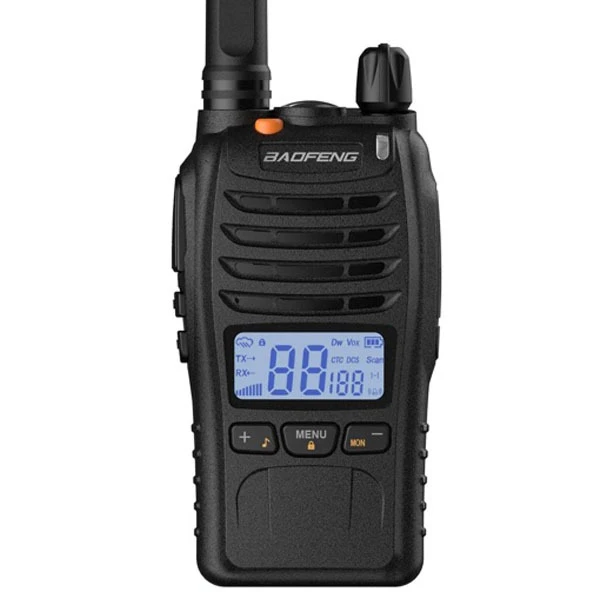
Baofeng BF-88ST Pro PMR446
PMR446 compliant · Pro upgraded features · Fixed antenna · No licence needed — the upgraded licence-free choice for road trips, offering simple push-to-talk communication that every family member can use from minute one.
View BF-88ST Pro PMR446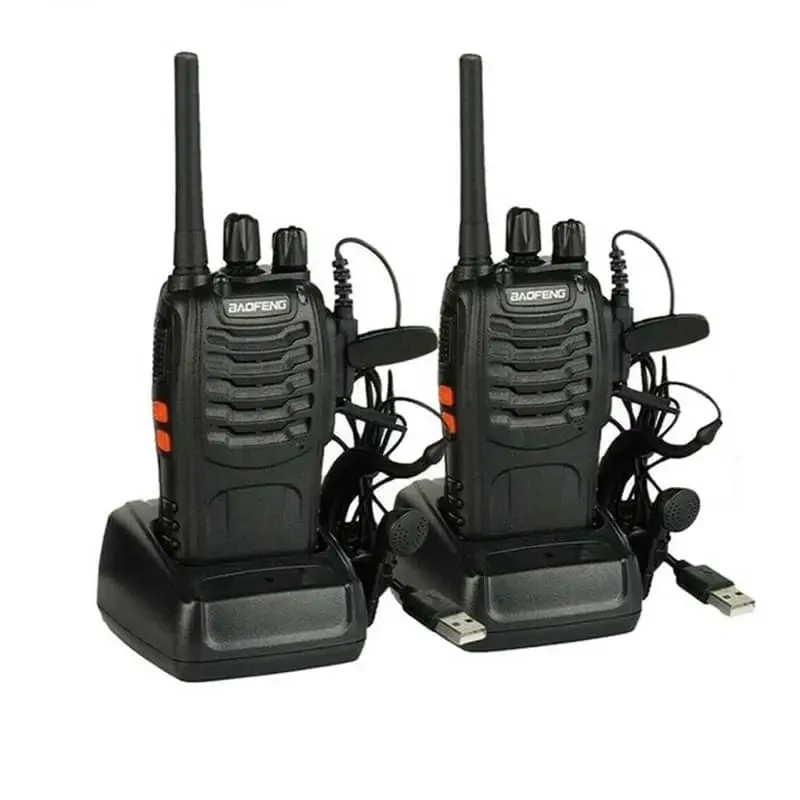
Baofeng BF-888S PMR446 Twin Pack
2 radios · Earpieces · Chargers · No licence needed — one per vehicle, matched and ready to use. The most straightforward licence-free solution for two-car convoys, family holidays and motorhome trips.
View Twin Pack📡 Licensed Radios — For Amateur Operators & Experienced Users
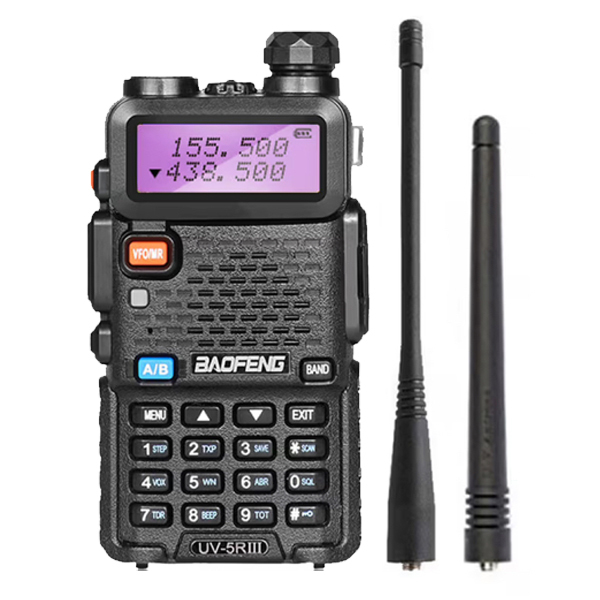
Baofeng UV-5R III Tri-Band
Tri-band VHF/UHF · Programmable · Compact — for licensed amateur radio operators travelling in convoy who want a programmable handset with more flexibility than a basic PMR446 model.
View UV-5R III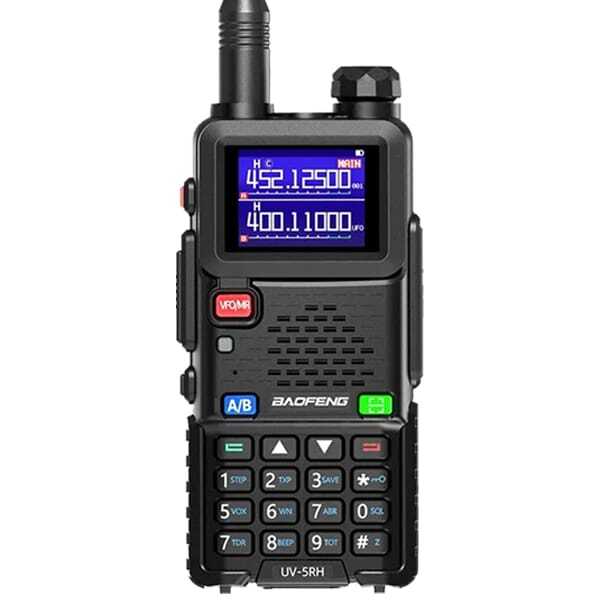
Baofeng UV-5RH
10W · 2500mAh · Multi-band · Airband receive — for experienced licensed operators on longer road trips who need higher output, all-day battery and more advanced radio features beyond PMR446.
View UV-5RH⚠️ PMR446 models are licence-free when fully compliant. UV-5R III and UV-5RH require an appropriate Ofcom Amateur Radio Licence to transmit legally in the UK.
PMR446 or a higher-power radio: which should you choose?
For most readers, the decision can be reduced to one question: do you need simple communication for ordinary users, or advanced radio functionality for appropriately licensed operators?
Choose PMR446 when:
- Radios will be shared between family members or friends
- You want uncomplicated licence-free operation
- Simple Push-to-Talk communication is enough
- You do not need amateur-radio features
Consider an amateur handheld radio when:
- The users hold the appropriate licence
- You understand the permitted frequencies and operating conditions
- Programming flexibility matters
- Amateur-radio functionality is genuinely part of your intended use
⚠️ Commercial fleets: For commercial fleets or organised business communications, investigate the appropriate business-radio options instead of assuming an amateur-radio licence covers business activity. If the terminology still feels confusing, read the licensed vs licence-free walkie talkie guide before choosing a radio.
Key takeaways
📋 Key takeaways for UK road-trip buyers
- For most UK family and leisure convoys, start with a compliant PMR446 radio
- Programming another handheld onto a PMR446 frequency does not automatically make the equipment PMR446-compliant
- Real car-to-car range depends heavily on terrain, vehicle bodywork, antenna design and line of sight
- Higher transmitter power does not guarantee better communication through hills and valleys
- Do not modify licence-free PMR446 equipment with an external antenna and assume its licence-exempt status remains unchanged
- Drivers should prioritise vehicle control and avoid operating a hand-held microphone while driving
- UV-5R III and UV-5RH models are more appropriate for users who understand and comply with the relevant licensing requirements
- The best road-trip radio is the one your group can use legally, understand quickly, keep charged and operate without distracting the driver
Frequently asked questions
What is the best walkie talkie for a UK road trip?
For most family road trips, motorhome holidays and casual car convoys, a compliant PMR446 model is the most practical choice. The BF-88ST Pro PMR446 and BF-888S PMR446 twin pack are both designed for straightforward licence-free operation — charge them, set the same channel across all vehicles and everyone can communicate immediately without studying radio licensing. For licensed amateur operators, the UV-5R III or UV-5RH offer more programming flexibility but require an appropriate Ofcom licence to transmit.
Can I use a walkie talkie while driving in the UK?
The UK Highway Code requires drivers to remain in proper control of their vehicle. Rule 149 advises drivers not to use a hand-held microphone while driving. For a convoy, the most practical arrangement is to make the radio the passenger's job. If you are the only person in the vehicle, stop somewhere safe before making a transmission. The radio should make the journey easier — not create another task for the driver.
Do I need a licence to use walkie talkies on a road trip in the UK?
Not if you use compliant PMR446 equipment. Compliant PMR446 handheld radios can be operated without an individual Ofcom licence when they meet all PMR446 technical requirements — including a fixed integral antenna, operation between 446.0 and 446.2 MHz and a maximum of 0.5W ERP. Programming another radio to a PMR446 frequency does not automatically make it licence-free. Higher-power programmable radios such as the UV-5R III and UV-5RH require an appropriate Amateur Radio Licence before transmitting.
How far do walkie talkies reach between cars?
There is no guaranteed distance. Real car-to-car range depends on terrain, hills, woodland, vehicle bodywork surrounding the handset, radio position inside the vehicle and local interference. A radio may perform well across open countryside but lose reliable communication when vehicles round a hill or enter dense woodland. Manufacturer maximum-range figures are typically based on ideal open-air conditions and should not be treated as reliable guides for a road trip through varied British terrain.
Can I fit an external antenna to my PMR446 walkie talkie to improve car-to-car range?
No — not while assuming the radio remains licence-free. An integral antenna forms part of the PMR446 technical requirements for licence-exempt operation. Modifying a compliant PMR446 handset to accept an external antenna is likely to place the equipment outside the PMR446 licence-exemption conditions. If you genuinely need vehicle antenna installations, investigate an appropriately licensed radio system rather than modifying a PMR446 handset.
What walkie talkies are best for a 4x4 or green-laning convoy?
For casual off-road groups, compliant PMR446 equipment is usually the most practical starting point — and organisation matters more than chasing extreme range. Keep vehicles within reasonable sight of each other and agree on a regrouping procedure before entering difficult terrain. Groups with more specialised requirements, such as large estates or challenging hills, should consider whether an appropriately licensed radio system is more suitable. A radio should support the group's safety procedure — not replace it.
Find the Right Radio for Your UK Road Trip
From simple PMR446 twin packs for two-car family convoys to licensed advanced handsets for experienced operators — Baofeng UK has the right walkie talkie for every road trip, convoy and 4x4 group.
Browse Licence-Free PMR446 Radios