
15th Sep 2026
Best Two Way Radios for Industrial Use: A Practical UK Guide
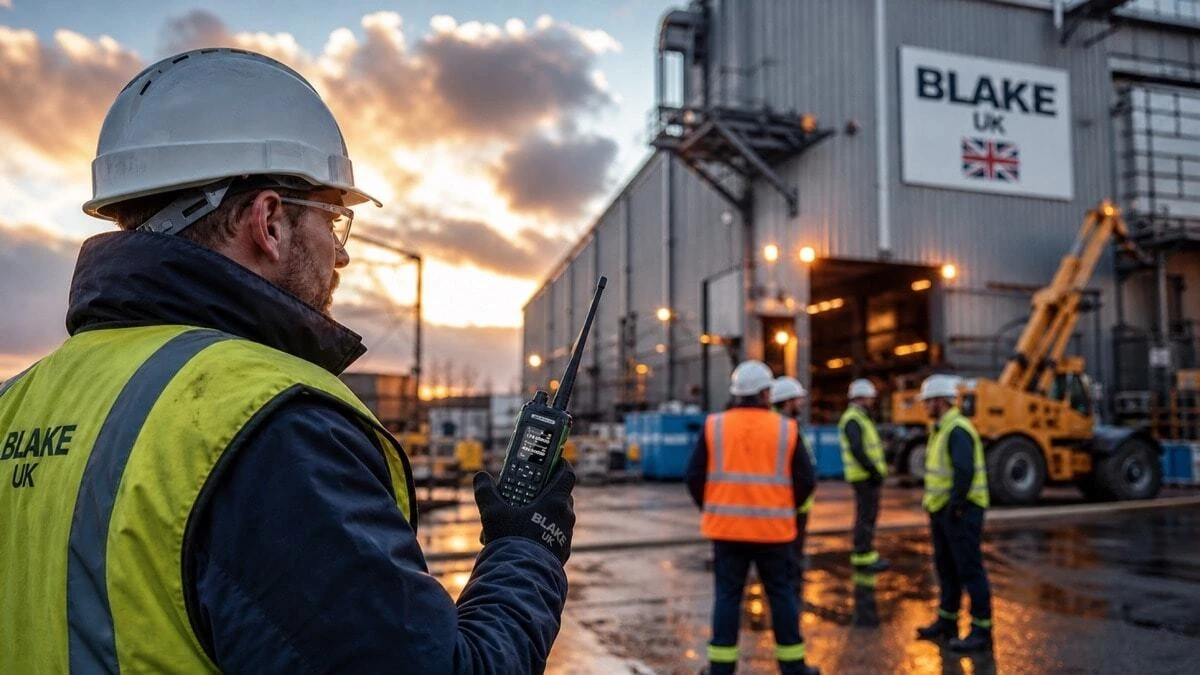
This guide was written and reviewed by the Baofeng UK technical team — UK-based radio communications specialists with over 10 years of experience supplying factories, warehouses, logistics operations and industrial sites with reliable two-way radio equipment. Licensing information reflects current Ofcom guidance. HSE references are consistent with current Health and Safety Executive guidance for industrial workplaces and lone workers.
Reliable communication is essential in factories, warehouses, construction sites, utilities, logistics yards and other industrial environments.
When teams are spread across large sites, moving between indoor and outdoor areas or working around heavy machinery, mobile phones can be slow or unreliable. A push to talk radio gives staff instant communication without waiting for a call to connect or relying on mobile coverage.
Choosing the best two way radios for industrial use therefore requires more than comparing headline range. Industrial radio users need dependable audio, long battery life, durable housings, practical charging options and a communication system suited to the layout of the site. UK businesses also need to understand when licence-free radios are sufficient and when a licensed radio system offers greater flexibility.
This guide explains the main features to consider and highlights Baofeng options for different industrial priorities. Businesses comparing a wider selection can also explore Baofeng's walkie talkies and handheld two-way radios.
Rugged outdoor and mixed sites: UV-16 Pro V2 IP68 — waterproof, durable, USB-C charging. Licensed radio — appropriate Ofcom authorisation required.
Long shifts and remote work: AR-152 Pro GPS — 12000mAh battery, GPS, multiple charging methods. Licensed radio.
Advanced digital communication: DM-32 DMR — GPS, APRS, digital messaging, 10W. Licensed radio.
Smaller teams, licence-free simplicity: BF-888S PMR446 — no individual Ofcom licence required, 16 pre-programmed channels.
⚡ Two way radios for industrial use — key points
- 🌧️ Match the IP rating to the site: Wet, dusty or outdoor sites need IP-rated protection — check the specific declared rating, not just a general "rugged" claim
- 🔋 Battery must cover the full shift: Plan charging routines alongside capacity — a 12000mAh battery like the AR-152 Pro GPS suits teams away from fixed charging points
- 🎧 Audio accessories matter: Speaker microphones and earpieces improve usability in high-noise industrial environments
- ✅ PMR446 for smaller sites: Compliant licence-free equipment avoids individual Ofcom licensing for short-range industrial communication
- 📋 Licensed radios for larger operations: Ofcom Business Radio licences provide greater frequency control for complex industrial sites
- 📲 Digital adds structure and GPS: DMR systems with GPS can support supervision of dispersed teams and lone workers
- 👷 HSE lone worker guidance: Industrial employers must have defined arrangements for keeping in contact with isolated workers
📋 Table of Contents
- Why industrial radio requirements are different
- Durability and IP ratings
- Long battery life for long shifts
- Clear audio in noisy environments
- Range, coverage and radio interference
- Digital radios for more advanced communication
- Licence-free or licensed radios?
- Which Baofeng radio fits each industrial priority?
- Recommended industrial two way radios
- Planning coverage across a manufacturing plant or large site
- Battery management matters as much as capacity
- Safety features and lone worker communication
- Choosing the best two way radios for industrial use
- Frequently asked questions
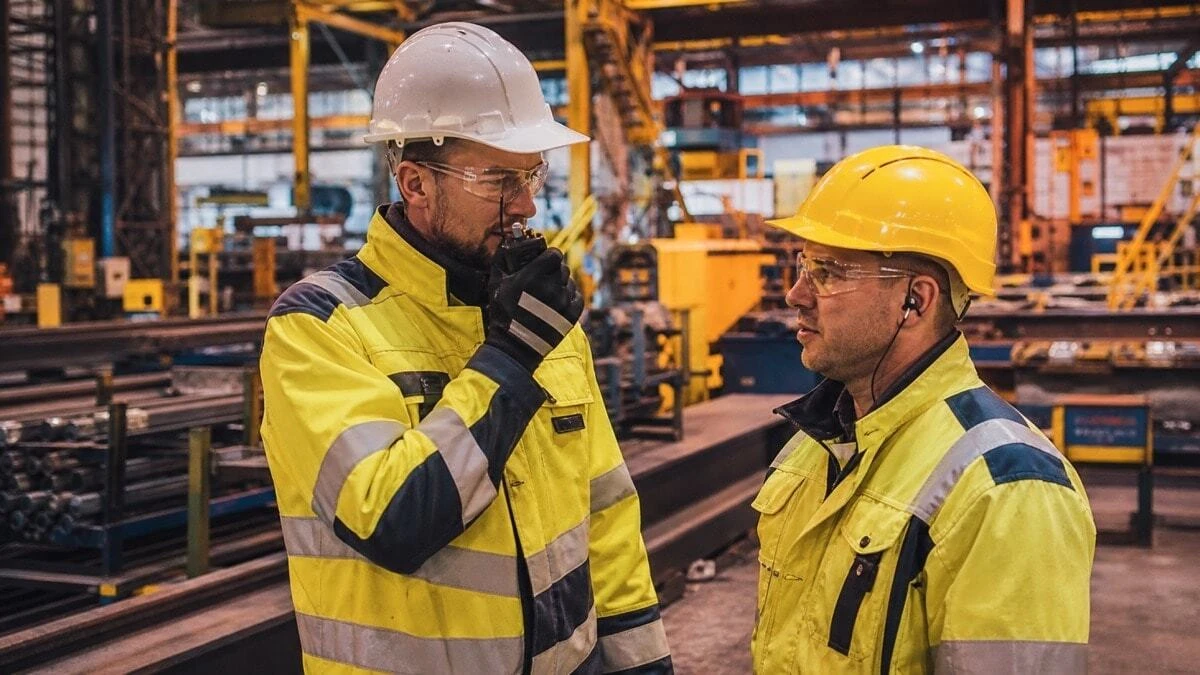 Industrial environments place greater demands on two-way radios than ordinary leisure use — radios may be carried continuously through a manufacturing plant, exposed to dust or rain, and operated around heavy machinery across a full shift.
 Why industrial radio requirements are different
Industrial environments place greater demands on handheld radios than ordinary leisure use. A radio may be carried through a manufacturing plant, clipped to workwear on a job site, exposed to dust or rain and operated continuously across a full shift. It may also need to remain understandable over machinery, vehicle movement and general background noise.
Robust construction, clear audio and simple controls are therefore important. Staff should be able to reach the correct channel quickly, hear instructions clearly and operate the radio while wearing gloves or protective equipment. In busy operations, reliable two way radios can support coordination between supervisors, maintenance teams, warehouse staff, security personnel and lone workers.
🔵 HSE lone worker guidance: HSE guidance recognises the importance of effective communication for lone workers. Regular contact may be maintained through phones, radios and other systems, with the exact arrangements determined by the workplace risk assessment.
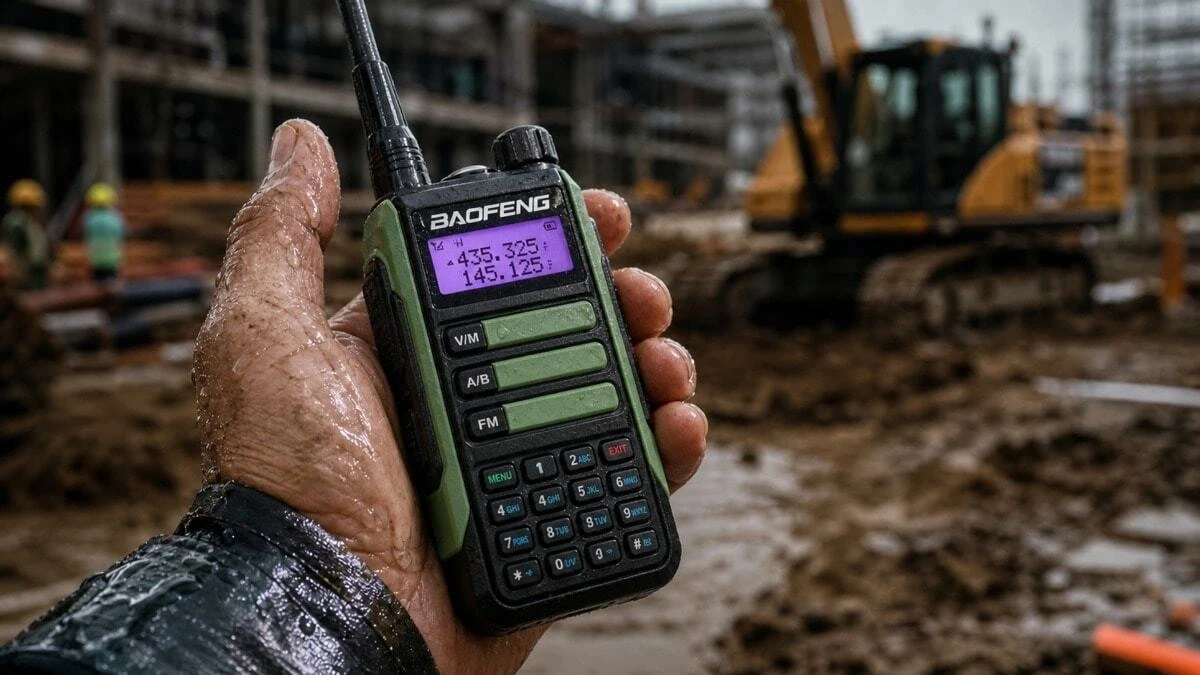 An IP rating gives useful information about protection against solids and liquids, but buyers should always check the specific declared rating and operating limits for each radio. A higher number does not automatically mean unlimited protection in all industrial conditions.
 Durability and IP ratings
The physical environment should be one of the first factors considered. Industrial radios may encounter water, dust, mud, knocks and repeated daily handling. An IP rating gives useful information about protection against solids and water, although buyers should always check the stated rating and operating limits for the specific radio. For a detailed explanation of what IP ratings mean, see the guide to walkie talkie IP ratings.
For wet, dusty or outdoor job sites, the Baofeng UV-16 Pro V2 is designed around demanding use. It carries an IP68 rating and uses a durable housing intended to resist water, dust and everyday impacts. It also supports USB-C charging. That combination makes it suitable for construction, warehouse logistics, events and other operations where equipment regularly moves between different environments.
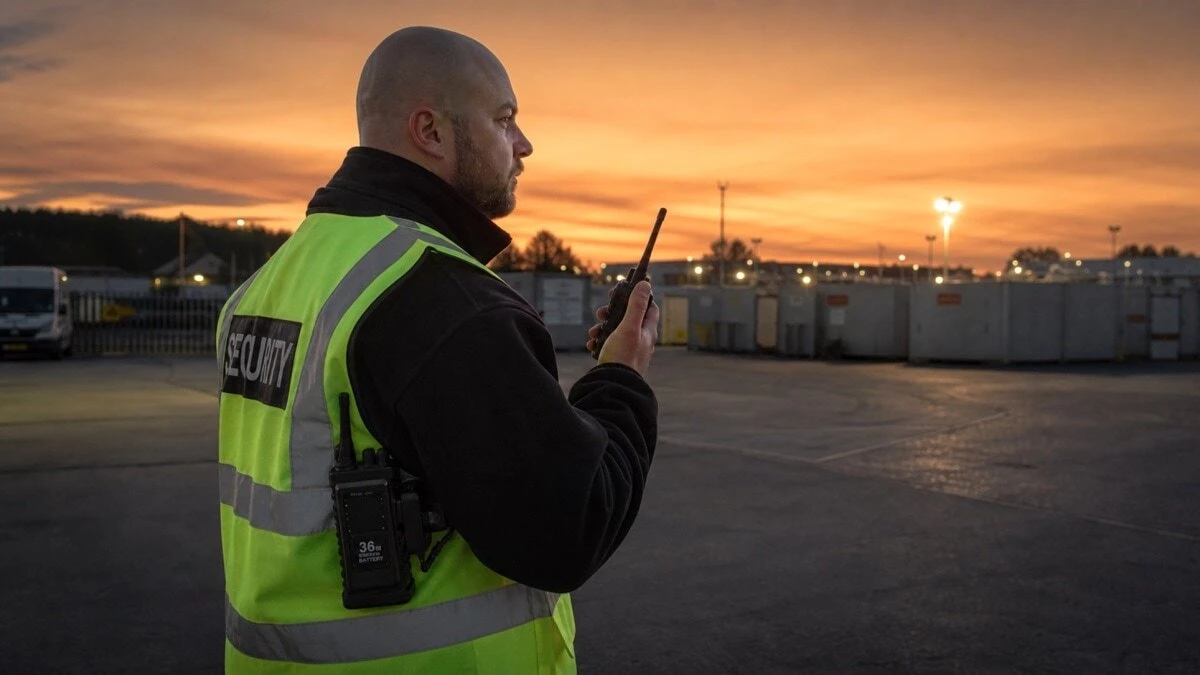 Battery capacity is only part of the picture for industrial teams — the charging routine, spare battery availability and shift handover process all determine whether radios are actually available when workers need them.
 Long battery life for long shifts
Long battery life is especially important for industrial teams. A radio that needs charging halfway through a shift can create gaps in communication and add unnecessary equipment management. Battery capacity, transmit time, standby time, power settings, temperature and how frequently the radio is used all influence real-world endurance.
For teams working long shifts or operating away from fixed charging points, extended battery life should be treated as a core specification. The Baofeng AR-152 Pro GPS uses a 12000mAh battery and supports several charging methods, making it a strong option where operating time is a priority. It also includes GPS functionality for field use.
🎯 Expert note: A larger battery can be useful for outdoor patrols, utility work, remote maintenance and outdoor operations. For fixed manufacturing or warehouse teams, a smaller battery may still provide all-day battery life if charging docks and spare batteries are managed properly between shifts.
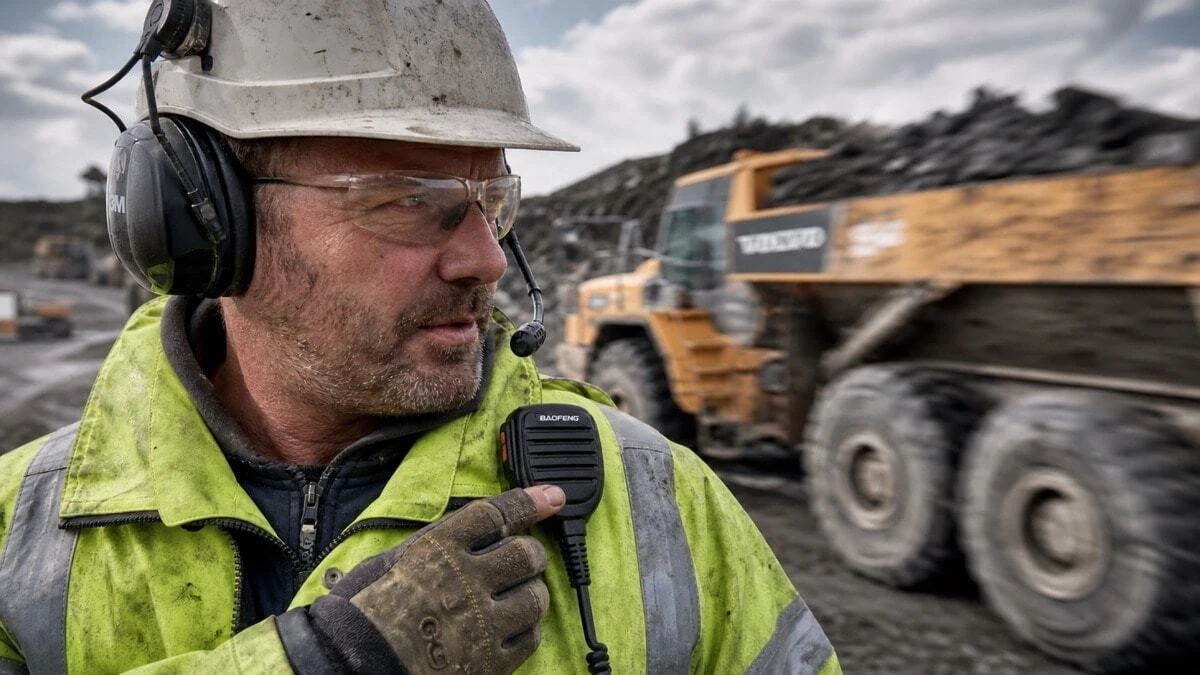 A speaker microphone keeps the radio secured to a belt while the microphone remains closer to the user's mouth — a practical improvement in high-noise industrial environments where holding the radio up to speak is impractical around machinery.
 Clear audio in noisy environments
Industrial communication depends on intelligibility. High volume alone does not guarantee clear communication. Speaker quality, microphone position, radio settings and surrounding noise all affect whether a message is understood. Factories and construction sites can have substantial background noise. HSE notes that workplace noise can interfere with conversation and warning signals, so radio communication should be planned alongside the wider safety system.
In noisy environments, a speaker microphone or earpiece may improve day-to-day usability by placing the microphone or audio output closer to the user.
⚠️ Hearing protection: Where hearing protection is required, radio accessories should be assessed alongside the site's hearing protection procedures. HSE specifically warns that excessive hearing protection can make communication and warning signals harder to hear. The aim is clear communication without compromising the worker's ability to hear important warning signals.
Range, coverage and radio interference
Maximum range figures are useful for comparison, but they should never be treated as guaranteed site coverage. Radio signals are affected by walls, reinforced concrete, metal shelving, plant, terrain, antenna position and radio interference. A manufacturing plant with dense machinery can behave very differently from an open yard, even when the straight-line distance is shorter.
For large sites, plan around coverage zones. Identify control rooms, loading areas, workshops, stairwells, basements, external yards and known weak points, then test the intended radios during normal operating hours. Higher-power licensed radios can provide greater range and flexibility than basic unlicensed radios in many professional settings. Baofeng's long-range two-way radio range is a useful starting point for teams comparing higher-power handheld options for demanding coverage requirements.
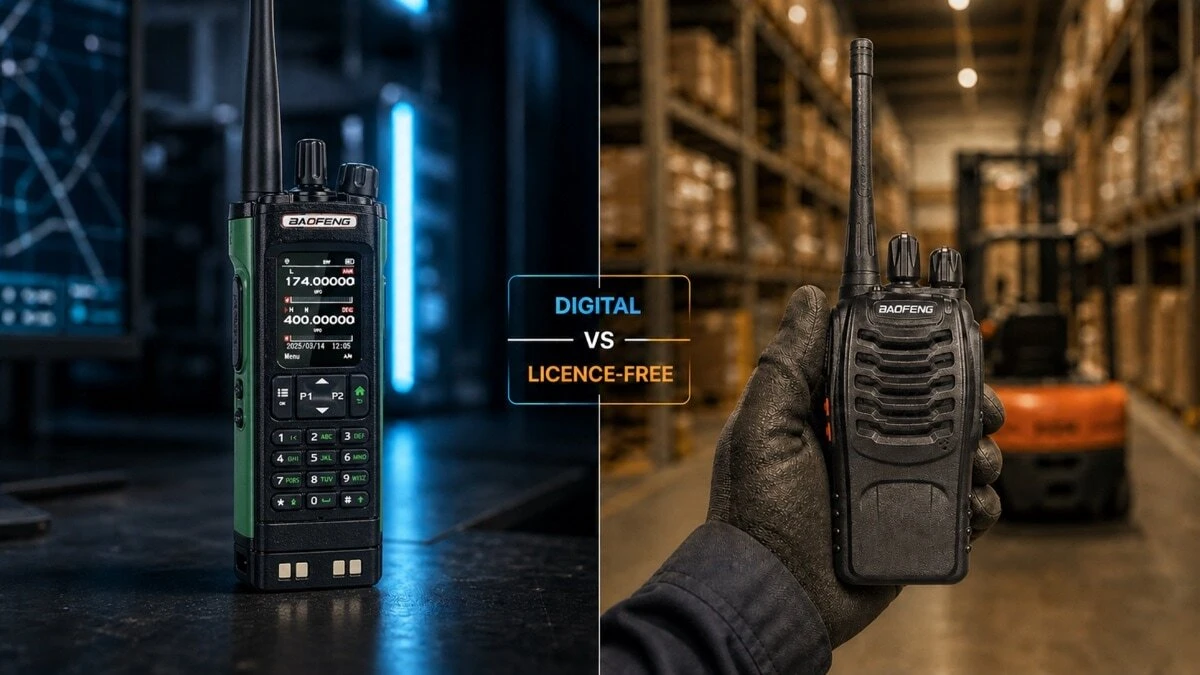 Analogue PMR446 licence-free radios suit smaller industrial operations with straightforward coverage needs. Digital DMR systems add GPS, talk groups, messaging and structured user management for larger or more complex industrial environments.
 Digital radios for more advanced communication
Digital radios can suit businesses that want a more feature-rich communication system. Depending on the model and configuration, digital operation can support structured user groups, location functions and clearer voice performance near the edge of usable coverage.
The Baofeng DM-32 digital radio is a 10W DMR digital radio that supports both digital and analogue operation. It also includes GPS and APRS-related location functions and USB Type-C charging. This can suit professional radio users who want digital capabilities while retaining analogue compatibility where required. Businesses considering this type of system can also browse the wider Baofeng digital radio collection.
Licence-free or licensed radios?
UK businesses can use compliant PMR446 equipment without obtaining an individual radio licence. Ofcom describes PMR446 as a mobile, short-range, peer-to-peer communication system operating under licence-exempt conditions. This can be cost effective for smaller businesses, compact warehouses and sites where modest coverage is sufficient.
The Baofeng BF-888S PMR446 range is designed for straightforward deployment. The PMR446 version is pre-programmed for licence-free UK use, has a fixed antenna, provides 16 channels and uses a 1500mAh battery. It is a practical choice for teams that want simple business radios without an Ofcom Business Radio Licence.
⚠️ Higher-power radios require licensing: Higher-power programmable radios are different. Ofcom states that business radio systems generally require a Business Radio licence, with options including Light licences and technically assigned licences. The licensing position should be confirmed before purchase and programming. Read the full guide on whether you need a licence for a walkie talkie in the UK before deploying any licensed radio system on an industrial site.
Which Baofeng radio fits each industrial priority?
For rugged outdoor or mixed indoor and outdoor work, the UV-16 Pro V2 is one of the strongest options in the range. Its IP68 protection, 10W output, USB-C charging and durable construction suit tough conditions where water protection and physical resilience matter.
For long shifts and remote work, the AR-152 Pro GPS stands out because of its 12000mAh battery. Teams that spend extended periods away from charging facilities can prioritise battery endurance while also gaining GPS-related functions.
For organisations moving towards digital radio systems, the DM-32 provides DMR capability, GPS functions and analogue compatibility in one handheld radio. It suits users who need advanced features and a more structured communication system.
For smaller teams that prefer licence-free simplicity, the BF-888S PMR446 offers a cost-effective entry point. It works best where the site is compact enough for PMR446 coverage and the communication requirement is straightforward.
Recommended industrial two way radios
The five models below cover the main industrial priorities discussed in this guide — from rugged IP68 protection and extreme battery life to digital GPS communication and licence-free team deployment.
🏭 Baofeng Two Way Radios for UK Industrial Use
Choose by environment, shift length and licence situation — not by headline wattage alone.
🏭 Rugged, Long Battery & Digital — Core Industrial Radio Options
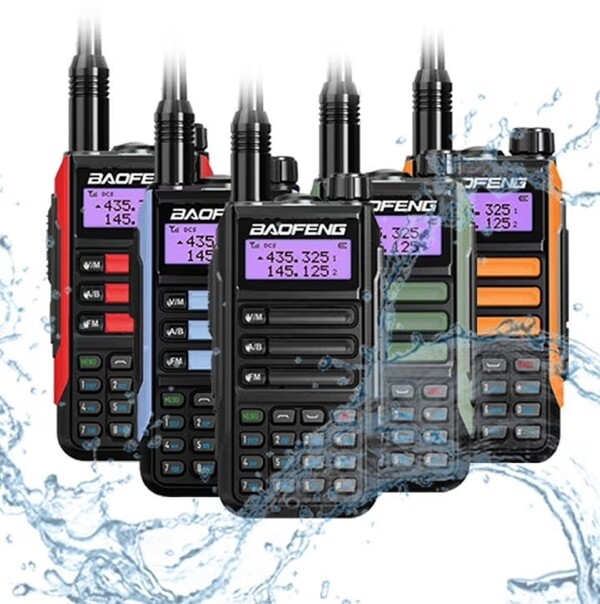
Baofeng UV-16 Pro V2
IP68 waterproof · 10W · 1800mAh · USB-C · Dual-band — for outdoor, mixed and physically demanding industrial sites requiring maximum weather and dust protection. Licensed radio — appropriate Ofcom authorisation required.
View UV-16 Pro V2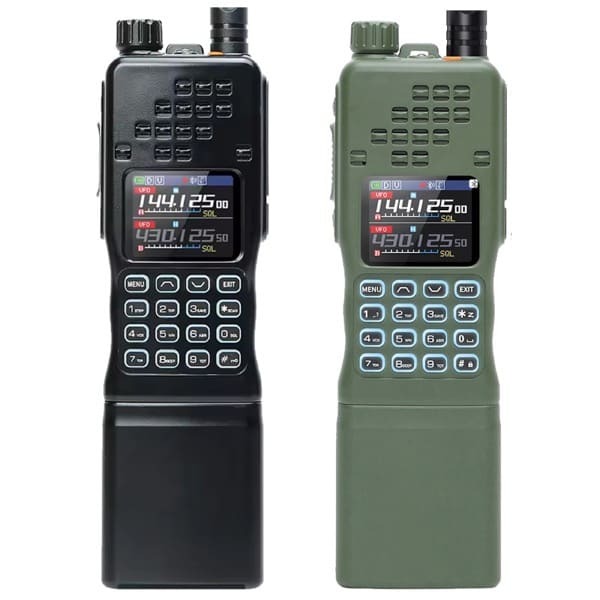
Baofeng AR-152 Pro GPS
12000mAh · GPS · 10W · Multiple charging methods — for utility teams, remote maintenance and extended field operations where standard battery life is insufficient. Licensed radio — appropriate Ofcom authorisation required.
View AR-152 Pro GPS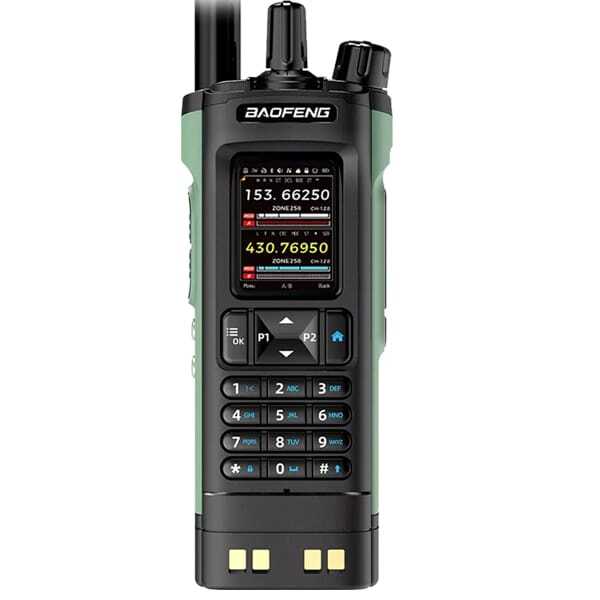
Baofeng DM-32 DMR
Digital DMR · GPS · APRS · 10W · 2500mAh · USB-C — for industrial operations requiring talk groups, GPS location, digital messaging and analogue compatibility. Licensed radio — appropriate Ofcom authorisation required.
View DM-32 DMR✅ Licence-Free PMR446 — For Smaller Industrial Teams & Compact Sites
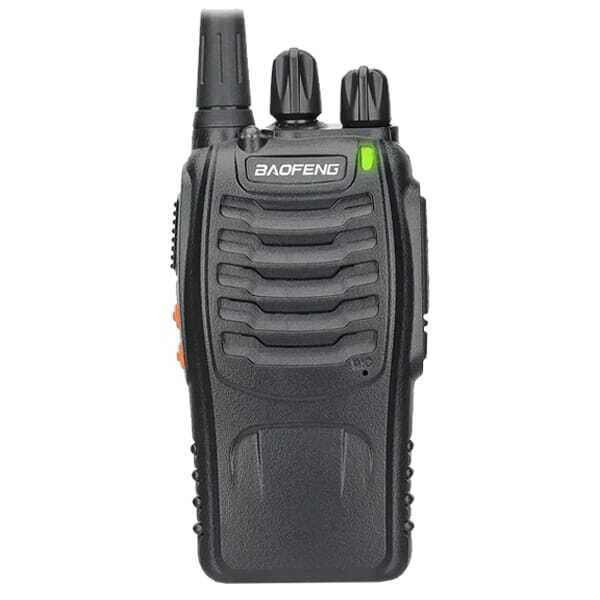
Baofeng BF-888S PMR446
PMR446 compliant · 16 channels · 1500mAh · Fixed antenna · Earpieces included · No licence needed — cost-effective push-to-talk for smaller industrial teams where compact site coverage is sufficient and simple deployment is the priority.
View BF-888S PMR446
Baofeng BF-888S PMR446 Eight-Pack
8 radios · Earpieces · Chargers · No licence needed — equip a complete industrial shift covering supervisors, maintenance, logistics and warehouse roles with standardised licence-free radios ready for shift handover.
View Eight-Pack⚠️ BF-888S PMR446 and Eight-Pack are licence-free when equipment is fully compliant. UV-16 Pro V2, AR-152 Pro GPS and DM-32 require an appropriate Ofcom licence to transmit legally in the UK.
Planning coverage across a manufacturing plant or large site
Before ordering radios in volume, map how communication actually happens during a normal shift. A site manager may need to contact maintenance, security may need a separate channel, and loading teams may need rapid coordination with warehouse staff. If every conversation uses one channel, radio traffic can become crowded quickly.
Identify user groups and the places where communication is most critical. Test radios when machinery, vehicles and other sources of interference are active. Open areas often provide greater range than enclosed industrial buildings, so testing should include difficult indoor locations as well as the site perimeter. For large sites, consider whether several channels, licensed frequencies or repeaters are required. Radios should be programmed consistently, labelled clearly and supported by a simple channel plan.
Battery management matters as much as capacity
A radio with excellent battery life can still fail operationally if charging is poorly organised. Industrial teams should have a clear charging routine, especially where equipment is shared across shifts. Radios should begin each shift with a known charge level. High-use teams can keep spare batteries or spare charged radios available, while multi-unit charging equipment can reduce the number of individual chargers needed.
For replacement batteries, chargers, speaker microphones, earpieces, protective accessories and programming accessories, Baofeng's walkie talkie accessories collection can help standardise the complete radio setup around the chosen handset.
 For lone workers on large industrial sites, a radio with GPS location and emergency alarm functions supports the employer's duty to maintain regular contact. The radio should form part of a defined procedure — not act as a standalone safety system.
 Safety features and lone worker communication
Two way radios can support safety procedures by giving workers a fast route to supervisors or colleagues. Emergency alerts, GPS-related location features, easy-access push to talk controls and dedicated channels may all be valuable, depending on the job.
For lone workers, the radio should form part of a defined communication procedure. HSE guidance recommends clear arrangements for keeping in touch, with supervision based on risk. That may include pre-agreed contact intervals, radios or phones, alarm systems and checks that the worker has completed the task safely.
🎯 System, not just equipment: Industrial teams should therefore evaluate the process around the handset. Staff need to know who monitors the channel, how emergency calls are handled, what happens when there is no response and what backup communication method is available. Read the UK walkie talkie licence guide to understand which radio type requires an Ofcom licence before deploying any industrial radio system.
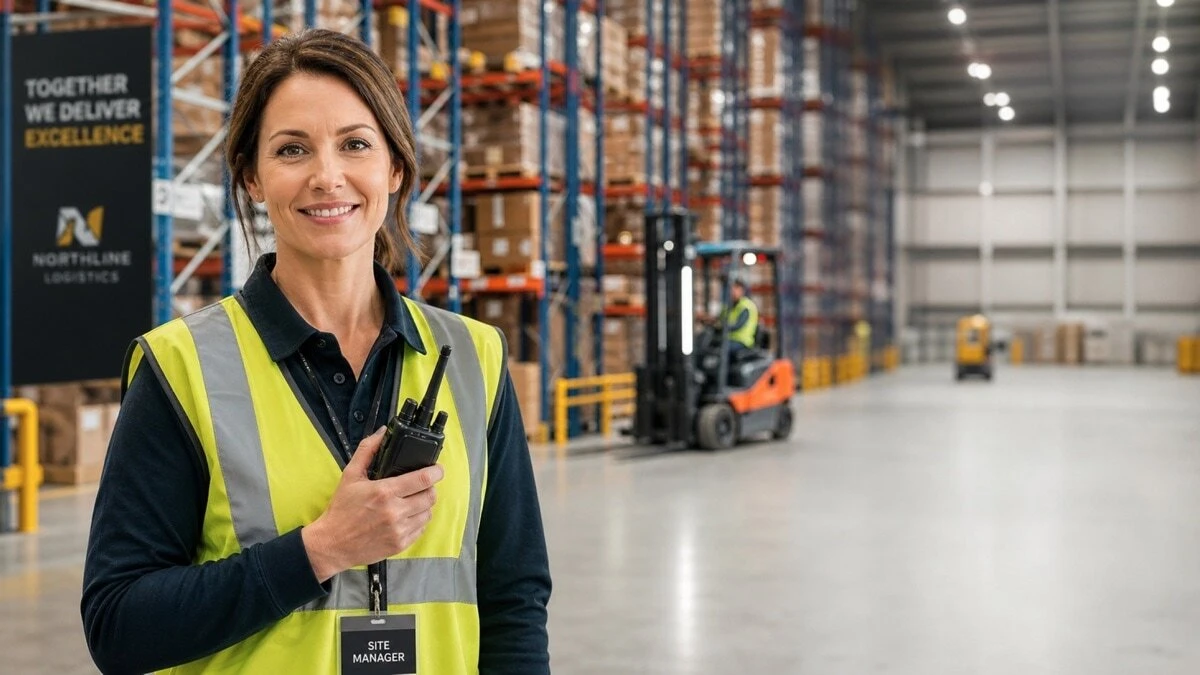 The best industrial radio system starts with the site, not the specification sheet. Test coverage where workers actually operate, match the IP rating to real conditions, plan battery routines around shift patterns and confirm the correct UK licensing position before deployment.
 Choosing the best two way radios for industrial use
The best two way radios for industrial use should match the working environment, staffing pattern and coverage requirement. For most businesses, the priorities are robust construction, clear communication, dependable range, long battery life and controls that employees can use quickly.
Rugged IP-rated radios make sense for wet, dusty or physically demanding sites. High-capacity batteries help teams working long shifts. Digital radios can support more advanced communication requirements, while PMR446 handsets provide a simple licence-free option for smaller operations.
📋 Key takeaways for UK industrial buyers
- Test coverage in the real workplace before committing to a fleet — machinery, concrete and metal structures all affect radio performance differently from open ground
- Match the IP rating to actual site conditions — IP68 protection suits outdoor and mixed environments, while a simpler rating may be sufficient for dry indoor sites
- Battery planning, charging routines and shift handover procedures matter as much as the mAh figure on the product page
- PMR446 licence-free radios suit smaller operations where compact coverage is sufficient — no individual Ofcom licence required for compliant equipment
- Higher-power radios require an appropriate Ofcom Business Radio licence before transmitting — confirm licensing before purchase and programming
- Digital systems add GPS, talk groups and structured communication for larger industrial operations where analogue push-to-talk reaches its limits
- Accessories — speaker microphones, earpieces, chargers and protective pouches — complete the radio system and should be planned alongside the handset
Frequently asked questions about industrial two way radios
How many two way radios does an industrial team need?
Most teams need at least one radio for every employee who must communicate independently during a shift. It is also sensible to keep one or two spare handsets available for shift changes, visitors or unexpected battery issues. The best approach is to map the roles that genuinely need immediate radio access, then add spare capacity for critical positions rather than issuing one radio per person by default.
Should industrial radios use separate channels for different teams?
Yes, separate channels can make communication more efficient on busy sites. Maintenance, security, warehouse and supervisory teams can use dedicated channels while keeping an agreed channel available for site-wide coordination when necessary. A simple written channel plan and regular staff training help ensure everyone knows where to communicate and what to do during an incident.
How often should industrial two way radios be replaced?
There is no fixed replacement schedule, but radios should be reviewed when battery performance, audio quality or physical condition begins to affect reliability. Regular checks can help identify worn batteries, damaged antennas or accessories before they disrupt day-to-day communication. Battery condition should be monitored because rechargeable batteries gradually lose capacity over time, particularly in demanding industrial environments.
Do industrial businesses need an Ofcom licence for two way radios?
It depends on the radio. Compliant PMR446 handheld radios can be operated without an individual Ofcom licence when the equipment meets all PMR446 technical requirements — including a fixed integral antenna, operation between 446.0 and 446.2 MHz and a maximum of 0.5W ERP. Higher-power programmable radios require an appropriate Ofcom Business Radio licence before transmitting legally in the UK. Confirm the licensing position for the specific equipment before purchase or programming.
What IP rating do industrial radios need?
The required IP rating depends on the working environment. For dry indoor sites such as offices or controlled manufacturing areas, a basic rating may be sufficient. For outdoor groundwork, wet construction environments or dusty sites, IP67 or IP68 protection provides substantially better resistance. IP68 means the radio has been tested against full water immersion under specified conditions — buyers should check the manufacturer's exact declared test conditions rather than assuming the same performance across all IP68 products.
Can two way radios support lone worker safety on industrial sites?
Yes. The Health and Safety Executive identifies radios as one method employers can use for maintaining regular contact with lone and isolated workers. However, a radio alone does not constitute a complete lone worker safety system — employers still need appropriate risk assessment, agreed check-in procedures, monitoring arrangements and emergency response plans. The radio communication should integrate with the wider safety process so that every worker understands when to call, which channel to use and what happens if they do not respond.
Find the Right Radios for Your Industrial Operation
From IP68 waterproof handsets for outdoor sites to extreme-battery models for long shifts and digital GPS systems for large industrial operations — Baofeng UK has the right two-way radio for every industrial environment and budget.