
17th Aug 2026
Walkie Talkies vs Mobile Phones: When Radios Are Still the Better Choice
This guide was written and reviewed by the Baofeng UK team — UK-based radio communications specialists with over 10 years of experience helping businesses, outdoor groups and individuals choose the right communication tool. Licensing information reflects current Ofcom guidance on PMR446 and UK radio use.
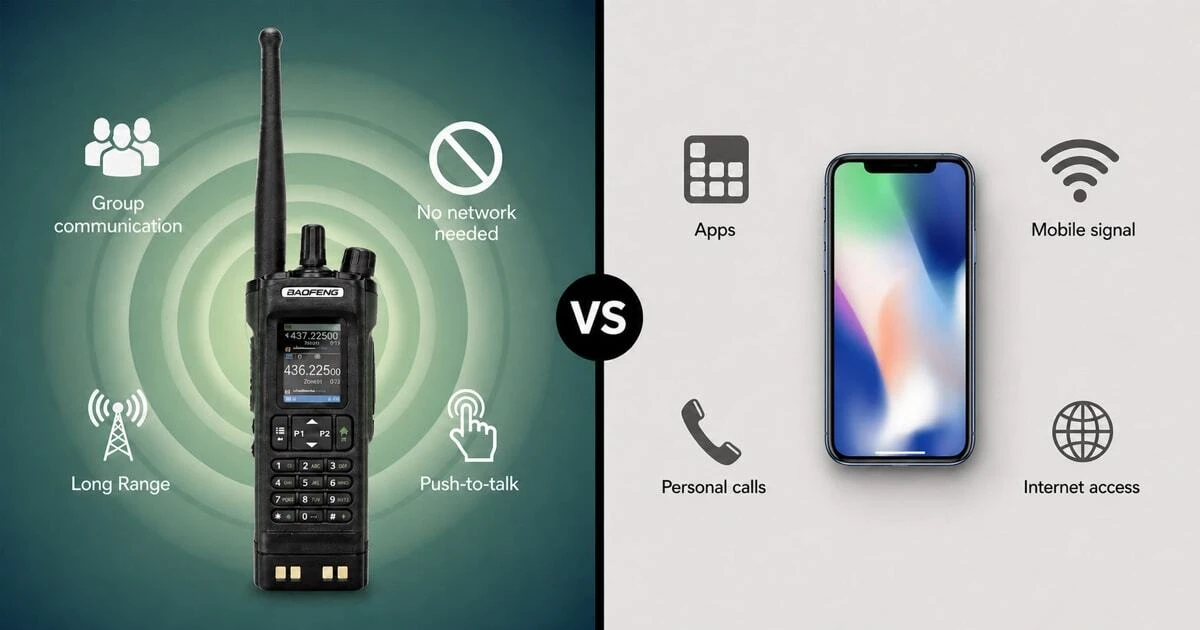
Walkie talkies are still the better choice when you need instant group communication, reliable contact without mobile coverage, longer battery life, or simple push-to-talk communication.
Mobile phones are better for personal communication, internet access and long-distance contact, but they depend on networks, charging and individual connections.
For many UK users — from outdoor groups to security teams and small businesses — the question is not whether walkie talkies or mobile phones are better. It is whether you need a device designed for conversation or one designed for everything.
Choose a walkie talkie when: You need instant group communication · No mobile signal available · Long battery life matters · Simple push-to-talk is enough
Choose a mobile phone when: You need internet access · Private conversations · Apps and navigation · Personal everyday communication
⚡ Key points at a glance
- 📻 Radios excel at group communication: One press reaches the whole team — no dialling, no waiting, no missed calls
- 📶 No signal? No problem: Walkie talkies communicate directly, radio-to-radio, without a mobile network
- 🔋 Battery advantage: Radios are designed for communication only — not GPS, apps and notifications
- 📱 Phones win for personal use: Internet, private calls, navigation and apps are better on a smartphone
- ⚖️ Licensing matters: Not every radio is licence-free — PMR446 radios are the main UK licence-free option
- ✅ Best answer for most teams: Use both — a phone for personal communication, a radio for teamwork
📋 Table of Contents
- Why compare walkie talkies and mobile phones?
- Walkie talkie vs mobile phone: key differences
- When walkie talkies are still the better choice
- When mobile phones are the better option
- Are walkie talkies cheaper than mobile phones?
- Walkie talkies vs mobile phones for different users
- Recommended radios for UK teams
- UK licence considerations
- Which should you choose?
- Final thoughts
- Frequently asked questions
Why compare walkie talkies and mobile phones?
Mobile phones have become the default communication tool for most people. They combine calling, messaging, navigation, cameras and internet access into one device.
So why do walkie talkies still exist? Because some situations require communication that is:
- Instant
- Shared with multiple people at once
- Simple to operate
- Independent from mobile networks
- Available throughout a working day without constant charging
🔵 The key distinction: A smartphone is a powerful personal device. A walkie talkie is a dedicated communication tool. That difference matters when your priority is fast, reliable, group communication rather than personal connectivity.
Walkie talkie vs mobile phone: key differences
| Feature | Walkie Talkie | Mobile Phone |
|---|---|---|
| Communication style | Push-to-talk radio | Calls, messages and apps |
| Group communication | Multiple users can communicate quickly | Usually requires calls/groups/apps |
| Mobile signal required | No — radio-to-radio communication | Yes — for calls and data |
| Battery usage | Designed for communication | Many background functions consume power |
| Setup | Simple channel-based communication | Accounts, apps and networks required |
| Best use | Teams, outdoor groups, workplaces | Personal communication |
When walkie talkies are still the better choice
Radios communicate directly — no mobile network needed. Ideal for remote countryside, farms, construction sites and outdoor events.
One press reaches the whole team simultaneously. No dialling, no waiting — faster than any phone call for group coordination.
Radios are designed for communication only. No GPS, apps or notifications draining power during long shifts or outdoor trips.
A radio is focused on one task. No social notifications, no app alerts — just reliable, focused team communication.
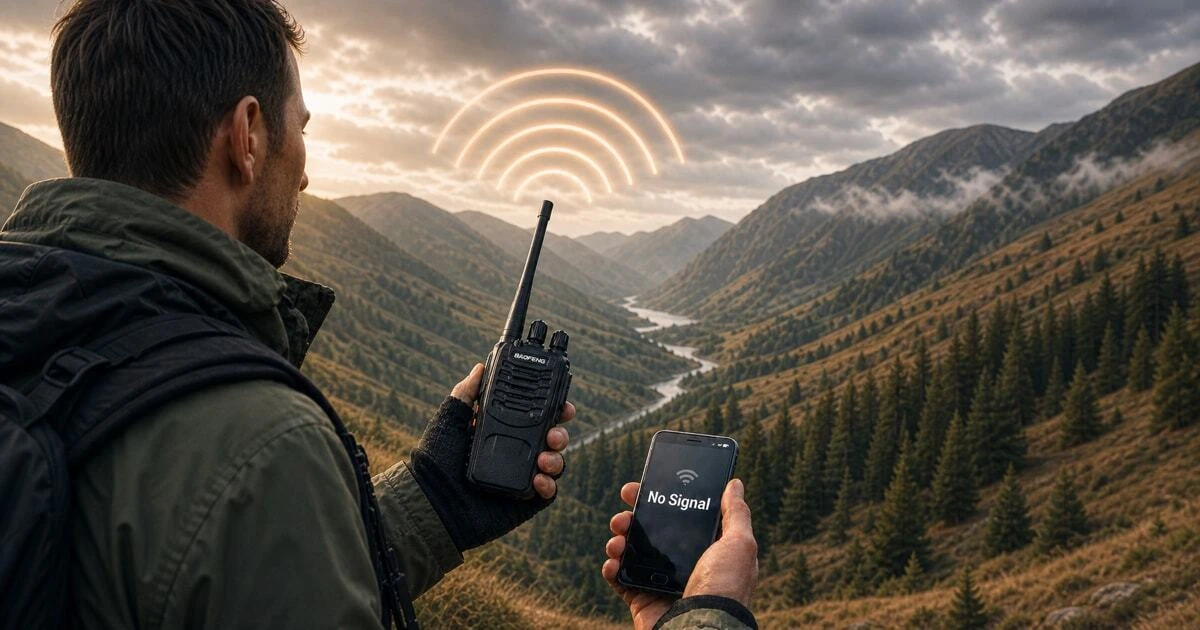 When mobile coverage fails in rural UK terrain, a walkie-talkie continues to work — communicating directly between radios without relying on any network infrastructure.
 1. When mobile signal is weak or unavailable
One of the biggest advantages of walkie talkies is that they do not rely on mobile networks for direct radio communication. This makes them popular among users looking for outdoor walkie talkies for activities where mobile coverage may not always be available.
Hikers, campers, farmers and rural workers often deal with areas where phone coverage is limited. In these situations, a suitable radio system can provide direct communication between users without relying on a mobile network.
Many outdoor users choose radios because they want a backup communication method when phone coverage becomes unreliable. For users who need additional range and features, exploring suitable long-range two-way radios can help identify the right solution.
⚠️ Range reminder: Radio performance depends on terrain, buildings, antenna quality, power output, frequency type and legal operating limits. A "long range" radio does not guarantee unlimited distance.
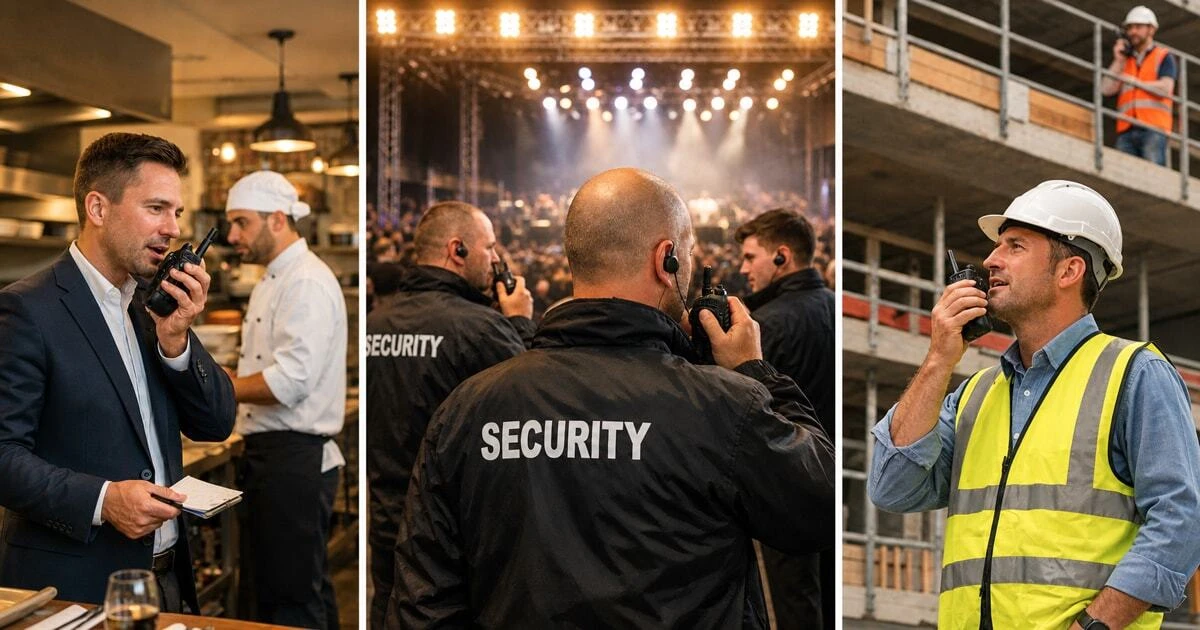 In a restaurant, security operation or construction site, a single push-to-talk message reaches the entire team instantly — faster and more practical than making individual phone calls during a busy shift.
 2. When teams need instant communication
Imagine a restaurant manager coordinating staff during a busy evening. A security team managing an event. A construction supervisor communicating between floors.
In these situations, making individual phone calls is slower and less practical. A walkie talkie allows users to press one button and communicate immediately with the whole team. For businesses, this simplicity is often the main advantage.
Baofengradio.co.uk identifies small businesses, security teams, hospitality teams and construction users as important audiences because they need affordable communication without the complexity or cost of traditional professional radio systems.
3. When battery life matters
A smartphone does far more than communication: GPS, apps, cameras, notifications and internet browsing — all of which use battery power. A walkie talkie is designed mainly for communication. For users spending long periods outdoors or working extended shifts, a dedicated communication device can be more practical.
This is why radios remain popular among event staff, outdoor groups, security teams and rural workers.
4. When you need communication without distractions
Phones create distractions. A team member may receive social notifications, messages, app alerts and personal calls. A radio is focused on one task: communication. For workplaces, this can make coordination faster and easier. A warehouse worker, hotel team member or event marshal does not need a smartphone experience. They need a reliable way to speak to colleagues.
When mobile phones are the better option
Walkie talkies are not a replacement for smartphones. Mobile phones are usually better when you need:
- Personal communication — calling family members, sending messages or video chatting is easier on a phone
- Long-distance communication — radios generally communicate locally unless connected through more advanced radio systems
- Internet-based services — maps, online information, email and business apps
- Private conversations — radio communication is normally designed for shared channels, while mobile calls are naturally more private
🎯 Expert note: The best setup for most UK teams is not choosing one or the other. A phone handles personal communication. A radio handles teamwork. Together, they cover more situations than either device alone.
Are walkie talkies cheaper than mobile phones?
The answer depends on how they are used. For a single person, a mobile phone may already be owned and convenient. For small businesses, affordable walkie talkie bundles can provide simple team communication without investing in:
- Individual phone contracts
- Mobile data plans
- Apps
- Charging infrastructure
🟢 Cost advantage for teams: For businesses buying multiple units, affordable radio bundles — such as a four-pack of PMR446 radios — can offer a practical and cost-effective communication solution compared with providing multiple smartphones and monthly contracts.
Walkie talkies vs mobile phones for different users
| User | Better choice | Reason |
|---|---|---|
| Family hiking group | Walkie talkie | Simple group communication outdoors |
| Restaurant staff | Walkie talkie | Fast team coordination |
| Security team | Walkie talkie | Immediate communication |
| Construction workers | Walkie talkie | Hands-free workplace communication |
| Remote worker travelling | Mobile phone | Internet and personal communication |
| Everyday consumer | Mobile phone | More features |
Recommended radios for UK teams
Whether you need a simple licence-free radio for a small hospitality team or a rugged waterproof model for outdoor and security use, the four models below cover the most common UK use cases discussed in this guide.
📻 Baofeng Two Way Radios — Better Than a Phone for Team Communication
Matched to the scenarios where radios outperform smartphones — team coordination, outdoor use and long battery life.
✅ Licence-Free PMR446 — Ideal for Businesses, Hospitality & Families
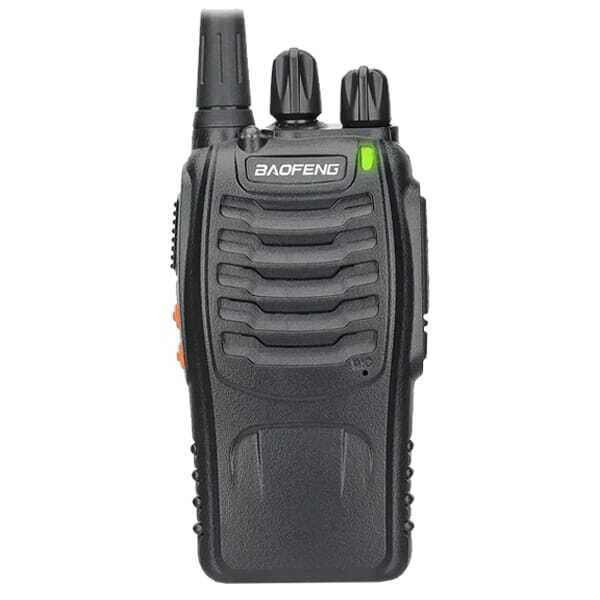
Baofeng BF-888S PMR446
0.5W · 16 PMR446 channels · Earpieces included · No licence needed — the simplest licence-free radio for restaurants, retail, schools and small teams who need instant group communication.
View BF-888S PMR446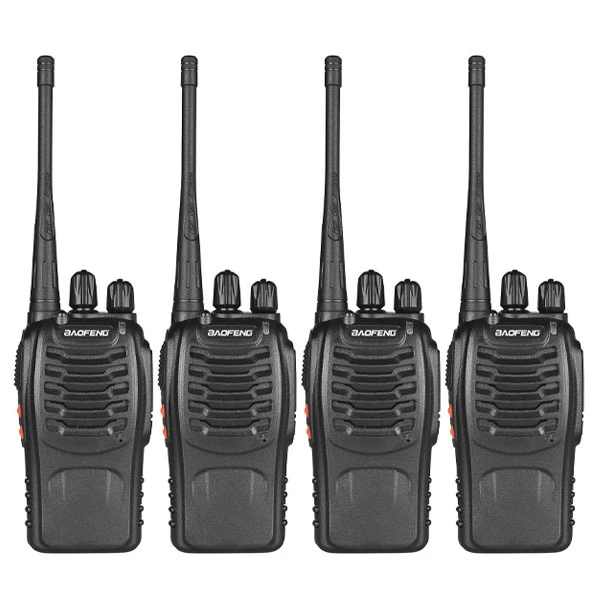
Baofeng BF-888S PMR446 Four-Pack
4 radios · Earpieces · Chargers · No licence needed — cover host, bar, kitchen and manager simultaneously. The most cost-effective alternative to phone-based team coordination.
View Four-Pack🥾 Outdoor & Rugged — For Security, Construction & Outdoor Groups
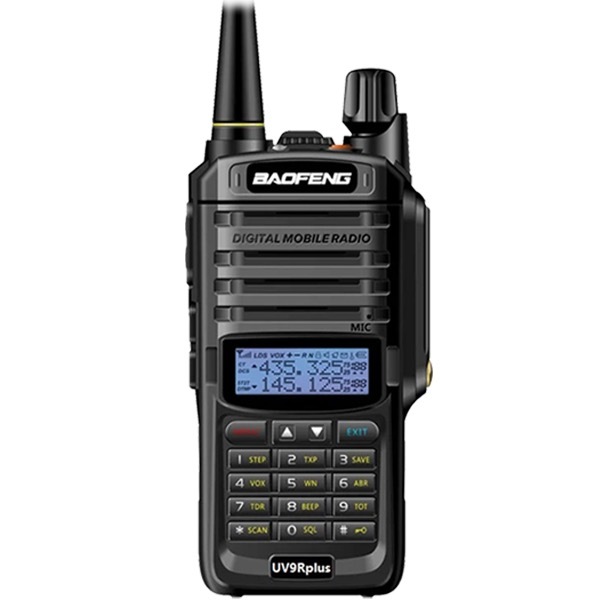
Baofeng UV-9R Plus
IP67 waterproof · 8W · Earpiece included — rugged construction for outdoor workers, security teams and anyone who needs a radio that outperforms a smartphone in harsh UK weather conditions.
View UV-9R Plus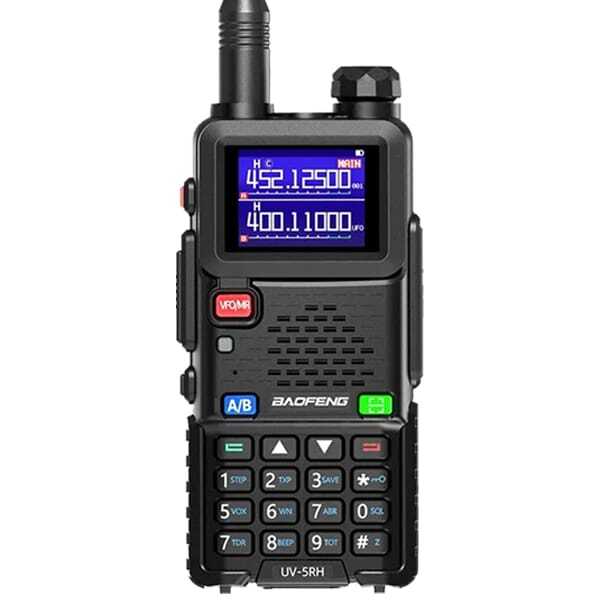
Baofeng UV-5RH
10W · 2500mAh · USB-C · Multi-band · Airband receive — for licensed operators who need maximum capability and all-day battery life across large outdoor areas and work sites.
View UV-5RH⚠️ PMR446 models are licence-free when compliant. The UV-9R Plus and UV-5RH require an appropriate Ofcom licence to transmit. Always verify licence requirements before purchase.
UK licence considerations: not every radio works like a phone
A common misunderstanding is that all walkie talkies can be used without a licence. Before choosing a radio, users should understand the difference between PMR446 licence-free radios and higher-power radios that may require licensing.
In the UK:
- PMR446 radios are designed for licence-free short-range communication when they meet the required specifications
- Higher-power radios, including many Baofeng models, may require the appropriate licence before transmitting
⚠️ Important: Baofengradio.co.uk highlights licensing confusion as one of the biggest barriers for UK buyers choosing radios. Before using any radio, check that the equipment and your intended use comply with current Ofcom requirements. Read the full UK radio licence guide for full details.
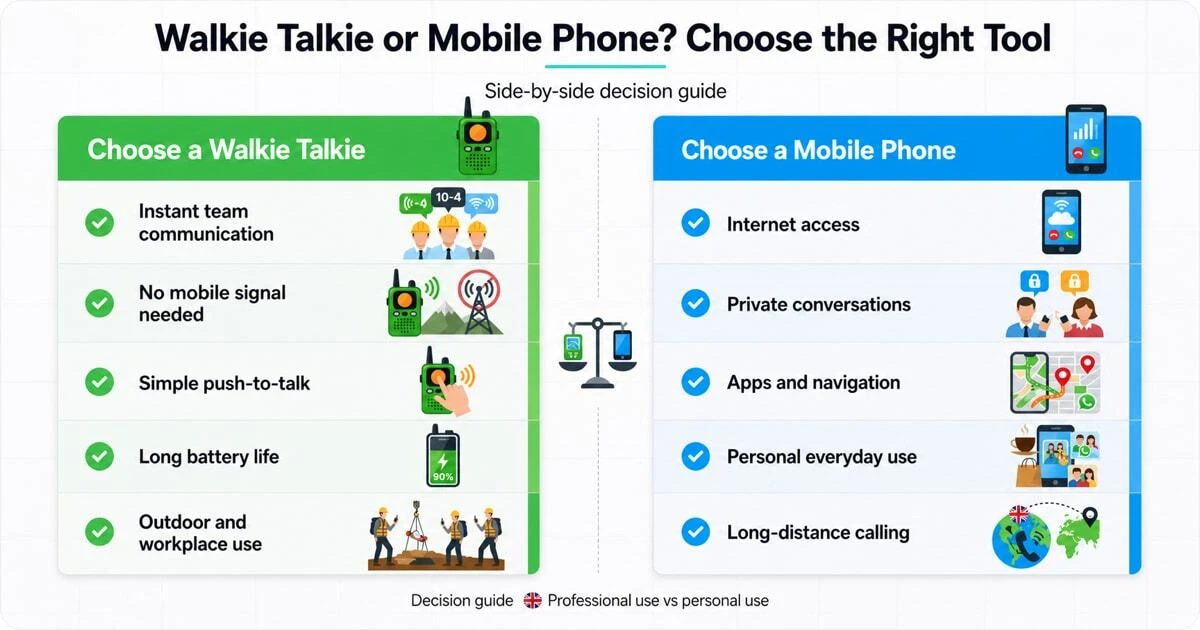 The decision is straightforward once you know the use case — walkie-talkies win for team communication, outdoor reliability and battery life; mobile phones win for personal connectivity, internet access and private conversations.
 Which should you choose: walkie talkie or mobile phone?
- Instant team communication
- Communication without mobile signal
- Simple push-to-talk operation
- A dedicated workplace or outdoor device
- All-day battery without constant charging
- Internet access
- Private conversations
- Apps and navigation
- Personal everyday communication
- Long-distance calling
🟢 Best answer for most UK users: For many UK users, the best solution is not choosing one or the other. A phone handles personal communication. A radio handles teamwork. Browse two-way radios and walkie talkies to find a model matched to your team and environment.
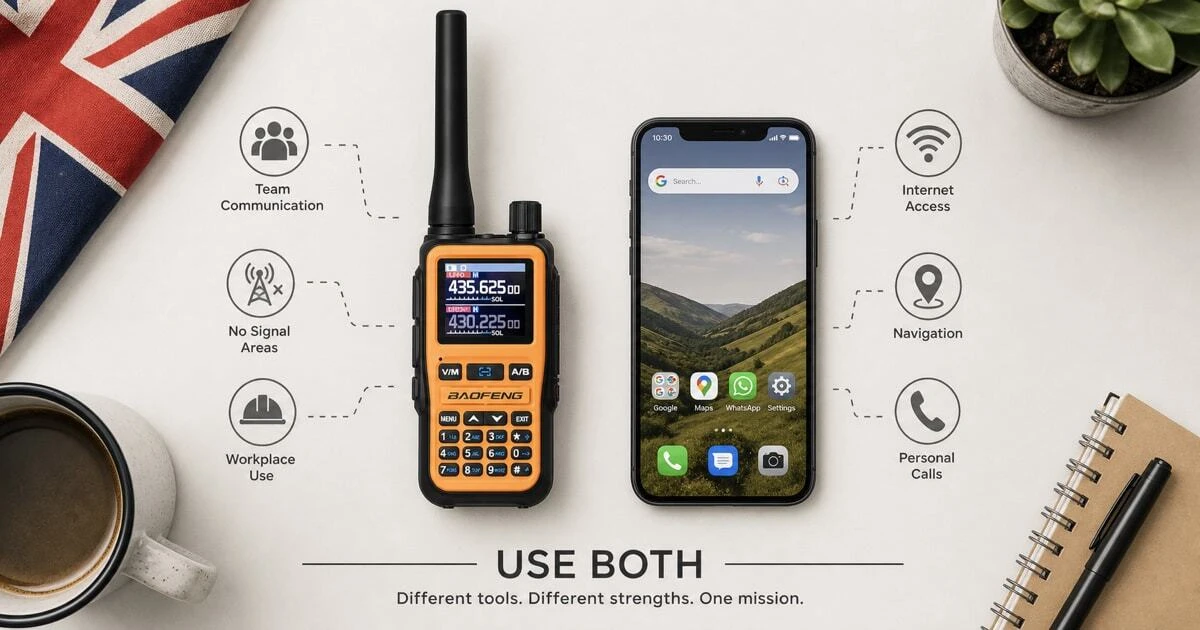 The smartest communication setup for most UK teams uses both — a mobile phone for personal connectivity and a walkie-talkie for fast, reliable group communication without network dependency.
 Final thoughts: radios still have a place in a smartphone world
Mobile phones changed the way people communicate, but they did not make walkie talkies unnecessary.
When communication needs to be fast, shared and dependable, radios still solve a problem smartphones were never designed to solve.
For outdoor users, businesses and teams working across larger spaces, a walkie talkie remains a practical communication tool — especially when choosing the right type of radio for the environment and understanding UK licence requirements.
📋 Key takeaways
- Walkie talkies are better for instant group communication, outdoor use and all-day battery life
- Mobile phones are better for personal communication, internet access and private conversations
- PMR446 radios are the main licence-free option for UK families, businesses and outdoor groups
- Higher-power radios require an appropriate Ofcom licence before transmitting
- The best setup for most UK teams combines both — a phone for personal use and a radio for teamwork
Frequently asked questions
Are walkie talkies better than mobile phones?
It depends on the situation. Walkie talkies are better when you need instant group communication, reliable contact without mobile coverage, or all-day battery life for a team. Mobile phones are better for personal communication, internet access, private conversations and long-distance contact. For most UK teams, the best approach is using both — a phone for personal use and a radio for group coordination.
Do walkie talkies work without mobile signal?
Yes. Walkie talkies communicate directly between radios using radio frequencies — they do not need a mobile network, Wi-Fi or internet connection to function. This makes them ideal for use in rural areas, outdoor events, construction sites and any location where mobile coverage is weak or unavailable. Range still depends on terrain, buildings and the radio's specifications.
Are walkie talkies cheaper than mobile phones for businesses?
For teams of multiple people, walkie talkies can be significantly more cost-effective than providing individual smartphones with contracts and data plans. An affordable PMR446 multi-pack can equip an entire small team for team communication at a one-off cost, without monthly fees, app subscriptions or individual contracts. For single users, a mobile phone may already be the more practical choice.
Can walkie talkies be used in restaurants and hotels?
Yes. Compliant PMR446 licence-free radios are widely used in hospitality businesses including restaurants, hotels and retail stores. They allow staff to coordinate between the kitchen, floor, bar and management instantly without using personal phones. For most single-site hospitality teams, a PMR446 radio requires no individual Ofcom licence when the equipment is fully compliant.
Do I need a licence to use a walkie talkie in the UK?
It depends on the radio. Compliant PMR446 handheld radios can be operated without an individual Ofcom licence when they meet all PMR446 technical requirements — including a fixed integral antenna, operation between 446.0 and 446.2 MHz and a maximum of 0.5W ERP. Higher-power programmable radios, including many Baofeng models, require an appropriate Amateur Radio or Business Radio licence before transmitting legally in the UK.
Why do security teams prefer walkie talkies over mobile phones?
Security teams prefer walkie talkies because they enable immediate, simultaneous communication with the whole team by pressing a single button. There is no dialling, no waiting for connection and no risk of the recipient being unavailable. Radios also work without mobile signal in underground venues, large buildings or remote locations. Compatible earpieces allow discreet communication, and radios do not create the distractions associated with smartphones.
Find the Right Radio for Your Team
From PMR446 licence-free handhelds for restaurants and small businesses to rugged waterproof models for outdoor and security teams — Baofeng UK has the right two way radio for every situation where a phone is not enough.
Browse Licence-Free PMR446 Radios