
30th Aug 2026
What Makes a Professional Walkie Talkie? A Guide for UK Businesses
This guide was written and reviewed by the Baofeng UK team — UK-based radio communications specialists with over 10 years of experience supplying professional communication equipment to UK businesses across hospitality, security, construction and retail. All licensing information reflects current Ofcom guidance as of August 2026.
A professional walkie talkie is not simply a more powerful version of a consumer radio.
For a UK business, a professional radio is one that delivers dependable communication in the environment where your staff actually work, is simple enough to use under pressure, lasts through normal shifts and can be operated legally under UK radio rules.
That distinction matters. A restaurant with 15 employees, a security company covering a festival and a construction team working across several buildings may all need professional communication, but they do not necessarily need the same radio.
In many smaller workplaces, a compliant PMR446 radio may be the most practical professional solution. Larger or more demanding operations may benefit from a licensed business-radio system.
Not maximum wattage. A professional walkie talkie is one that reliably supports the job it has been purchased to do — legally compliant, easy for staff to use, durable enough for the environment and available throughout the working day.
The right question: "Will this radio work in my workplace?" — not "What is the biggest number on the specification?"
⚡ Key points for UK business buyers
- ⚖️ Start with licensing, not power: PMR446 is licence-free for compliant equipment — but entering a PMR446 frequency into a powerful radio does not make it compliant
- 📏 Real-world range over headline figures: Test radios in your actual workplace — walls, floors and structures change everything
- 🎧 Audio matters as much as range: A message that arrives but cannot be understood has achieved nothing
- 🔋 Battery = fleet management: The question is not how long one battery lasts — it is whether every radio is available throughout every shift
- 👥 Simple operation wins: Features employees cannot use in a busy shift add no value
- 🔒 Privacy codes ≠ encrypted communication: Licence-exempt spectrum is shared — CTCSS and DCS tones are not encryption
📋 Table of Contents
- What actually makes a walkie talkie "professional"?
- Professional walkie talkie vs consumer walkie talkie
- UK businesses need to start with licensing, not power
- Real-world range matters more than the number on the box
- Durability should match the workplace
- Clear audio can be more important than extra range
- Battery life is really a fleet-management question
- More channels do not automatically mean more privacy
- PMR446 or licensed business radio: which fits your team?
- What about a licence-free professional fleet?
- Recommended professional radios for UK businesses
- A professional radio should be easy for employees
- Professional walkie talkie buying checklist
- So, what makes a professional walkie talkie?
- Frequently asked questions
What actually makes a walkie talkie "professional"?
There is no single specification that turns a handset into a professional walkie talkie. The better test is whether the radio can reliably support the job it has been purchased to do.
Staff can communicate throughout the actual workplace, not simply at a quoted maximum distance
Messages remain understandable around customers, machinery, traffic or other background noise
The handset can cope with the dust, rain, knocks and daily handling expected in its environment
Battery capacity and charging arrangements fit the team's working pattern
Staff can use push-to-talk, volume and channel controls with minimal training
Earpieces, speaker microphones, chargers and replacement batteries fit the workflow
Multiple employees can be issued compatible radios using a controlled channel plan
The equipment and frequencies are appropriate for licence-exempt or licensed operation
🎯 Key insight: Professional does not automatically mean maximum wattage, maximum range or the largest number of channels. A radio that is legally compliant, easy for staff to use and reliable throughout a hotel may be a better professional tool than a much more powerful handset that has been purchased without considering licensing or the building itself.
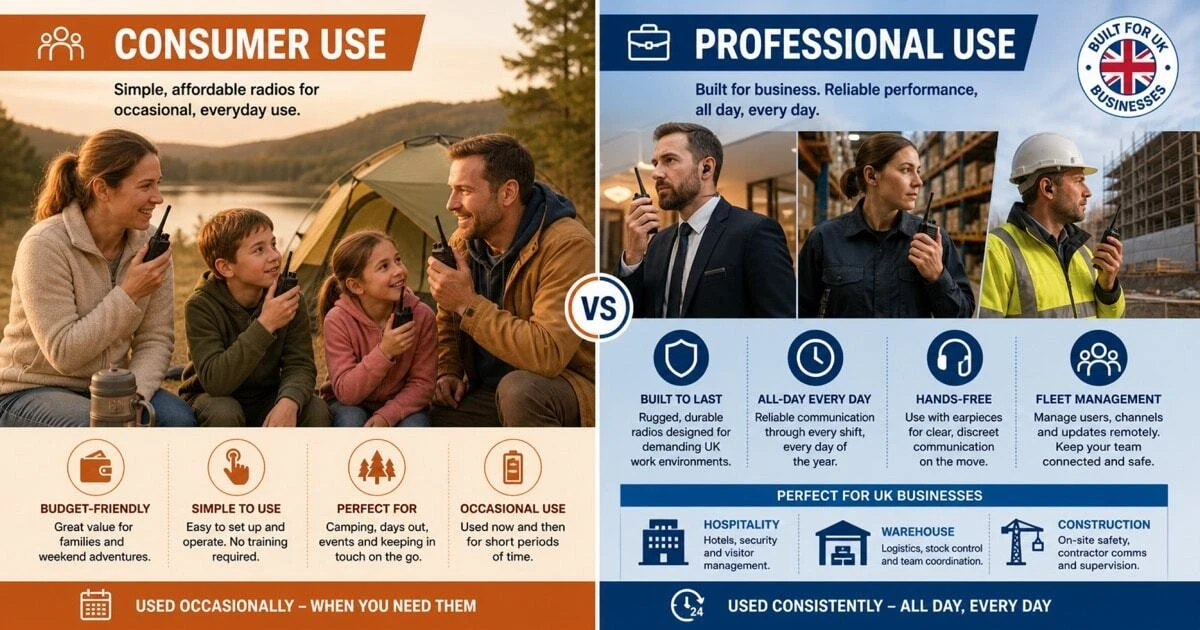 A family uses walkie-talkies occasionally at a campsite — a business team uses them hundreds of times during every working week. That difference in intensity completely changes the buying criteria.
 Professional walkie talkie vs consumer walkie talkie
Consumer radios normally prioritise simplicity and occasional use. Professional radios need to survive repetition.
A family might use walkie talkies for a weekend camping trip. A hotel receptionist, warehouse supervisor or security officer may press the push-to-talk button hundreds of times during a working week.
That changes the buying criteria. Businesses should think about the whole operating system: handset construction, audio quality, charging, accessories, staff training, replacement equipment and whether every radio in the fleet has been configured consistently.
🔵 Where to start: For businesses starting from scratch, the Baofeng UK walkie talkie and handheld two-way radio collection provides a useful starting point for comparing available radio types.
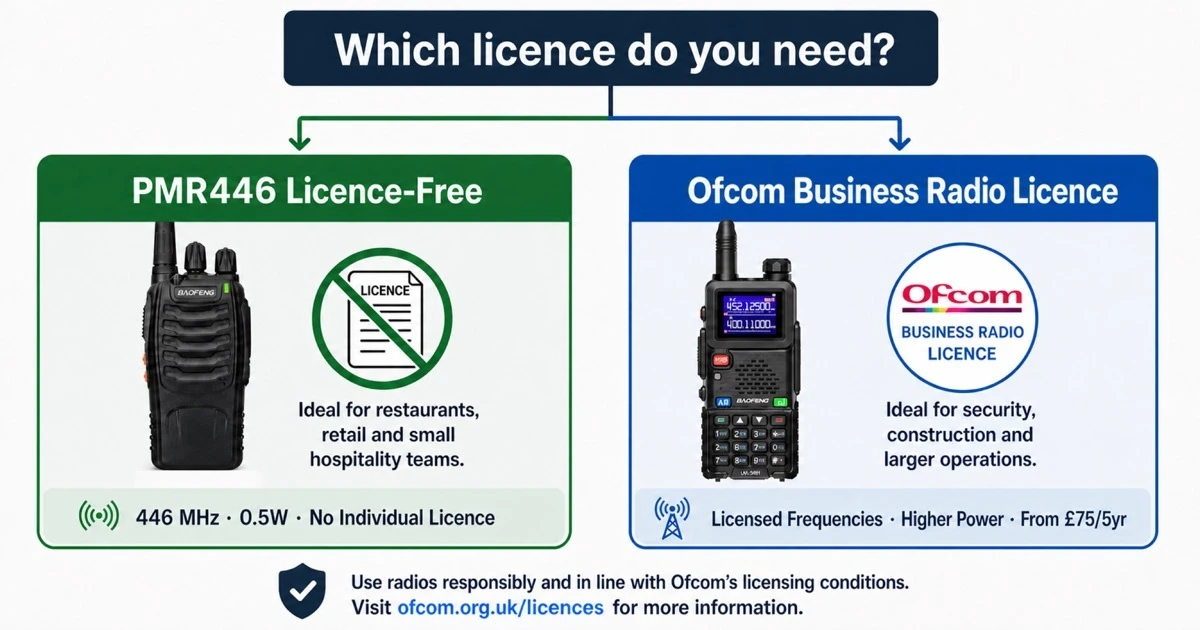 UK business buyers face two clear licensing paths — PMR446 licence-free for smaller operations and an Ofcom Business Radio licence for larger or more demanding sites. Choosing the wrong path wastes money and creates compliance risks.
 UK businesses need to start with licensing, not power
This is where many UK buyers become confused. Ofcom permits compliant PMR446 equipment to be used without an individual radio licence. Current Ofcom guidance describes PMR446 as a low-power, mobile-only service operating between 446.0 and 446.2 MHz, with a maximum of 500 mW ERP. It can be used by professional as well as non-professional users.
That makes PMR446 particularly attractive to businesses wanting straightforward short-range communication without managing a radio licence.
⚠️ Critical catch: Entering a PMR446 frequency into a more powerful programmable radio does not automatically make that handset a compliant PMR446 radio. The equipment itself has to satisfy the licence-exemption requirements. For a deeper explanation before purchasing, see Baofeng UK's guide to whether you need a walkie talkie licence in the UK and its licensed vs unlicensed radio guide.
When does a business licence make more sense?
If PMR446 cannot provide suitable coverage or operational flexibility, a business may need an Ofcom Business Radio licence and appropriately configured equipment.
As of August 2026, Ofcom lists its Business Radio Light licences — Simple UK, Simple Site and Suppliers Light — at £75 for five years. More complex technically assigned or area-defined licences are priced according to factors such as location, spectrum and coverage requirements.
⚠️ Wrong order: This is why purchasing the "most powerful walkie talkie" before deciding how it will legally be used is the wrong way around. For a larger security operation, extensive construction site or multi-building facility, choosing the radio system and the appropriate Ofcom authorisation should be treated as one decision.
Real-world range matters more than the number on the box
Few walkie talkie specifications cause more disappointment than maximum range. A professional buyer should ask: "Will these radios cover my workplace?" — not — "What is the biggest distance shown in the specification?"
Walls, reinforced concrete, steel structures, hills, trees, antenna position and line of sight can all change radio performance. The same handset that communicates well over open ground can behave very differently between floors of a concrete building.
- For a single restaurant or retail shop, extreme distance may be irrelevant. What matters is reaching the stockroom, loading area, kitchen or basement.
- A construction manager may care much more about communication between concrete floors.
- A farm or event operator may need coverage across a much larger outdoor area.
🎯 Expert recommendation: Testing radios in the real operating environment — or obtaining specialist coverage advice for a complicated site — is more valuable than buying from headline range claims alone.
Durability should match the workplace
"Rugged" is another term that can become meaningless without context. A radio carried by hotel staff does not face the same conditions as one clipped to a construction worker's clothing in British rain.
Look at what can realistically happen during a normal shift. Will the radio encounter dust? Rain? Repeated drops? Outdoor temperature changes? Gloves? Constant movement?
🔵 IP ratings in practice: An IP-rated handset can be valuable in wet or dusty environments, but do not buy an IP rating purely because the number looks impressive. Check the actual declared rating for the model and make sure it matches your operating conditions. Professional buying is about appropriate durability, not maximum specification.
Clear audio can be more important than extra range
A message that arrives but cannot be understood has achieved very little. Warehouses, kitchens, festivals, construction sites and busy retail environments can all create substantial background noise. Speaker quality, microphone placement, sensible volume controls and compatible audio accessories therefore deserve as much attention as radio power.
Security and front-of-house teams may prefer an earpiece so that routine conversations are not broadcast into the surrounding environment. Construction or warehouse users may find a speaker microphone easier when a handset is attached to workwear.
Baofengradio.co.uk carries radios alongside accessories such as earpieces, batteries, chargers and programming equipment, which can make the complete communication setup more useful than evaluating the handset alone.
Battery life is really a fleet-management question
Businesses sometimes ask simply, "How long does the battery last?" A better question is: "Can we keep every radio available throughout the working day?"
A team running eight-hour shifts has different requirements from a venue operating late into the night or an event team working a long temporary deployment.
Consider charging locations, spare batteries, shared chargers, handover between shifts and what happens when somebody forgets to charge a handset.
🟢 Practical reality: A slightly less sophisticated radio with a simple, repeatable charging routine can be more useful operationally than an advanced model that regularly disappears from service because batteries are flat.
More channels do not automatically mean more privacy
Multiple channels are useful when a business wants to separate groups such as reception, security, logistics and management. CTCSS and DCS tones can also help radios ignore transmissions that do not carry the matching tone.
But businesses should not confuse this with confidential communication.
⚠️ Privacy codes ≠ encryption: Licence-exempt spectrum is shared, and Ofcom makes clear that licence-exempt users receive no protection from other users of that spectrum. Privacy tones mainly control what your radio opens its speaker for — they should not be treated as encryption. Businesses handling genuinely sensitive communications should obtain appropriate specialist advice.
PMR446 or licensed business radio: which fits your team?
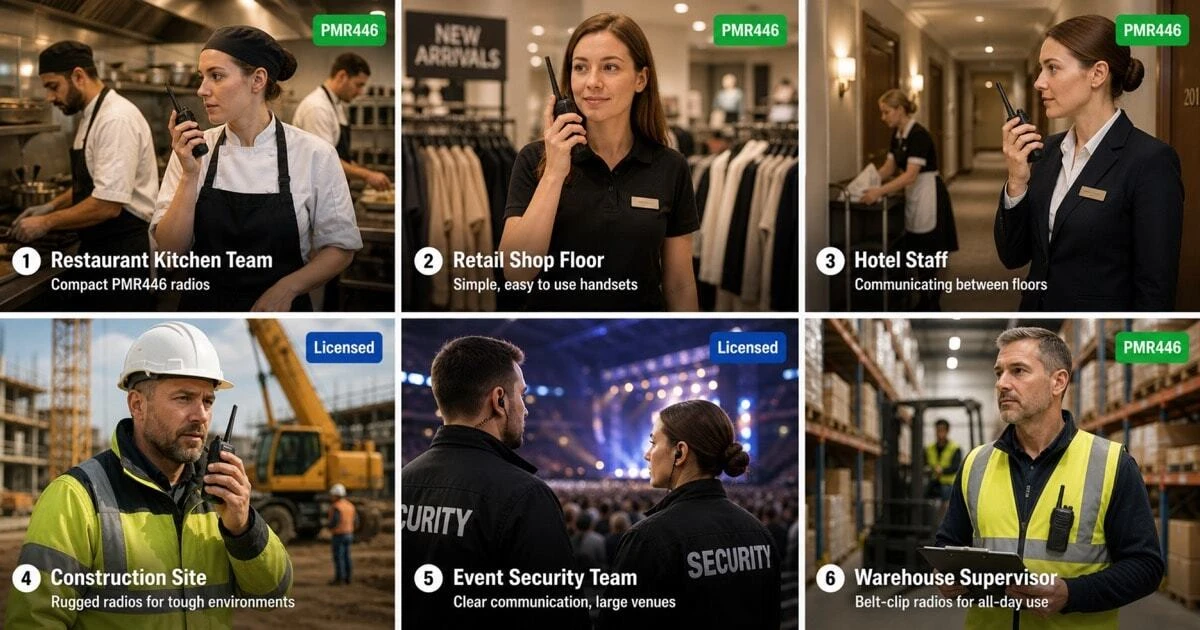 Six UK professional workplace scenarios — each with different radio requirements. The right starting point depends on site size, building construction, staff numbers and the operational consequences of a communication failure.
 | Workplace | Sensible starting point | Main consideration |
|---|---|---|
| Restaurant or café | PMR446 | Compact radios, discreet audio and reliable indoor coverage |
| Retail shop | PMR446 | Easy operation and stockroom/front-of-house communication |
| Small hotel | PMR446, subject to coverage testing | Floors, walls and basement areas |
| School or small campus | PMR446 may suit many short-range requirements | Simple controls, fleet management and safeguarding procedures |
| Warehouse | Test PMR446 first; consider licensed radio for harder sites | Steel construction, size and interference |
| Construction site | Depends strongly on site size and structure | Concrete, noise, durability and licensing |
| Security/event operation | Often requires a more detailed assessment | Site size, channel planning, accessories and operational resilience |
| Large farm or estate | Licensed system may be appropriate | Terrain, distance and reliable outdoor coverage |
The website already has more specific guidance for several of these situations. Businesses can continue to the workplace walkie talkie guide, UK security walkie talkie guide, restaurant walkie talkie guide or school walkie talkie buyer's guide depending on their operating environment.
What about a licence-free professional fleet?
"Licence-free" and "professional" are not opposites. For smaller sites, compliant PMR446 equipment can provide a very practical business communication system because there is no individual radio-licensing process and staff can be trained around a straightforward common channel setup.
For example, Baofeng UK's BF-88ST Pro PMR446 is positioned specifically around licence-free fleet deployment for businesses.
⚠️ Honest limitation: PMR446 operates on shared licence-exempt spectrum. Busy locations can therefore experience other users, and its low-power nature means it should not be purchased with unrealistic expectations about large sites or difficult buildings.
Recommended professional radios for UK businesses
The six models below cover the two main categories for UK business buyers — PMR446 licence-free solutions for smaller operations and rugged or advanced licensed radios for more demanding professional environments.
📻 Baofeng Professional Radios for UK Businesses
Choose by workplace type and licence situation — not by wattage alone.
✅ Licence-Free PMR446 — For Restaurants, Retail, Hotels & Small Teams
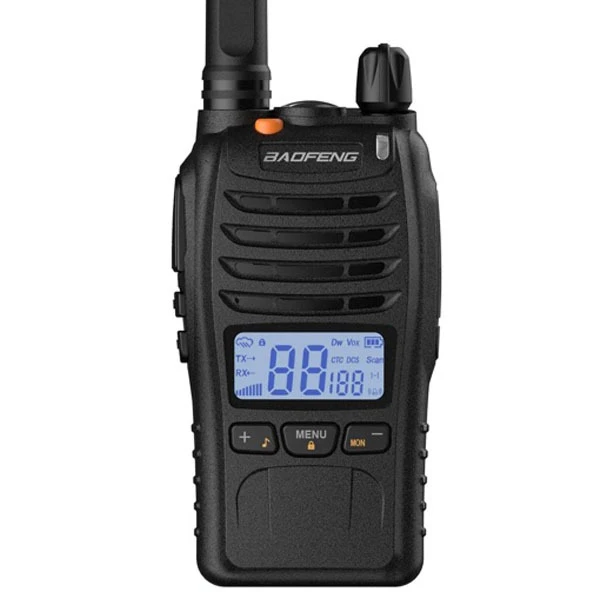
Baofeng BF-88ST Pro PMR446
PMR446 compliant · Pro upgraded features · Fixed antenna · No licence needed — designed specifically for professional licence-free fleet deployment in UK businesses.
View BF-88ST Pro PMR446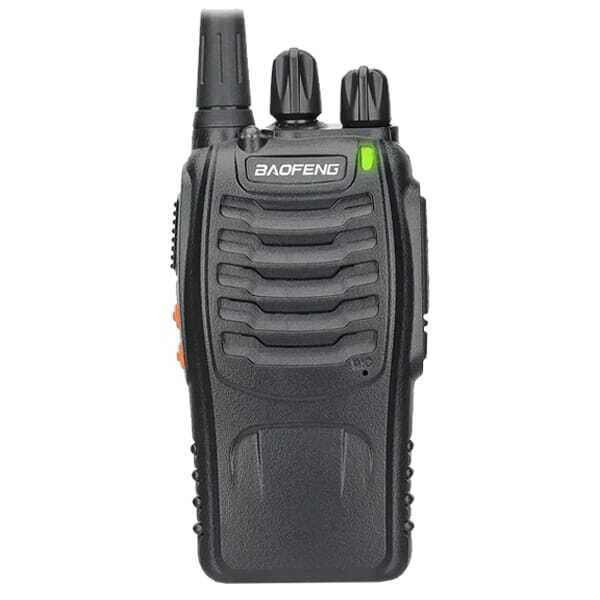
Baofeng BF-888S PMR446
0.5W · 16 PMR446 channels · Fixed antenna · No licence needed — simple push-to-talk operation ideal for hospitality, retail and small business teams with minimal training requirements.
View BF-888S PMR446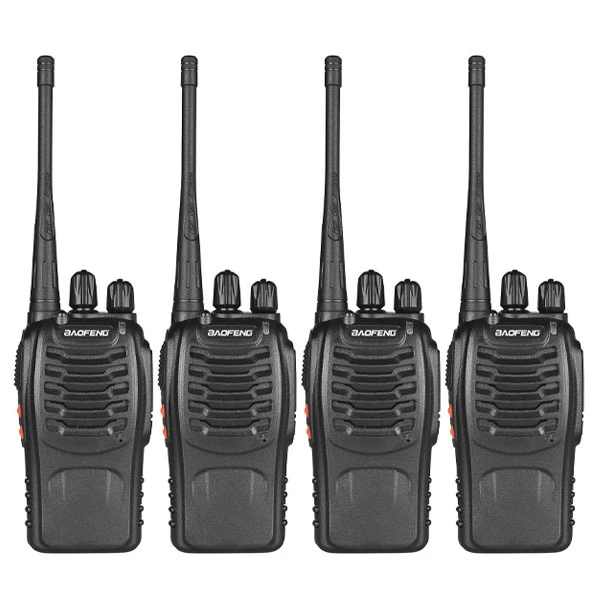
Baofeng BF-888S PMR446 Four-Pack
4 radios · Earpieces · Chargers · No licence needed — the most cost-effective way to equip a small professional team with consistent, compatible radios from one purchase.
View Four-Pack🛡️ Rugged & Advanced — For Construction, Security & Larger Operations
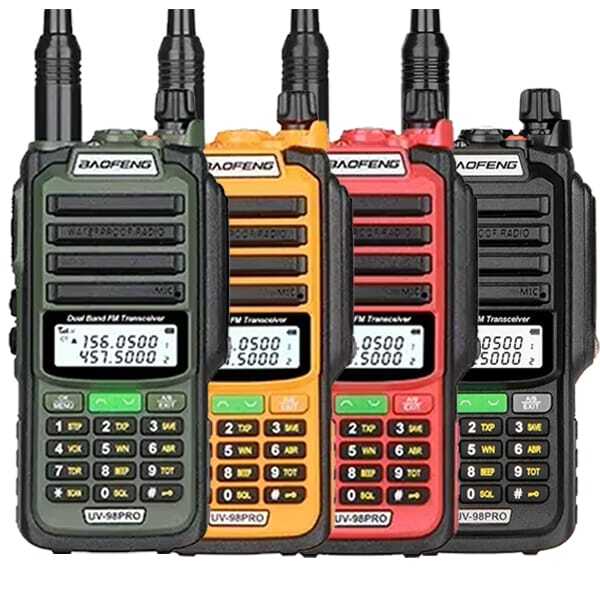
Baofeng UV-98 Pro IP68
IP68 waterproof · 8W · Dual-band — maximum environmental protection for licensed operators in construction, outdoor security and wet working conditions across the UK.
View UV-98 Pro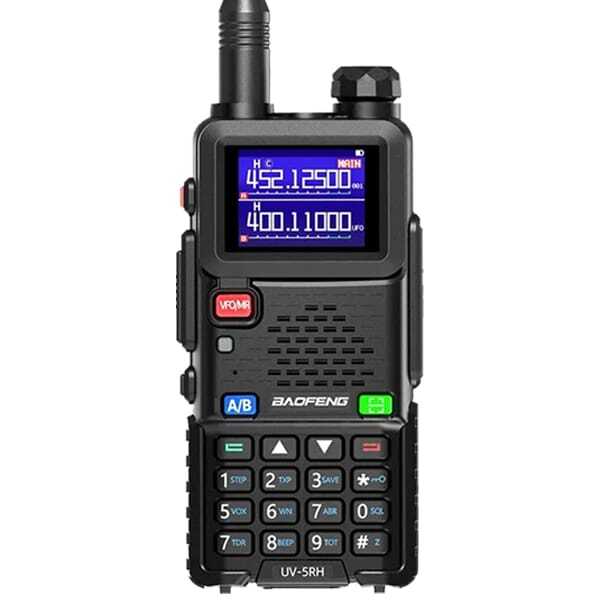
Baofeng UV-5RH
10W · 2500mAh · USB-C · 999 channels — for licensed operators who need high output, all-day battery and advanced features for demanding professional environments.
View UV-5RH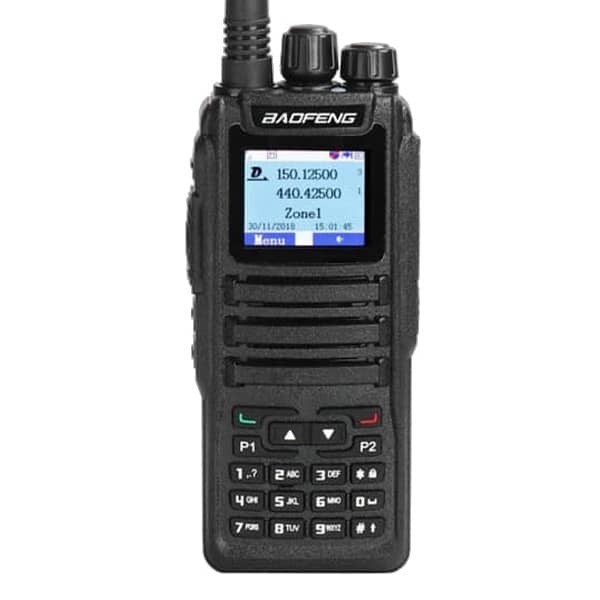
Baofeng DM-1701 DMR
Digital DMR · Dual time-slot · Clearer audio — for licensed professional teams in security, large venues and industrial facilities requiring structured talk groups and digital voice quality.
View DM-1701 DMR⚠️ PMR446 models are licence-free when compliant. UV-98 Pro, UV-5RH and DM-1701 require an appropriate Ofcom licence to transmit. Always verify licensing requirements before deploying a business fleet.
A professional radio should be easy for employees, not just interesting to the buyer
Technical features are useful only when the people carrying the radios can operate them confidently.
Imagine a busy restaurant during Saturday dinner service. Nobody wants to navigate several menus before asking for a supervisor. A security officer dealing with a developing situation needs a radio that can be operated quickly. A new warehouse employee should not need to understand frequency programming simply to call the goods-in team.
🟢 Operational reality: For most business fleets, consistent programming, clear channel names or procedures, locked-down settings where appropriate and basic staff training will deliver more operational value than filling the handset with features employees never use.
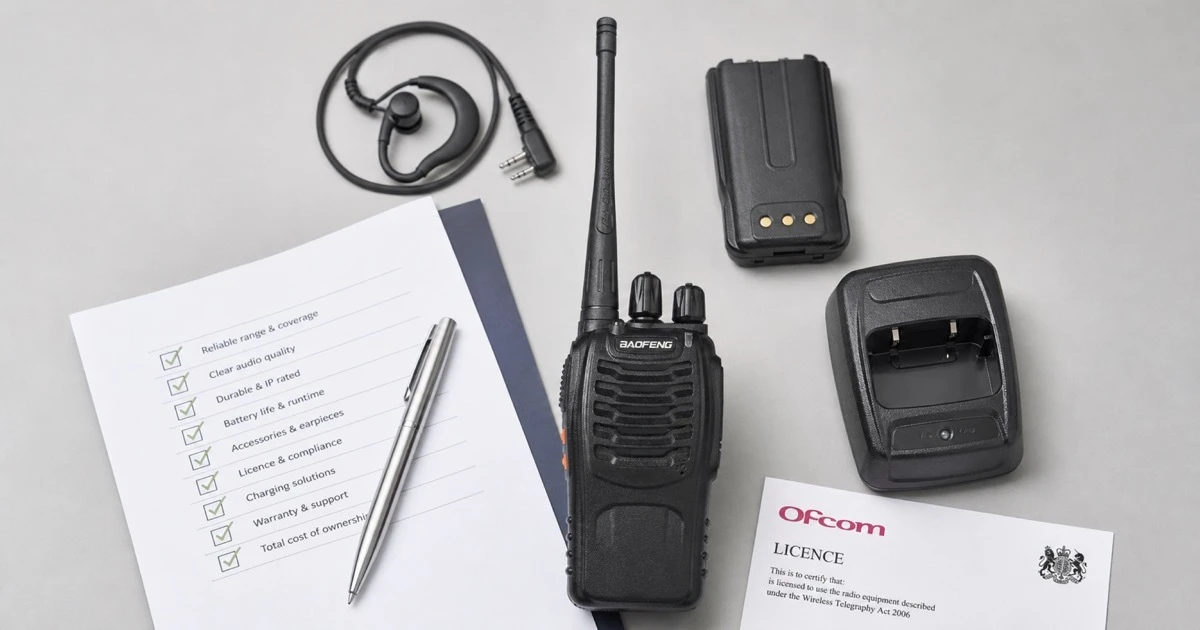 A professional fleet purchase is more than a handset decision — it includes licensing, accessories, charging infrastructure, channel planning and staff training. Working through a checklist before ordering avoids the most common and costly mistakes.
 Professional walkie talkie buying checklist
Before ordering a business fleet, confirm:
Pre-purchase checklist for UK business buyers
- Where employees need coverage, including basements, stairwells, outdoor areas and separate buildings
- Whether compliant PMR446 equipment can meet that requirement or an Ofcom business licence is appropriate
- Whether radios can be operated comfortably while wearing normal work clothing or PPE
- Whether audio remains understandable in the normal noise level of the workplace
- Whether battery and charging arrangements cover complete shifts
- Which employees need earpieces, speaker microphones or other accessories
- How channels will be allocated between departments
- Whether the chosen model has an appropriate durability or IP rating
- Whether replacement radios, batteries and accessories will remain easy to obtain
- Who will be responsible for programming, charging, issuing and maintaining the fleet
So, what makes a professional walkie talkie?
A professional walkie talkie is a radio you can build a reliable working process around.
For one UK business, that could be a straightforward PMR446 handset used between the kitchen and front of house. For another, it might be a licensed fleet designed for a security operation, industrial facility or extensive outdoor site.
📋 Judge professional radios by these criteria
- Legal suitability — compliant PMR446 or appropriately licensed for the intended use
- Real-world coverage — tested in the actual workplace, not quoted at a maximum distance
- Understandable audio — clear in the noise level your staff actually work in
- Durability — matched to the physical conditions of the environment, not to the most impressive IP number
- Battery management — every radio available throughout every shift, not just one unit tested in isolation
- Ease of use — operable by all staff without specialist knowledge
- Fleet support — how well the complete setup supports employees throughout the working day
Businesses beginning their search can compare the wider Baofeng UK walkie talkie range and then use the site's UK licensing guidance to narrow the choice before purchasing.
🔵 Final thought: The most professional radio is not necessarily the most powerful one. It is the one your team can rely on when somebody presses the push-to-talk button.
Frequently asked questions
What makes a walkie talkie professional?
A professional walkie talkie is one that reliably supports the job it has been purchased to do — not simply the most powerful handset available. The key criteria are: legal suitability for the intended use, reliable coverage throughout the actual workplace, clear audio in the normal working environment, appropriate durability, shift-ready battery management and simple enough operation for all staff to use confidently under pressure.
Do UK businesses need a licence for professional walkie talkies?
It depends on the equipment. Compliant PMR446 handheld radios can be deployed by businesses without an individual Ofcom licence, provided the equipment meets all PMR446 technical requirements — including a fixed integral antenna, operation between 446.0 and 446.2 MHz and a maximum of 0.5W ERP. Higher-power or programmable radios require an appropriate Ofcom Business Radio licence before transmitting. Businesses should confirm the licensing status of any radio before deploying it.
Is PMR446 suitable for professional business use?
Yes, for many smaller sites. Compliant PMR446 equipment can provide a practical professional communication system for restaurants, retail shops, small hotels, schools and similar venues. It requires no individual licensing process, is straightforward to deploy and can be used immediately. However, it operates on shared licence-exempt spectrum at low power — businesses with large sites, difficult buildings or demanding operational requirements may need a licensed radio system.
How many walkie talkies does a business need?
Count the roles that need to make or receive operational decisions during the same shift — not the total number of employees. A restaurant with 20 staff may only need four or five radios to cover the host, kitchen pass, bar and duty manager. Add one spare per fleet where the budget allows, to ensure no key role is left without a working radio if a battery goes flat or a handset is damaged.
What is the difference between PMR446 and a business radio licence?
PMR446 is a licence-exempt category of short-range handheld radio requiring no individual Ofcom application. It is limited to 0.5W ERP on shared frequencies between 446.0 and 446.2 MHz. A Business Radio licence permits the use of dedicated or shared frequencies at potentially higher power, with more operational flexibility — including base stations where appropriate. As of August 2026, Ofcom lists Business Radio Light licences at £75 for five years.
Are CTCSS and DCS codes private for business use?
No. CTCSS and DCS tones control when your radio opens its speaker — they do not encrypt the transmission or prevent other users monitoring the same frequency from hearing the conversation. Ofcom makes clear that licence-exempt users receive no protection from interference on shared spectrum. Businesses that need genuinely private communications should seek specialist advice rather than relying on privacy tone settings.
Find the Right Professional Radio for Your UK Business
From PMR446 licence-free fleets for hospitality and retail to rugged licensed radios for construction, security and large operations — Baofeng UK has a professional communication solution matched to your workplace.
Browse Professional Walkie Talkies