
26th Nov 2026
How Many Walkie Talkies Do I Need? Plan for Staff, Shift Changes and Spares
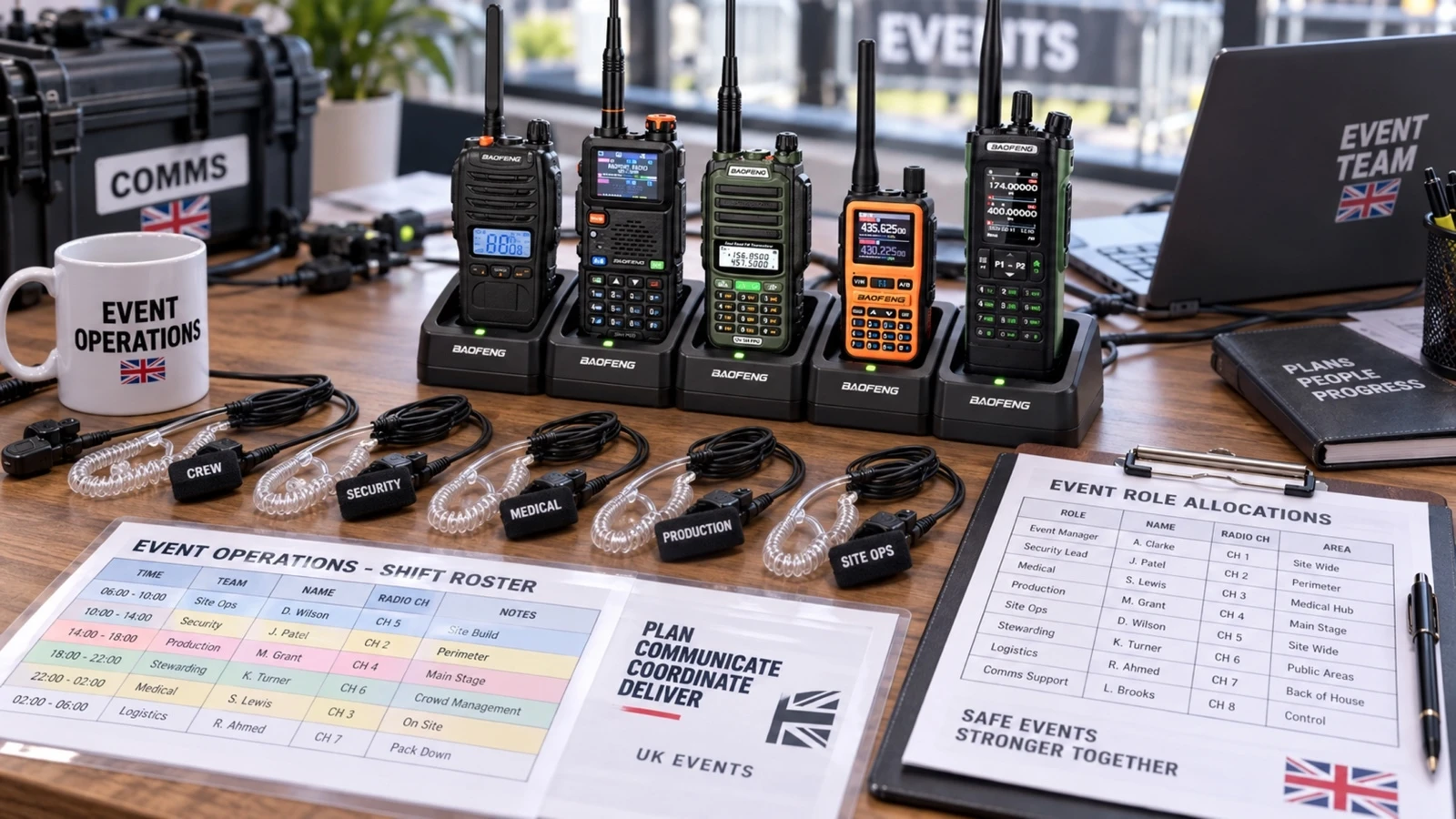
Compiled by Baofeng UK logistics specialists and commercial communications advisors. This planning framework is based on real-world UK event safety deployments, workplace shift-rotation mathematics, and Ofcom equipment allocation standards.
To work out how many walkie talkies you need, count the people or staffed positions that require independent radio access at your busiest time.
Then allow for any additional handsets tied up during handovers or charging, and choose a separate reserve for faults or loss. Your total employee count is rarely the right starting figure.
For example, a venue with eight radio-equipped roles, two additional handsets needed during a shift overlap and one chosen spare would plan for 11 radios. That is an illustrative calculation, not a universal fleet size for every venue.
If you are comparing two-way radio multi-packs, use the calculation below to match the pack size to your operating needs, then plan batteries and charging separately.
📋 Table of Contents
- A Simple Formula for Your Walkie Talkie Quantity
- Count Radio-Equipped Roles Before Counting Employees
- Worked Example: How Many Radios Do I Need for an Event?
- Choose Spare Radios by the Consequence of a Failure
- Plan Spare Batteries Separately from Spare Handsets
- How Many Charging Positions Will You Need?
- Turn the Calculation into a Purchase List
- Explore Two-Way Radio Multi-Pack Sizes
- FAQs About How Many Walkie Talkies You Need
A Simple Formula for Your Walkie Talkie Quantity
Calculating your required fleet size does not require complex software. The baseline equation is straightforward:
Planned Fleet = Peak Operational Requirement + Selected Spare Handsets
Calculate across your highest concurrent operational window, not cumulative daily shifts.
For each time period, the operational requirement includes radios being used and any additional units temporarily unavailable for reuse. Take the highest total across the day. This avoids adding together separate peaks that never occur at the same time.
Suppose eight walkie talkies are in active use. Two incoming staff also need radios before outgoing staff return theirs, and no units are charging at that point. The peak is ten. If two returned radios later charge while only six are in use, that later total is eight; it does not increase the peak to twelve.
🔵 Protection of Ready Spares: Keep spares outside this calculation only while they remain a protected reserve. A spare routinely issued to cover a regular shift is part of the operating fleet and cannot simultaneously cover an unexpected failure.
Count Radio-Equipped Roles Before Counting Employees
Start with who must hear or send messages without finding somebody else. Two people working at the same fixed position may be able to share one handset. Two mobile workers in different areas may each need one, even if they have the exact same job title.
Shared allocation only works when the radio remains accessible throughout the task. If a worker leaves the position carrying its only handset, the person left behind loses access. Record that movement when deciding whether a shared unit is realistic.
The following worksheet can be copied and completed for each operating period. The rows are examples of roles to consider, not a required staffing structure.
| Role / Location | Peak Users Needing Radios | Can a Handset Be Shared? | Handover / Return Time |
|---|---|---|---|
| Fixed reception or control point | Fill in | Record the conditions | Fill in |
| Mobile staff in separate areas | Fill in | Record the conditions | Fill in |
| Supervisor / duty manager | Fill in | Avoid double-counting | Fill in |
| Additional temporary roles | Fill in | Count only when active | Fill in |
Add a control point as its own allocation only if it uses a separate radio. A supervisor acting as the controller on the same handset should appear once. Likewise, avoid listing the same person under both a job title and a department.
For the wider choice of radio system, our business two way radios guide covers workplace considerations. Keep the quantity worksheet focused on who needs access, rather than trying to solve every purchasing question at once.
Worked Example: How Many Radios Do I Need for an Event?
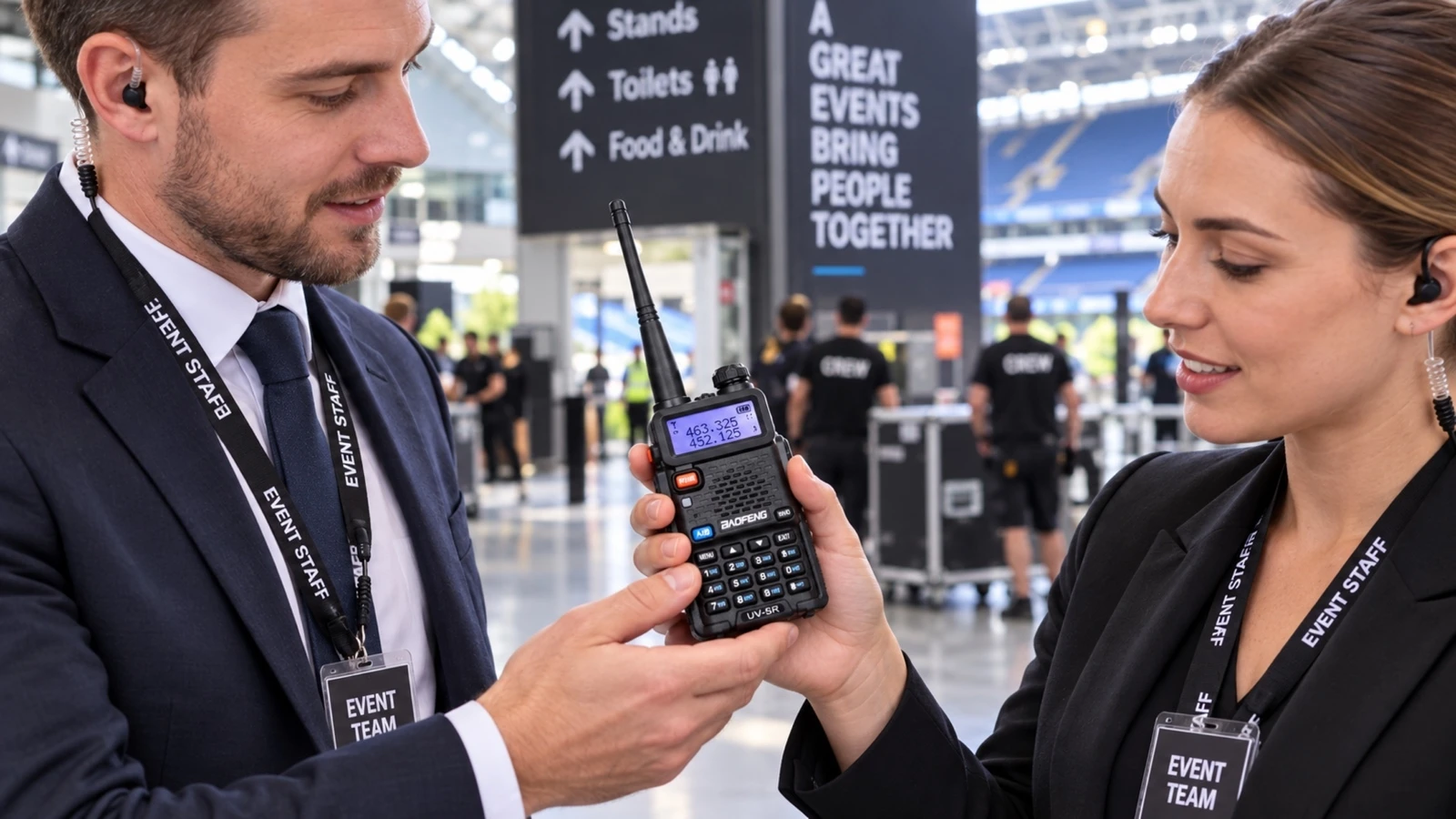
Consider a hypothetical venue with 24 staff during an event. Eight roles require independent radio access: two entrance positions, three mobile operations staff, one duty manager, one reception position and one service point. Other staff communicate through those positions as appropriate to their duties.
Assume that two incoming staff need separate radios during handover while all eight original users remain active. Batteries have been checked against the intended shift, no additional radios need to be taken out for charging at that peak, and the venue chooses one ready spare.
| Planning Item | Radios | Reason |
|---|---|---|
| Normal active allocation | 8 | Eight independent radio-equipped roles |
| Additional handover allocation | +2 | Two incoming users need separate units during shift overlap |
| Peak operational requirement | 10 | 8 + 2; no additional charging units required at peak |
| Selected ready reserve | +1 | Illustrative choice for instant replacement, not a universal rule |
| Planned fleet total | 11 | 10 operational + 1 spare |
The other incoming staff collect returned handsets as their predecessors leave. Counting the entire next shift again would overstate this example’s requirement. If the whole incoming team needed radios before any outgoing units were returned, the overlap would be larger and the calculation would change.
This answers a different question from how many staff the event needs. The allocation must follow the venue’s operating and safety arrangements. Our event coordination guide provides broader context on event radio use.
Choose Spare Radios by the Consequence of a Failure
There is no universal spare-radio percentage. Decide what happens if one handset fails, who can fetch a replacement and how long that takes. A reserve stored near the issue desk may be practical for one compact venue but slow to reach across several buildings.
Consider the number of failures you need to cover simultaneously, the time required to repair or replace equipment and any expected temporary users. An extra handset reserved for a visiting contractor is a planned allocation during that visit, not an unused spare.
A spare also needs a charged battery, the correct settings and any radio accessory the role requires (such as acoustic tube earpieces or heavy-duty belt clips). An unconfigured radio in a cupboard does not provide immediate replacement capacity. For patrol and control-point workflows, see our security radio guide.
Plan Spare Batteries Separately from Spare Handsets
A depleted battery and a broken radio create different needs. Where the model supports user-replaceable batteries, a compatible charged battery may return a working handset to service without buying another complete radio. Swapping still needs a suitable place and time, and the battery must match the exact model.
Check operating time using the intended mix of transmitting, receiving and standby (the standard 5-5-90 duty cycle). A capacity figure in mAh alone cannot establish how long your team will use the radio in practice. Use the manufacturer’s stated conditions and a representative trial before relying on a battery for a full 12-hour shift.
Record the battery rotation alongside the roster. If every user starts with one battery and receives a replacement during the day, the removed batteries must either recharge before their next use or be backed by enough additional charged stock. Do not count the same battery as both issued and ready in reserve.
How Many Charging Positions Will You Need?
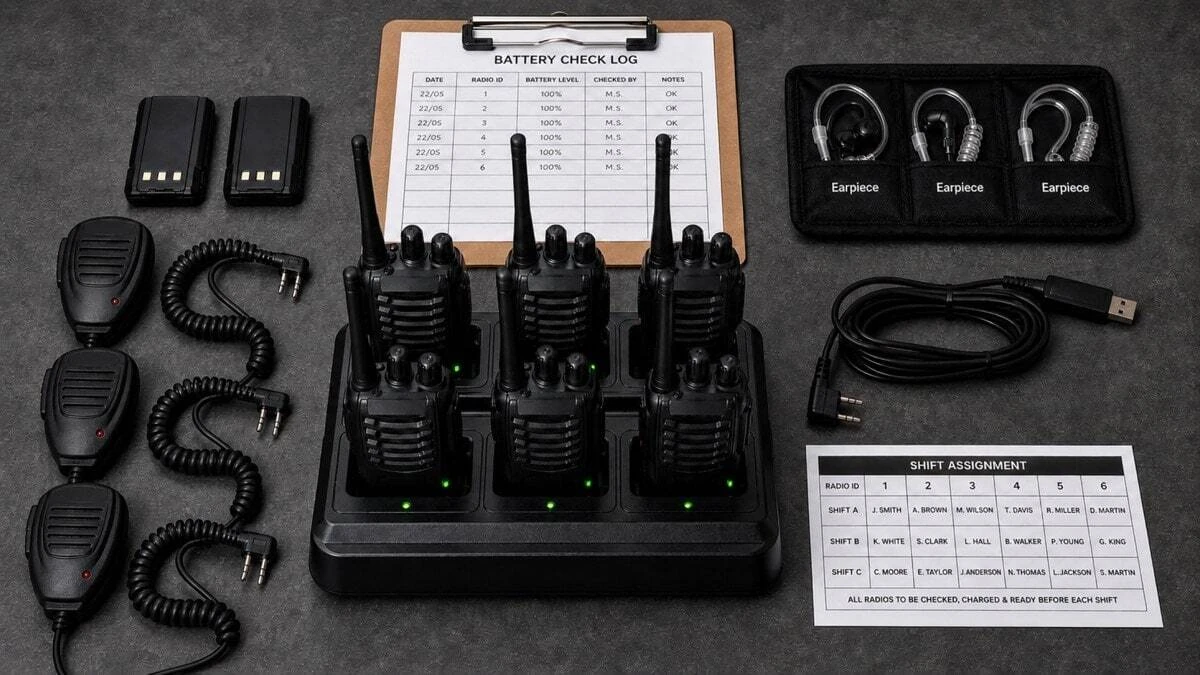
Base charger capacity on the turnaround window. If six compatible batteries all return together and all must be ready before there is time for a second full charging cycle, plan six compatible charging positions. If verified charge times and staggered returns permit multiple cycles, fewer positions may work.
For illustration only, assume six batteries each require three hours to recharge. With a six-hour window, three positions could process two batches of three in an ideal schedule. That assumes all six are available at the start, both batches take the stated time and somebody swaps them promptly. It leaves no delay allowance; actual charging instructions and observed performance must determine the final arrangement.
⚠️ Charging Infrastructure Checklist: Check what each position charges: a complete radio, a detached battery or either. A six-position charger does not necessarily fit six arbitrary models. Also distinguish charging positions from power sockets, and use the power supplies and charging arrangements specified for the equipment.
If the whole handset must be removed from service to charge, include that unavailability in the operational peak. With detachable batteries and an adequate rotation, a charging battery need not take a working radio out of service.
Turn the Calculation into a Purchase List
Once your peak and reserve are agreed, list radios, batteries, charging positions and role-specific accessories separately. In the venue example, the target is 11 usable radios; it does not automatically mean 11 extra batteries, 11 charging docks or 11 identical headsets.
Compare two-way radio multi-packs by the actual number of handsets and included accessories. A ten-radio pack plus one compatible unit may match the example; another combination may offer a better complete cost. Check the contents of the selected options before treating a pack name or product photograph as a full equipment list.
Choose equipment appropriate to the intended UK use. Compliant PMR446 radios can be used without an individual Ofcom radio licence; other high-power systems require the appropriate Business Radio authorisation. Buying more radios does not resolve a coverage or compatibility problem, so trial the proposed setup before ordering the full fleet.
Finally, check the worksheet against a busy operating period: who collected each radio, when it returned and whether a ready spare remained available. Revise the quantity when actual handovers, temporary duties or charging delays differ from the plan.
Explore Two-Way Radio Multi-Pack Sizes
📦 Tailored Fleet Multi-Packs for UK Teams
Select the exact multi-pack bundle tailored to your calculated peak roles and spares buffer.
2-Pack Kits
Ideal for small retail shops, pairs of stewards, or direct point-to-point security posts.
Explore 2-Packs3-Pack Kits
Suited for supervisor, entrance, and floor manager triangular coordination.
Explore 3-Packs4-Pack Kits
Standard four-point coverage: entrance, backstage, hospitality, and roving rover.
Explore 4-Packs5-Pack Kits
Provides four active operational roles plus one dedicated ready reserve spare.
Explore 5-Packs6-Pack Kits
The industry standard team pack, frequently paired with 6-way multi-charger docks.
Explore 6-Packs8-Pack Kits
Complete medium-venue coverage for door supervisors, bar managers, and medical staff.
Explore 8-Packs10-Pack Kits
Comprehensive multi-departmental coverage for festivals, logistics depots, and schools.
Explore 10-Packs20-Pack Kits
Full enterprise fleet deployment with maximum multi-buy savings and accessories.
Explore 20-PacksFAQs About How Many Walkie Talkies You Need
1. Do I need to buy walkie talkies in pairs?
No. For direct communication you need another compatible radio to communicate with, but an existing compatible handset can fulfil that role. Check whether a listing contains one radio, a pair or a larger pack before comparing prices.
2. Does adding more walkie talkies mean I need more channels?
Not automatically. Several users can share a compatible voice channel, although normally only one person can transmit intelligibly at a time on the same conventional simplex channel. Base the channel plan on conversation groups and traffic, rather than assigning a separate channel to every handset.
3. Should I buy the complete radio fleet before testing it?
A small representative trial is a better starting point where practical. Check coverage, audio, controls, battery use and the handover process with the people who will use the equipment, then apply those findings to the quantity plan.
4. How many spare batteries should I order per radio?
For standard single 8-hour shifts, one battery per radio is usually sufficient if charged overnight. For continuous 24-hour operations or 12-hour shifts with high transmit usage, plan for a 1:1 or 2:1 spare battery ratio per handset to enable seamless hot-swapping.
Operational notice: Fleet sizing calculations provided in this guide are planning tools based on standard operational practices. Always verify equipment compatibility, site coverage limitations, and statutory safety licensing before deploying communications fleets for safety-critical operations.