
31st Aug 2026
Bluetooth Two-Way Radios and Walkie Talkies: What UK Buyers Need to Know
This guide was written and reviewed by the Baofeng UK technical team — UK-based radio communications specialists with over 10 years of experience helping buyers understand radio technology, Bluetooth programming features and UK compliance. Licensing information reflects current Ofcom guidance.
Bluetooth has quietly made its way into two-way radios, but it has also created a new bit of confusion.
Search for a walkie talkie Bluetooth model and you might expect something that works like Bluetooth earbuds: pair it with your phone, connect a wireless headset and start talking. Some radio systems do offer Bluetooth audio capabilities, but that is not automatically what "Bluetooth" means on every walkie talkie.
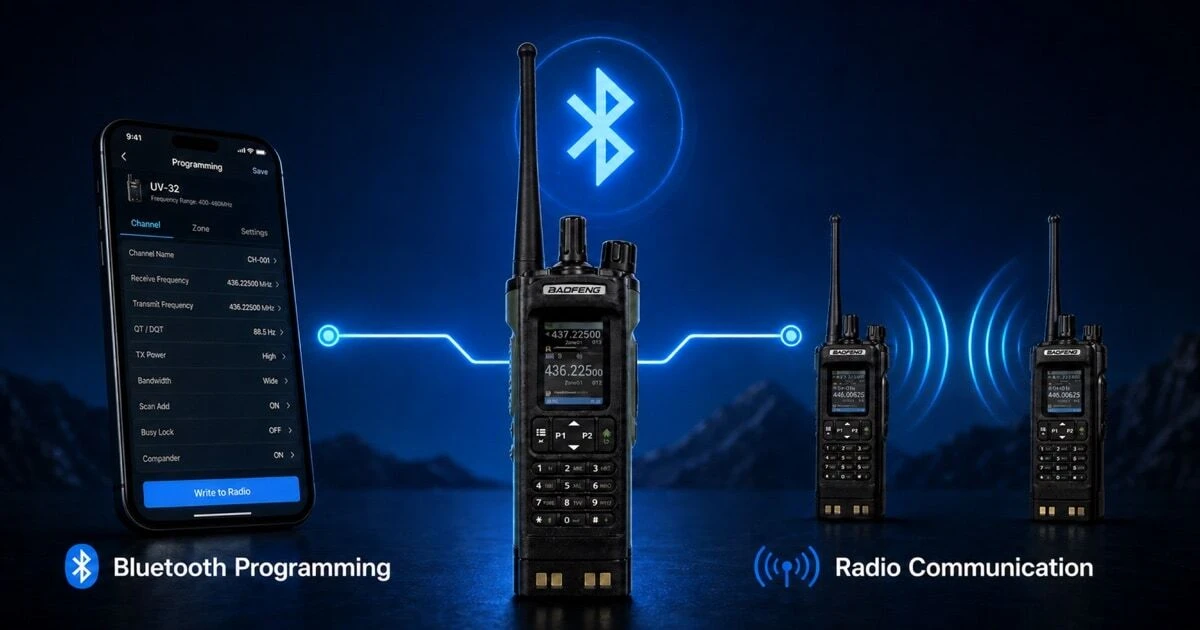
On several newer Baofeng radios, Bluetooth is primarily there to make programming the radio from a smartphone easier. Instead of finding the right programming cable, installing drivers and sitting beside a computer, compatible radios can be configured through an app.
That sounds like a small convenience until you are standing in a field, running an event or trying to configure several radios before a shift starts.
Bluetooth is a short-range wireless connection between the radio and another nearby device. Depending on the radio, it can be used for programming, accessories, audio or data. The important point is that Bluetooth functionality varies by model. For Baofeng models such as the UV-5R Mini and UV-32, the Bluetooth feature documented by Baofeng UK is primarily smartphone app programming. Users can change radio settings and manage channels from a compatible mobile app without relying on a conventional USB programming cable.
Key distinction: Bluetooth does not replace the radio link between two walkie talkies. Your actual voice communication still travels over the radio frequencies supported by the transceiver. It also does not increase transmission range.
⚡ Bluetooth walkie talkies — key points for UK buyers
- 📲 Main use on Baofeng radios: Smartphone app programming — change channels and settings wirelessly without a USB cable
- 🎧 Not always headset audio: "Bluetooth" on a radio spec does not automatically mean wireless earbuds — check the specific feature
- 📡 Range is unchanged: Bluetooth does not extend radio-to-radio communication distance
- ⚖️ Licensing is separate: Bluetooth has no effect on whether your radio needs an Ofcom licence
- 🔌 No Bluetooth built-in? A compatible adapter may add Bluetooth programming to existing radios
- ✅ When it is most useful: Regularly changing configurations, managing multiple radios, or programming in the field without a laptop
📋 Table of Contents
- Bluetooth walkie talkie features are not all the same
- Why smartphone programming is more useful than it sounds
- Baofeng UV-5R Mini: Bluetooth without the programming cable
- Baofeng UV-32: Bluetooth for users who want more control
- What if your Baofeng does not have Bluetooth built in?
- Bluetooth does not give a walkie talkie more radio range
- Does a Bluetooth walkie talkie need a licence in the UK?
- Where Bluetooth radios make the most sense
- Bluetooth vs a conventional walkie talkie
- Recommended Bluetooth and non-Bluetooth radios
- What to check before buying a Bluetooth two-way radio
- Are Bluetooth walkie talkies worth it?
- Frequently asked questions
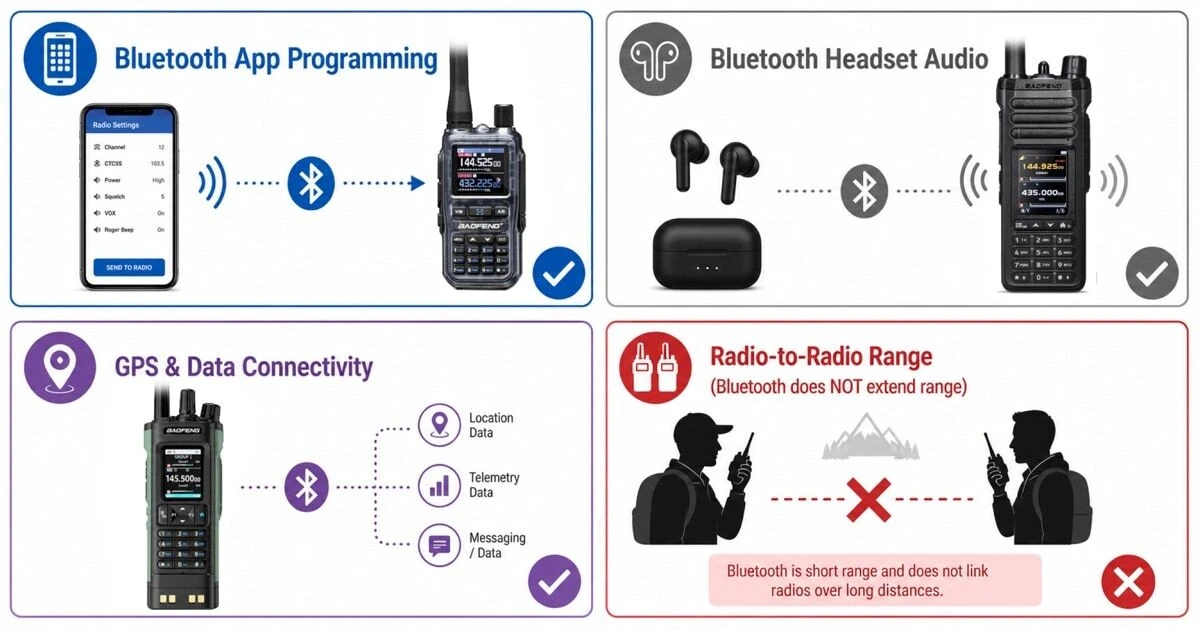 Not all Bluetooth walkie-talkie features are equal — app programming, headset audio and GPS data are distinct functions. Radio-to-radio range is entirely separate from Bluetooth and is not affected by it.
 Bluetooth walkie talkie features are not all the same
This distinction matters when shopping.
| Bluetooth feature | What it means | Why it may matter |
|---|---|---|
| Bluetooth app programming | Phone communicates wirelessly with the radio to change settings | Easier channel and configuration changes |
| Bluetooth programming adapter | An external adapter adds wireless programming to a compatible radio | Useful for radios without built-in Bluetooth |
| Bluetooth headset/audio | Radio sends or receives audio through a Bluetooth accessory | Can reduce cables during hands-free operation |
| GPS/data connectivity | Bluetooth may be part of a wider smart-radio ecosystem | Useful on certain advanced models |
| Radio-to-radio communication | The normal VHF/UHF or other radio transmission | This is separate from Bluetooth — Bluetooth does not affect this |
⚠️ Buying risk: If wireless audio is important to you, check specifically for Bluetooth audio or Bluetooth headset compatibility. Do not assume that a radio described as Bluetooth-programmable can automatically pair with ordinary wireless earbuds.
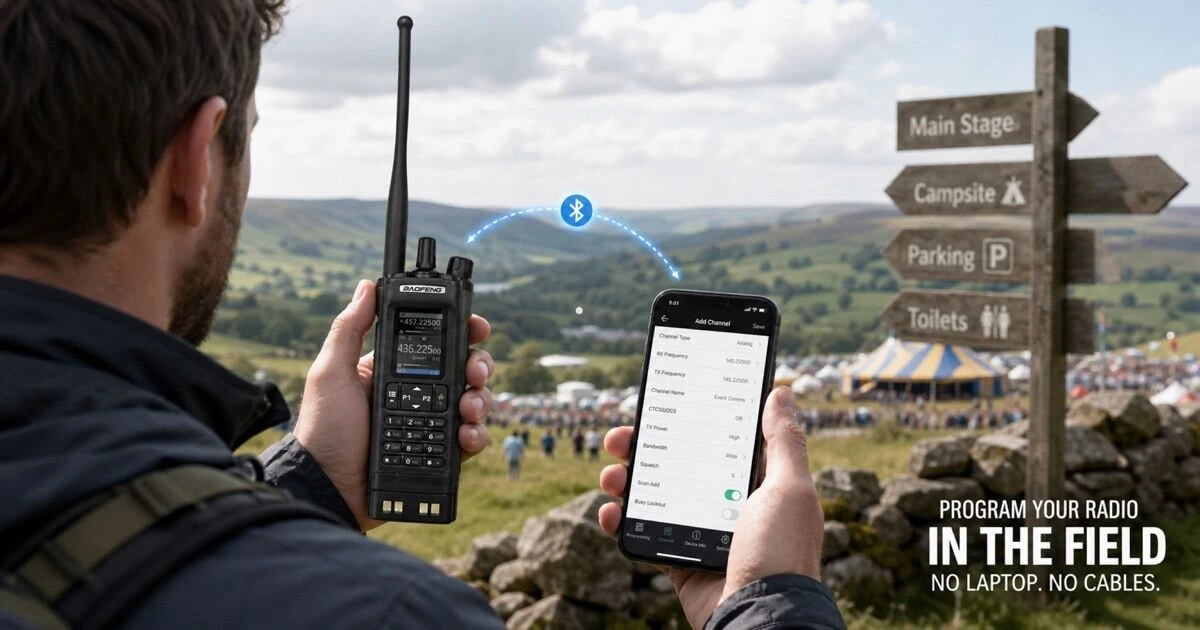 Bluetooth programming means changing radio settings from the smartphone already in your pocket — no laptop, no USB drivers, no cable to track down. In a field, at an event or before a shift starts, this makes a practical difference.
 Why smartphone programming is more useful than it sounds
Traditional programmable radios can be intimidating for new users. The radio itself may have dozens or hundreds of channel memories, frequency settings, tones, offsets and menu options. PC programming makes managing them easier, but introduces a different problem: cables, USB drivers and software compatibility.
Bluetooth programming removes some of that friction. With the compatible app and radio, you can adjust settings from the phone that is probably already in your pocket. Baofeng UK's software resources currently identify models including the UV-5R Mini, UV-32 GPS and UV-28 Pro as having built-in Bluetooth programming, while several other radios can use a compatible BT-A1D Bluetooth programming adapter.
- For a beginner, the value is simplicity
- For somebody running several radios, the value is speed and consistency
- For a hiker, event organiser or amateur operator away from home, the benefit is making configuration changes without carrying a laptop
🔵 Setup guide: If you already own a compatible Baofeng and want to understand the setup process, the Bluetooth programming and OLA app guide explains the wireless programming workflow.
Baofeng UV-5R Mini: Bluetooth without the programming cable
The Baofeng UV-5R Mini is one of the clearest examples of how Bluetooth is being used in a modern handheld radio. Its published specifications include built-in Bluetooth app programming, up to 999 memory channels, an 1800mAh battery with USB-C charging and VHF/UHF transmission capability.
The interesting part is not simply that it has Bluetooth. It is that Bluetooth addresses one of the most common frustrations around programmable radios: setup.
Baofeng's own programming documentation shows that the radio can be placed into its wireless programming mode and connected to the OLA Radio app on an iOS or Android device. That makes the Mini particularly interesting for users who like the flexibility of a programmable handheld but do not want their first experience to involve troubleshooting a USB driver.
⚠️ Still a learning curve: There is still a learning curve. You need to understand what frequencies, channels and settings you are programming. Bluetooth makes the interface easier; it does not remove the need to use the radio correctly.
Baofeng UV-32: Bluetooth for users who want more control
The Baofeng UV-32 GPS Bluetooth two-way radio takes the same idea further. Baofeng UK's current product specification lists Bluetooth app programming alongside GPS positioning, a 2-inch display, 1,000 memory channels, a 2500mAh USB-C rechargeable battery and selectable high, medium and low transmit power.
This makes it a more appropriate example for the enthusiast or experienced user who regularly changes configurations and wants more information visible on the handset itself.
🎯 Important buying lesson: Bluetooth is not the feature that determines whether the UV-32 or UV-5R Mini is right for you. Transmission requirements, licensing, environment, battery needs, size and radio features matter more. Think of Bluetooth as a workflow improvement, not the core communication technology.
What if your Baofeng does not have Bluetooth built in?
Buying a new radio is not always necessary simply because you want wireless programming. Baofeng UK's UV-5R Series information states that the BT-A1D Bluetooth programming adapter can add OLA app programming to compatible models including the UV-5R, UV-5RH, UV-5RH Pro GPS and UV-5RM Plus. The UV-5R Mini has Bluetooth built in and therefore does not need the adapter.
This creates three practical choices:
Consider a model with built-in app programming for the simplest experience
Check whether the Bluetooth programming adapter supports your model
Continue using CHIRP/CPS and a compatible programming cable — perfectly adequate if settings rarely change
🟢 No pressure to upgrade: There is no reason to pay for Bluetooth purely because it sounds newer. If your radio configuration rarely changes, traditional programming may be perfectly adequate.
Bluetooth does not give a walkie talkie more radio range
This misconception is worth clearing up. Bluetooth works over a comparatively short local connection between devices. It is not responsible for the range between the two people speaking over their walkie talkies.
Radio range instead depends on factors such as frequency, permitted transmit power, antenna characteristics, terrain, building materials, elevation and obstructions. A hilltop conversation across open ground is very different from trying to communicate through several concrete floors.
🔵 For genuine range requirements: Buyers who genuinely need greater radio coverage should compare the radio specification and expected operating environment rather than filtering products simply by Bluetooth support. Baofeng UK's long-range two-way radio collection provides a more relevant starting point for those requirements.
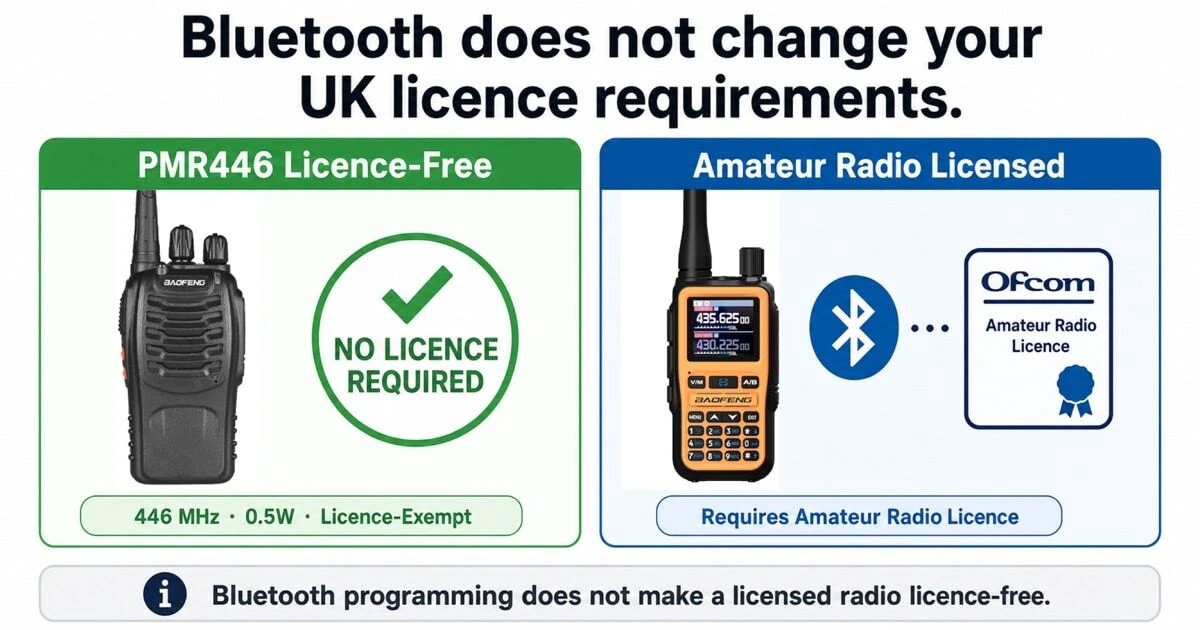 Bluetooth has no effect on UK radio licensing. A PMR446 radio remains licence-free with Bluetooth on or off. A programmable Bluetooth radio still requires the appropriate Ofcom licence to transmit — Bluetooth programming does not change that.
 Does a Bluetooth walkie talkie need a licence in the UK?
Potentially, yes. Bluetooth has no bearing on whether your two-way radio transmissions require an Ofcom licence. This is probably the most important point for a UK buyer.
Ofcom states that compliant PMR446 equipment can be operated on a licence-exempt basis in the UK. PMR446 operates between 446.0 and 446.2 MHz and has a maximum permitted effective radiated power of 0.5 watts. Ofcom also states that operating as a UK radio amateur requires an Amateur Radio Licence, with Foundation, Intermediate and Full licence levels providing different privileges.
⚠️ A Bluetooth feature does not change either rule. For example, the UV-5R Mini is sold as a programmable multi-band amateur radio with 5W transmit capability. Its Bluetooth programming function makes configuration more convenient, but it does not transform the radio into a licence-free PMR446 handset.
If you simply need straightforward licence-free short-range communication for staff, family activities or similar purposes, a compliant PMR446 model such as the BF-88ST Pro PMR446 licence-free radio may be the more appropriate choice.
For a more detailed explanation, read the site's UK walkie talkie licence guide before transmitting with a programmable or higher-power radio.
Where Bluetooth radios make the most sense
A Bluetooth radio becomes compelling when setup itself is part of the problem.
- An outdoor group changing channel plans before a trip — carrying a laptop just to reprogramme a handheld radio is inconvenient
- An amateur operator who wants to adjust saved channels away from home — phone-based configuration can be much easier
- An event or operational team where consistent settings across multiple units matters more than the novelty of Bluetooth itself
⚠️ When Bluetooth may not add value: The appeal is different for somebody buying two simple radios for occasional family use. If the radios will remain on the same pre-programmed channels, Bluetooth may offer little practical value. A simpler PMR446 set could make more sense. That is the decision buyers should be making: will Bluetooth remove a problem you actually have?
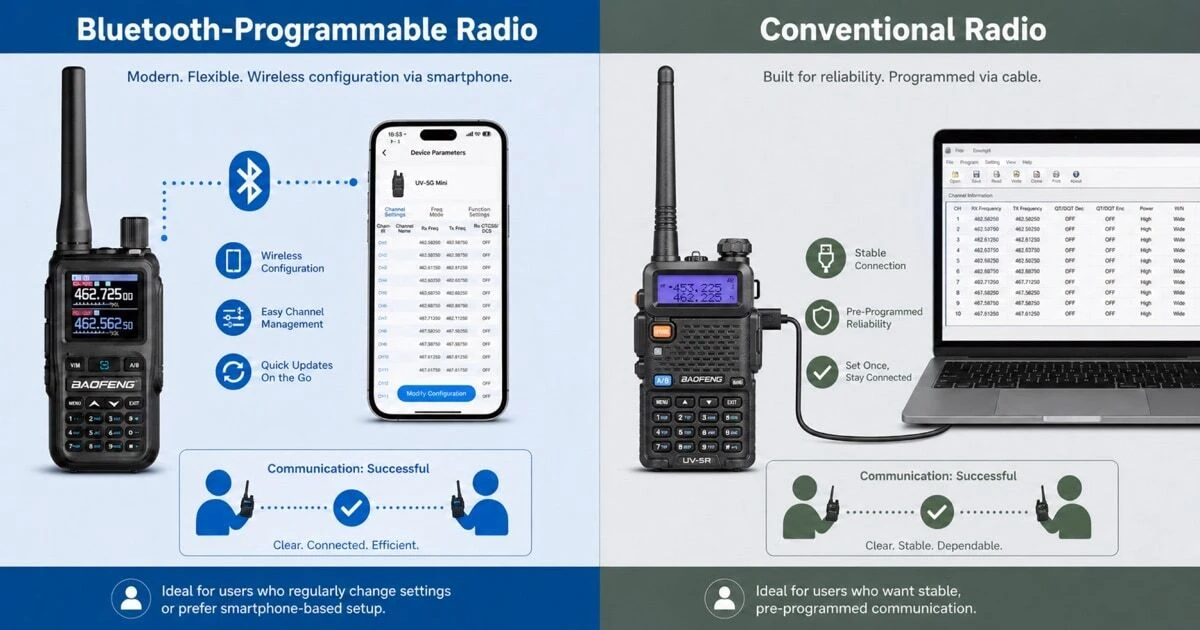 Neither approach is automatically superior. Bluetooth-programmable radios suit users who regularly change settings or want easier field configuration. Conventional radios with USB programming suit users who want stable, pre-programmed communication with minimal setup.
 Bluetooth vs a conventional walkie talkie
| Consideration | Bluetooth-programmable radio | Conventional radio |
|---|---|---|
| Smartphone configuration | Available on compatible models | Usually unavailable |
| Programming cable | May not be necessary | Often required on programmable models |
| Basic push-to-talk communication | Yes | Yes |
| Radio range | Determined by radio system, not Bluetooth | Determined by radio system |
| UK licence status | Depends on radio specification and use | Depends on radio specification and use |
| Ideal buyer | User who changes settings or values easier setup | User who wants simple, stable communication |
| Possible downside | More features and settings to learn | Less flexible configuration |
🎯 The more useful question: Do you need a radio that is easy to configure or simply easy to operate? Those are not always the same thing.
Recommended Bluetooth and non-Bluetooth radios for UK buyers
The six models below cover both categories — Bluetooth-programmable radios for users who value wireless configuration, and compliant PMR446 options for users who simply need straightforward licence-free communication.
📻 Baofeng Radios — With and Without Bluetooth
Choose by what you actually need — wireless programming convenience or simple licence-free operation.
📲 Built-In Bluetooth App Programming — For Licensed Operators Who Value Wireless Setup
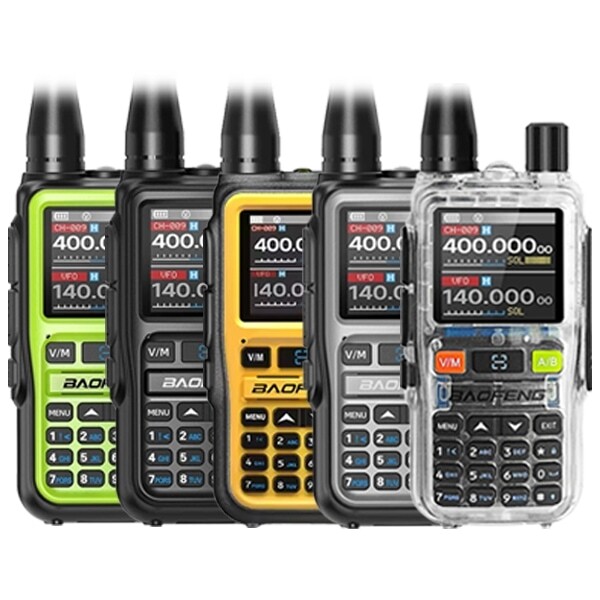
Baofeng UV-5R Mini
Built-in Bluetooth · 5W · 999 channels · USB-C · OLA app programmable — the most compact Bluetooth-programmable entry point for licensed users who want wireless configuration without a cable.
View UV-5R Mini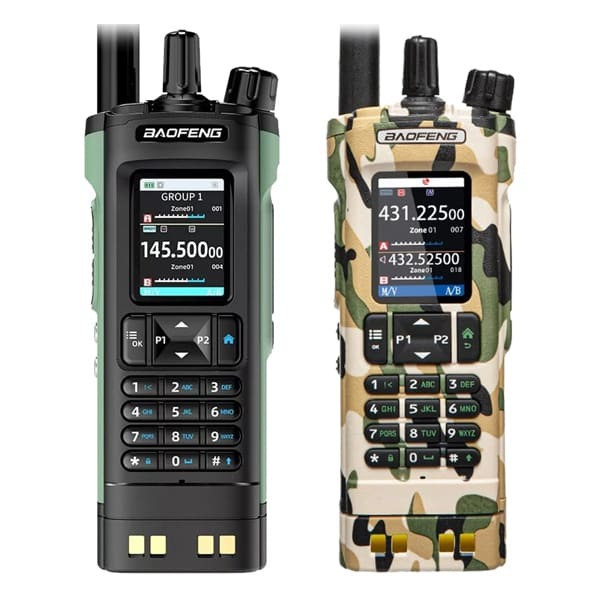
Baofeng UV-32 GPS
Built-in Bluetooth · 10W · GPS · 1,000 channels · 2500mAh USB-C — advanced Bluetooth + GPS for licensed operators who regularly update configurations and want maximum display information.
View UV-32 GPS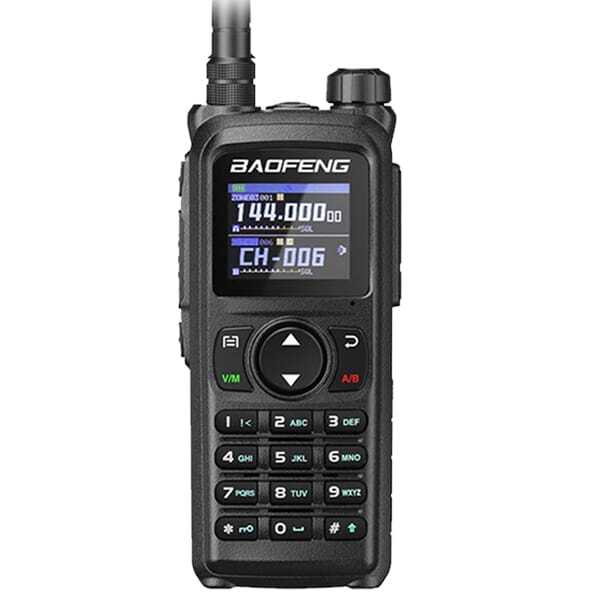
Baofeng UV-28 PRO
Built-in Bluetooth · 10W · GPS · Multi-band · OLA app programmable — high-power Bluetooth radio for experienced licensed operators who need maximum flexibility and wireless configuration.
View UV-28 PRO✅ No Bluetooth Needed — Licensed Advanced & PMR446 Licence-Free Options
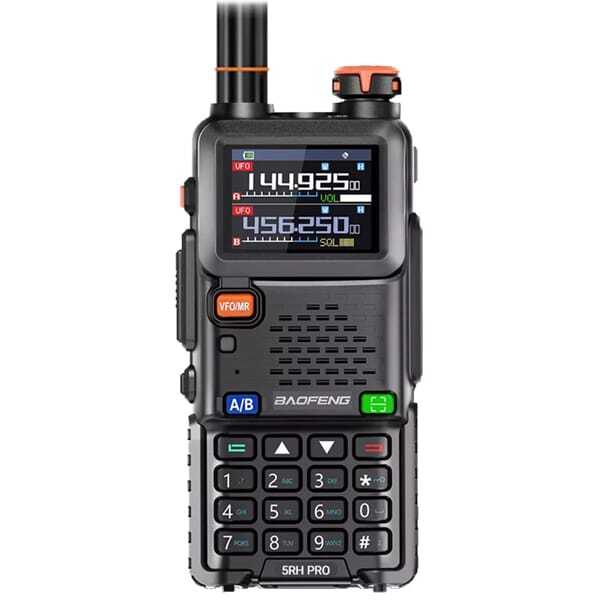
Baofeng UV-5RH PRO GPS
10W · GPS · 640 channels · USB-C · BT-A1D adapter compatible — add Bluetooth programming with the optional adapter, or use traditional PC programming with CHIRP. Licensed use.
View UV-5RH PRO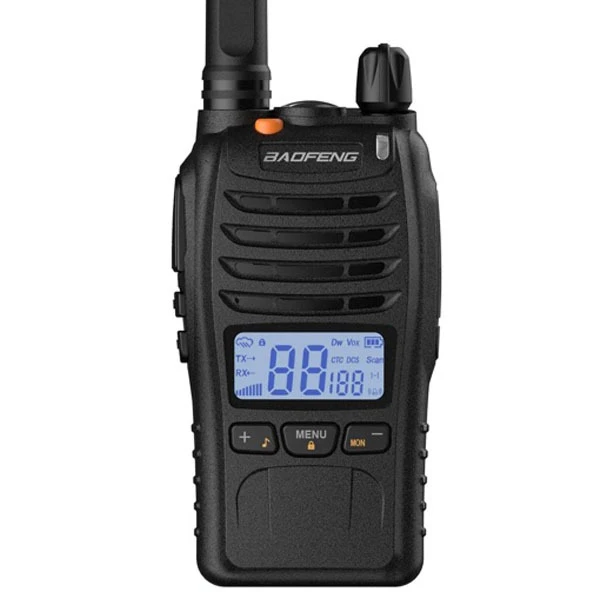
Baofeng BF-88ST Pro PMR446
PMR446 compliant · No licence needed · Simple pre-programmed channels — for users who do not need Bluetooth and want straightforward licence-free short-range communication from day one.
View BF-88ST Pro PMR446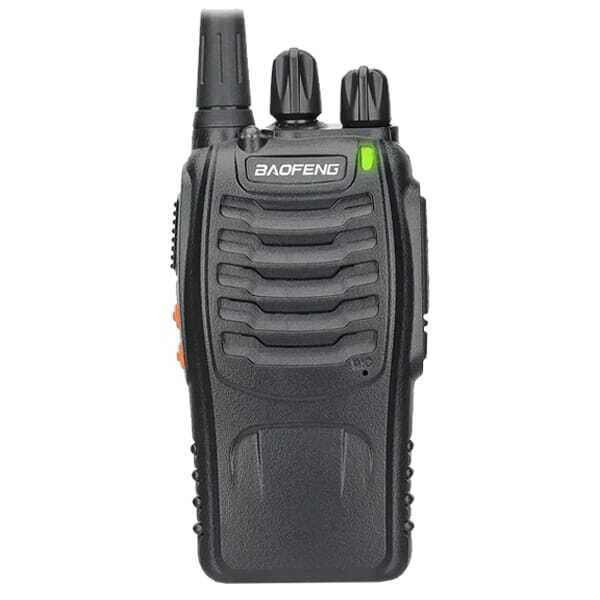
Baofeng BF-888S PMR446
0.5W · 16 PMR446 channels · Fixed antenna · No licence needed — the most affordable way to equip a team with licence-free communication when Bluetooth is simply not needed.
View BF-888S PMR446⚠️ UV-5R Mini, UV-32 GPS, UV-28 PRO and UV-5RH PRO require an appropriate Ofcom Amateur Radio Licence to transmit. PMR446 models are licence-free when compliant. Always verify licensing before transmitting.
What to check before buying a Bluetooth two-way radio
Start with the job, not the feature list. A restaurant may value a compact handset and simple staff controls. A hiker may care more about battery charging and weather resistance. An amateur radio beginner may prioritise easier programming. A security or event team may need consistent channel configurations across a larger fleet.
Pre-purchase checklist for Bluetooth two-way radios
- Confirm what "Bluetooth" actually does on this specific product — app programming, audio or both
- If you need wireless earbuds, check specifically for documented Bluetooth audio support
- Check the radio system itself: supported frequencies, permitted transmit power and UK licence requirements
- Consider battery capacity, charging method and physical durability for your intended environment
- Decide whether your radio settings will change regularly — if not, Bluetooth may not add value
- If you already own a compatible radio, check whether the BT-A1D adapter will add Bluetooth programming
- For licence-free use, confirm the radio is explicitly PMR446-compliant, not simply programmable to PMR446 frequencies
Are Bluetooth walkie talkies worth it?
For the right user, yes — but probably not for the reason the word "Bluetooth" initially suggests. The most interesting benefit in models such as the UV-5R Mini and UV-32 is not that Bluetooth changes how radio communication works. It is that it makes a traditionally technical task much less awkward.
Programming channels from a smartphone instead of finding a computer and cable can be genuinely useful in the field.
📋 The two rules that matter most
- Check exactly what the Bluetooth function supports — app programming, audio or something else specific to that model
- Treat UK radio licensing as a completely separate issue — Bluetooth can make a walkie talkie smarter to configure. It cannot change the law governing which transmissions you are allowed to make
- For someone who never changes radio settings, Bluetooth may be unnecessary
- For someone who regularly configures radios, manages multiple channels or wants an easier introduction to programmable two-way radio, it can remove one of the biggest barriers to ownership
You can compare the broader range through Baofeng walkie talkies and handheld two-way radios.
Frequently asked questions
What does Bluetooth do on a walkie talkie?
On most modern Baofeng radios, Bluetooth is primarily used for smartphone app programming — allowing users to change radio channels, frequencies and settings wirelessly from a phone without needing a USB cable and computer. Some radio systems also support Bluetooth audio accessories, but this is not universal. Always check the specific product specification to confirm exactly what the Bluetooth function supports on that model.
Does Bluetooth increase walkie talkie range?
No. Bluetooth is a short-range local wireless connection between the radio and a paired device such as a smartphone. It has no effect on the radio-to-radio communication range between two walkie talkie users. Radio range depends on factors such as frequency, permitted transmit power, antenna design, terrain and obstructions.
Can I use Bluetooth to connect wireless earbuds to my walkie talkie?
Not necessarily. Many Baofeng radios with Bluetooth support wireless programming via smartphone app, but not all of them also support Bluetooth audio accessories. If wireless earbuds or headsets are important to you, look specifically for documented Bluetooth audio support in the product specification rather than assuming it is included. Check connector compatibility and microphone positioning before purchasing any audio accessory.
Does having Bluetooth make a walkie talkie licence-free in the UK?
No. Bluetooth has no effect on UK radio licensing. Whether a walkie talkie requires an Ofcom licence depends on the radio equipment, frequency, transmit power and intended use — not whether Bluetooth is present. A programmable Bluetooth radio such as the UV-5R Mini still requires an appropriate Amateur Radio Licence to transmit legally. Compliant PMR446 radios are licence-free regardless of whether they have Bluetooth.
What is the BT-A1D Bluetooth adapter?
The BT-A1D is a Bluetooth programming adapter that connects to compatible Baofeng radios and enables wireless OLA app programming on models that do not have Bluetooth built in. Compatible models include the UV-5R, UV-5RH, UV-5RH Pro GPS and UV-5RM Plus. The UV-5R Mini has Bluetooth built in and does not require the adapter. Check the current product page for the full compatibility list before purchasing.
Is Bluetooth programming on a walkie talkie useful for beginners?
It can be. Bluetooth programming removes the need to find a specific USB cable, install drivers and use a computer — which can be a barrier for new radio users. Setting channels and configurations from a smartphone app is generally more approachable. However, Bluetooth does not remove the need to understand radio fundamentals: frequencies, channels, power levels and UK licence requirements still apply regardless of how the radio is programmed.
Find the Right Radio — With or Without Bluetooth
From compact Bluetooth-programmable handsets for licensed operators to simple PMR446 licence-free radios for families and teams — Baofeng UK has the right two-way radio for every configuration preference and budget.
Browse All Walkie Talkies