
2nd Aug 2026
Who Invented Walkie Talkies? The Real Story Behind Portable Radio
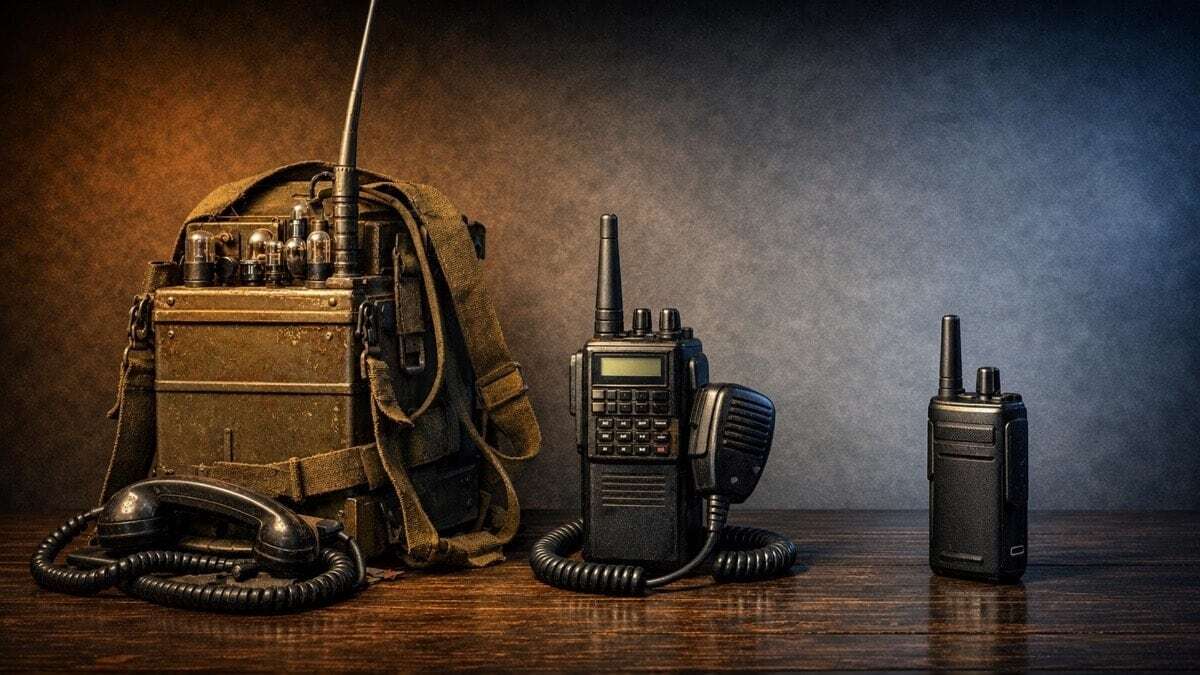
This article was researched and produced by the Baofeng UK team, drawing on published accounts of Donald Hings' wartime contributions, Motorola's documented SCR-300 and SCR-536 development records, and Ofcom's current PMR446 licensing guidance. Historical claims reflect the most widely cited sources in radio engineering history. Where accounts differ between historians, both perspectives are noted.
The walkie-talkie is most commonly credited to Canadian inventor Donald Hings, who developed a portable two-way voice radio called the "Packset" in 1937.
That answer, however, leaves out an important part of the story. Several engineers in Canada and the United States developed portable two-way radios independently during the late 1930s and early 1940s. Donald Hings created an early practical pack radio, Alfred J. Gross developed a compact VHF transceiver, and engineering teams at Galvin Manufacturing — later Motorola — produced the wartime SCR-300 and SCR-536 radios.
So, when was the walkie talkie invented? The most widely accepted starting date is 1937, although the device recognisable as a modern handheld walkie-talkie emerged during the following few years.
⚡ The quick answer: who invented the walkie-talkie?
- 🏆 First inventor: Donald Hings (Canada, 1937) — developed the portable "Packset" voice transceiver for remote operations
- 📻 Independent pioneer: Alfred J. Gross (USA, 1938) — compact VHF handheld transceiver, later contributed to CB radio and paging
- ⚔️ Military standard: SCR-300 (Galvin/Motorola, 1940–43) — the FM backpack radio that made "walkie-talkie" a household name
- 🖐️ Handheld design: SCR-536 Handie-Talkie (1940–41) — one-handed operation, closer to the modern design
- 📅 No single inventor: The walkie-talkie was a sequence of overlapping inventions shaped by remote-work needs and wartime urgency
📋 Table of Contents
- The walkie-talkie invention timeline
- Donald Hings and the 1937 Packset
- Why Alfred J. Gross is also called a walkie-talkie inventor
- The SCR-300 made "walkie-talkie" a familiar name
- The SCR-536 looked more like a modern handheld radio
- Was the walkie-talkie invented for the military?
- How walkie-talkies evolved after the war
- A UK note: modern walkie-talkies are regulated
- Who deserves the final credit?
- Frequently asked questions
The walkie-talkie invention timeline
| Year | Inventor or team | Contribution |
|---|---|---|
| 1937 | Donald Hings | Developed the portable "Packset" voice transceiver for remote Canadian operations |
| 1938 | Alfred J. Gross | Developed an independent compact VHF handheld transceiver |
| 1940 | Daniel E. Noble and the Galvin team | Developed the SCR-300 portable FM backpack radio |
| 1940–1941 | Donald Mitchell and the Galvin team | Created the handheld SCR-536 "Handie-Talkie" |
| 1943 onwards | Galvin Manufacturing | Began large-scale SCR-300 production for Allied forces |
🎯 Why there is no single uncontested answer: The timeline explains why historians still debate the question. "Walkie-talkie" gradually became a general name for several related portable radio designs rather than one precisely defined invention.
 Donald Hings designed the Packset in 1937 for pilots, geologists and mining teams working in remote parts of British Columbia — not for the military, and not under wartime pressure. The military application came later.
 Donald Hings and the 1937 Packset
Donald Lewes Hings was working for the Consolidated Mining and Smelting Company of Canada when he was asked to solve a serious communication problem.
Pilots, geologists and mining teams were travelling through remote parts of British Columbia where fixed telephone infrastructure was unavailable. If an aircraft landed unexpectedly or a field team became isolated, communicating with a base could be extremely difficult.
Hings responded by creating a portable emergency voice transceiver in 1937. He called it the Packset, not a walkie-talkie. It was intended to be carried into remote areas and used for two-way speech rather than Morse code alone.
When the Second World War began, the Canadian military recognised the value of the design. Hings worked on military versions, including sets adapted for different environments and battlefield conditions. Approximately 18,000 Canadian walkie-talkies based on this development were reportedly produced by the end of the war.
Hings therefore has the strongest claim to being the person who invented the first practical walkie-talkie concept.
Why Alfred J. Gross is also called a walkie-talkie inventor
Alfred J. Gross was another important wireless pioneer. Working independently in the United States, he developed a compact high-frequency two-way radio around 1938.
Gross concentrated on the then relatively unexplored VHF and UHF frequency ranges. His work later contributed to military communication systems as well as civilian technologies including CB radio, paging and cordless communication.
His device appeared shortly after Hings' Packset and was closer in spirit to a small handheld transceiver. This is why some accounts name Gross as the walkie-talkie's inventor.
🔵 The fairest interpretation: Gross was an independent pioneer of handheld two-way radio, while Hings had already built a working portable voice-radio system in 1937. Both engineers deserve recognition — their work overlapped rather than one simply copying the other.
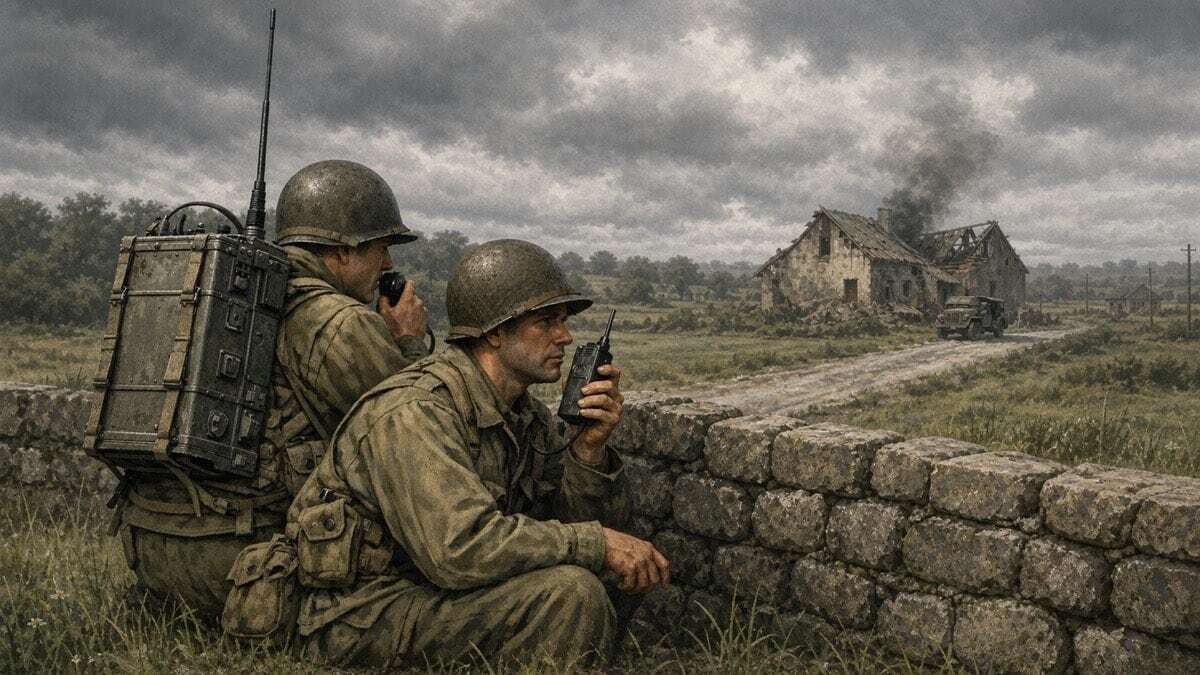 The SCR-300 (carried in a backpack) and the SCR-536 (held in one hand) gave rise to two distinct terms — walkie-talkie and handie-talkie — that were eventually merged into everyday language as a single word.
 The SCR-300 made "walkie-talkie" a familiar name
The device that helped popularise the term was the SCR-300, developed for the United States Army by Galvin Manufacturing Corporation, the company that later became Motorola.
Daniel E. Noble led the technical development of this portable FM radio. It was carried in a backpack and gave infantry units clearer, more mobile communication than many earlier battlefield sets. Motorola describes the SCR-300 as the world's first portable FM two-way radio. Production began in 1943, and more than 45,000 units were manufactured before the end of the war.
⚠️ Not quite pocket-sized: The SCR-300 weighed roughly 35 pounds, or almost 16 kilograms. A soldier could walk while carrying it and talk through a connected handset, which helped make "walkie-talkie" an appropriate and memorable nickname.
The SCR-536 looked more like a modern handheld radio
While the SCR-300 was carried on the back, the SCR-536 was designed to be operated with one hand.
Donald Mitchell and his team at Galvin Manufacturing began developing it in 1940 after Mitchell observed that vehicle-mounted radios could become useless when troops had to abandon their vehicles. Their solution was a self-contained AM radio containing its batteries, antenna, microphone, receiver and push-to-talk control in one portable case.
The SCR-536 weighed about five pounds and had a typical range of around one mile. The US Army placed an experimental order in early 1941, and the radio went on to become standard equipment for infantry and airborne personnel. It was officially known as a Handie-Talkie, although the public often used "walkie-talkie" for both designs.
- Walkie-talkie originally referred mainly to a portable radio carried while walking, including backpack sets.
- Handie-talkie referred to a unit designed to be held and operated in the hand.
- In everyday language, "walkie-talkie" eventually became the standard term for almost every portable push-to-talk radio.
Was the walkie-talkie invented for the military?
Not originally.
Donald Hings' first Packset was designed for civilian work in isolated Canadian regions. Its purpose was to connect pilots and field workers with remote bases. The Second World War accelerated development because armies urgently needed radios that could move with troops rather than remain installed in buildings or vehicles.
The military did not create the underlying idea, but wartime investment transformed portable radio from specialist field equipment into a widely manufactured and operationally important technology.
🎯 A recurring pattern in technology history: That familiar pattern appears throughout technology history — an invention begins as a solution to a narrow problem, then an emergency pushes engineers to make it lighter, stronger and easier to produce.
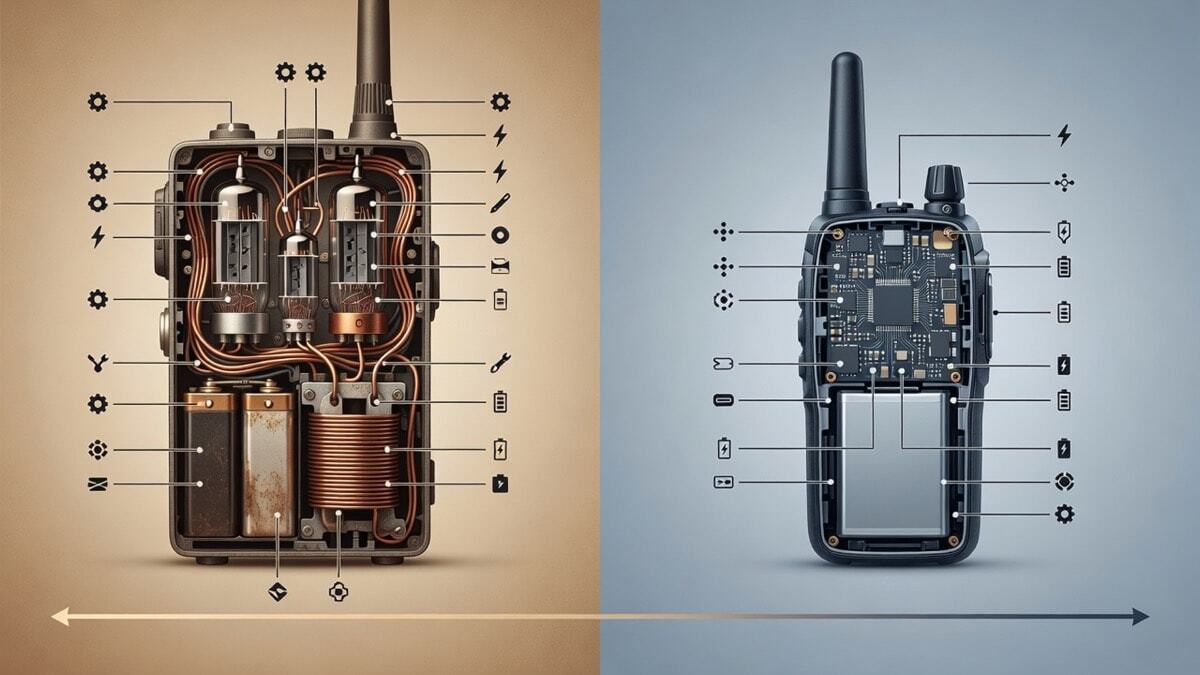 From vacuum tubes and heavy wet-cell batteries to integrated circuits and lithium-ion cells — the physical size shrank dramatically, but the operating principle of press, speak and release remained unchanged across eight decades.
 How walkie-talkies evolved after the war
Early sets relied on valves, heavy batteries and large components. Modern walkie-talkies use solid-state electronics, rechargeable lithium-ion batteries and compact integrated circuits.
Depending on the model and permitted use, a present-day radio may offer:
- Multiple programmable channels
- CTCSS or DCS filtering
- Digital audio
- USB-C charging
- Weather resistance
- Scanning and monitoring functions
- Headset and earpiece compatibility
- GPS or Bluetooth programming
🟢 What has not changed: The basic operating idea has changed very little. One person presses the push-to-talk button, speaks, releases the button and waits for the other person to respond. Modern systems are lighter and more capable, but the communication habit would still be recognisable to the engineers of the 1930s.
Readers interested in that operating method can explore this guide to walkie-talkie communication protocols and radio etiquette. The site also explains why CTCSS and DCS codes filter unwanted transmissions but do not encrypt a conversation.
A UK note: modern walkie-talkies are regulated
The earliest inventors did not have to navigate today's UK radio categories, but modern users do.
Ofcom describes PMR446 as a short-range, peer-to-peer radio service suitable for both business and non-business communication. Compliant PMR446 equipment can be operated without an individual radio licence. Other radios and frequency bands may require an amateur or business-radio licence before transmission is permitted.
⚠️ Important: A radio being physically capable of transmitting on a frequency does not automatically make that transmission legal. Always confirm the licensing requirements for the specific equipment and frequency before transmitting.
For families, hospitality teams, schools or casual outdoor groups that want straightforward local communication, a compliant licence-free PMR446 radio may be the simplest option. Amateur transceivers should be used according to the applicable Ofcom licence conditions.
 From remote Canadian wilderness operations in 1937 to a family campsite, a café kitchen and a community event in 2026 — the walkie-talkie found its everyday purpose far beyond what any of its inventors initially imagined.
 Who deserves the final credit?
Donald Hings deserves the clearest individual credit for inventing an early practical walkie-talkie in 1937.
Alfred J. Gross independently advanced the handheld transceiver in 1938. Daniel E. Noble and the Galvin Manufacturing team created the influential SCR-300 FM backpack radio, while Donald Mitchell's team developed the handheld SCR-536.
The walkie-talkie was therefore not a single flash of inspiration followed by an unchanged product. It was a sequence of inventions shaped by remote Canadian work, experimental radio engineering and the intense communication demands of the Second World War.
What began as a heavy pack radio is now small enough to clip to a belt. Yet its enduring appeal remains exactly the same: press one button and speak to someone without placing a call, finding mobile coverage or waiting for an internet connection.
🟢 From history to today: Modern licence-free PMR446 radios carry the same essential idea that Donald Hings demonstrated in 1937 — portable, push-to-talk, person-to-person communication without any infrastructure. Read the guide to walkie-talkie communication protocols and radio etiquette to get the most from a modern radio.
Frequently asked questions
Who invented the walkie-talkie?
The most widely accepted answer is Canadian engineer Donald Hings, who developed a portable voice transceiver called the Packset in 1937 for remote mining and aviation operations in British Columbia. However, American inventor Alfred J. Gross independently developed a compact VHF handheld radio in 1938, and the Galvin Manufacturing Corporation (later Motorola) created the influential SCR-300 and SCR-536 wartime radios between 1940 and 1943. There is no single, uncontested inventor.
When was the walkie-talkie invented?
The most commonly cited date is 1937, when Donald Hings built the Packset. The device recognisable as a modern handheld walkie-talkie — particularly the one-handed SCR-536 Handie-Talkie — emerged between 1940 and 1941. Large-scale military production of the SCR-300 began in 1943.
Was the walkie-talkie invented for military use?
Not originally. Donald Hings designed the Packset for civilian use — specifically to allow pilots, geologists and mining teams to communicate in remote parts of Canada. The military recognised the value of the design when the Second World War began, and wartime investment dramatically accelerated the development of portable radio technology.
What is the difference between a walkie-talkie and a handie-talkie?
The original distinction was practical. A walkie-talkie referred to a portable radio carried while walking, which included backpack-mounted sets like the SCR-300. A handie-talkie referred to a unit designed to be held and operated in one hand, like the SCR-536. In everyday language, "walkie-talkie" eventually became the standard term for almost every portable push-to-talk radio, regardless of size.
How heavy was the original walkie-talkie?
The SCR-300 backpack radio — one of the most significant early walkie-talkies — weighed roughly 35 pounds (approximately 16 kilograms). The SCR-536 Handie-Talkie, designed for one-handed operation, weighed around five pounds (about 2.3 kilograms). Modern PMR446 handheld radios typically weigh between 100 and 350 grams.
Do I need a licence to use a walkie-talkie in the UK today?
It depends on the radio and the frequencies used. Compliant PMR446 handheld radios can be operated without an individual Ofcom licence, provided the equipment meets all PMR446 technical requirements — including a fixed integral antenna, operation between 446.0 and 446.2 MHz and a maximum of 0.5W ERP. Higher-power radios, amateur transceivers and certain business-radio equipment require the appropriate Ofcom licence before transmission is permitted.
What does CTCSS mean on a walkie-talkie?
CTCSS stands for Continuous Tone-Coded Squelch System. It is a sub-audible tone transmitted alongside the voice signal that tells the receiving radio when to open its speaker. When two radios use the same CTCSS tone, the receiving radio only opens for transmissions that match. It does not encrypt the conversation — other users monitoring the same frequency can still hear what is being said. DCS (Digital Coded Squelch) works on a similar principle using a digital code rather than an analogue tone.
Explore Modern Walkie-Talkies for UK Use
From the 1937 Packset to today's compact PMR446 handhelds — the idea has not changed, but the technology has come a long way. Find the right radio for your use case.
Browse Licence-Free PMR446 Radios