
7th Jun 2026
Do Walkie Talkies Work Without Cell Signal or WiFi? The Definitive UK Guide
 Independent Connectivity | Technical Deep Dive | 2026 Edition
 - 1. The Short Answer: Off-Grid Communication Explained
- 2. The Core Technology: How Two-Way Radios Bypass Cellular Networks
- 3. Real-World Scenarios: Where Cellular Fails and Radios Thrive
- 4. Technical Deep Dive: VHF vs. UHF in Signal-Less Environments
- 5. The UK Compliance Shield: Legal Off-Grid Broadcasting
- 6. Frequently Asked Questions (FAQs)
The Short Answer: Off-Grid Communication Explained
If you are looking for a rapid, definitive answer: Yes, traditional walkie-talkies work flawlessly without any cellular signal, WiFi connection, mobile mast, or internet access.
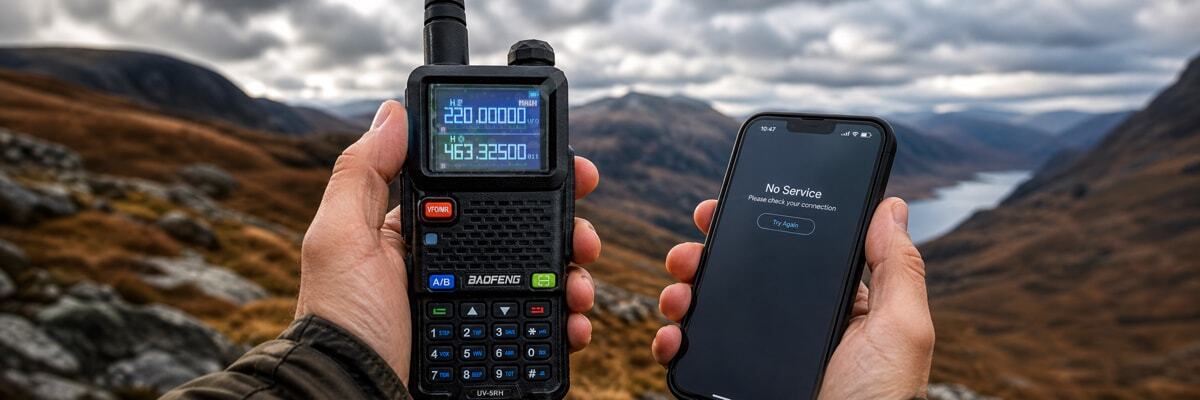
When a hiker is traversing the remote peaks of the Scottish Highlands, or a security professional is patrolling the subterranean concrete basement of a London retail complex, mobile phones frequently lose all service. In these critical moments, traditional two-way radios become indispensable. They do not rely on fragile external infrastructure; instead, they generate their own localized communication networks. Whether you are an outdoor enthusiast needing reliable communication with long battery life requirements, or a professional requiring exceptional performance and durability in dead zones, a walkie-talkie ensures you remain connected when the grid fails.
The Core Technology: How Two-Way Radios Bypass Cellular Networks
To truly understand why walkie-talkies are immune to cellular dead zones, we must examine the underlying technology. Modern telecommunications—like your smartphone—operate on a highly centralized, infrastructure-heavy model. When you make a mobile call, your voice is digitized and sent to a local cellular mast. That mast routes your data through underground fiber-optic cables, network servers, and sometimes satellites, before pinging another mast nearest to your recipient. If any link in that chain breaks—due to a power outage, remote geography, or simply too many people overloading the network—communication ceases.
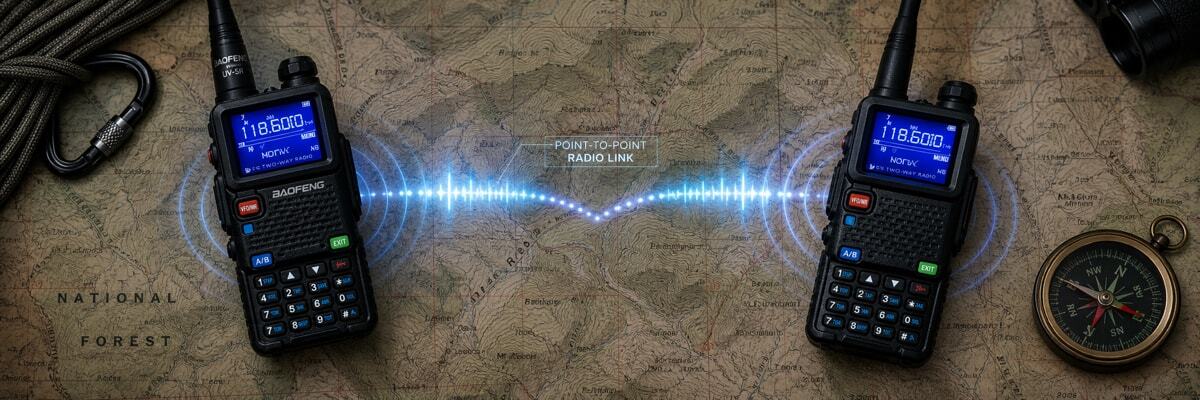
Walkie-talkies utilize a radically different approach: peer-to-peer (P2P) electromagnetic broadcasting.
When you press the Push-To-Talk (PTT) button on a two-way radio, the internal transmitter converts your voice directly into radio waves. These waves are then broadcasted outward through the antenna at the speed of light. Any compatible receiving radio within your broadcast radius that is tuned to the exact same frequency channel will instantly intercept those waves and convert them back into audible sound. There is no middleman, no routing server, and no subscription fee. As long as the transmitting and receiving radios have battery power and are within physical range of one another, communication is guaranteed.
Real-World Scenarios: Where Cellular Fails and Radios Thrive
Because they operate independently of telecommunication giants, walkie-talkies are the superior, and often the only, choice in several distinct environments.
The Professional Sector: Built for Obstacles
In the professional sector—encompassing construction, security, retail, hotels, and schools—reliable communication is a matter of safety and operational efficiency. Construction sites are filled with dense materials like steel mesh, thick concrete, and earth, all of which aggressively absorb and block high-frequency 4G and 5G mobile signals. Professional-grade two-way radios are engineered for clear communication over vast distances using rugged, durable radio shells that can withstand the physical rigours of a job site while penetrating environmental barriers.
The Outdoor Sector: Surviving the Wilderness
For hiking and camping, mobile phones are notoriously unreliable. Valleys, dense forests, and mountainous terrain create natural signal shadows. Furthermore, mobile phones constantly search for a signal in these dead zones, which rapidly drains their batteries. Walkie-talkies are built for the outdoors, catering specifically to hiking and camping with long battery life requirements. They only consume significant power when actively transmitting, allowing them to remain operational for days.
The Casual Sector: Neighbourhood Connectivity
Beyond extreme environments, there is the casual sector. For practical communication for kids and families in neighbourhoods, radios offer a simple, screen-free, and instant way to stay in touch. There are no data plans to manage, no apps to download, and no complex dials to navigate.
Technical Deep Dive: VHF vs. UHF in Signal-Less Environments
While walkie-talkies do not need a signal from a mast, their ability to transmit their own signal depends heavily on the frequency band they utilize. Understanding the difference between VHF (Very High Frequency) and UHF (Ultra High Frequency) is crucial for optimizing your off-grid communication.
- VHF (Very High Frequency): Operating at a lower frequency, VHF radio waves are longer. This makes them exceptionally good at travelling long distances across open terrain. If you are communicating across a lake, a sprawling farm, or between two mountain peaks with a clear line of sight, VHF is the optimal choice. However, these longer waves struggle to penetrate dense, solid objects.
- UHF (Ultra High Frequency): UHF waves are shorter and more energetic. While they do not travel as far as VHF in wide-open spaces, they excel at finding their way through doors, concrete walls, steel frameworks, and dense forests. For urban environments, indoor security, and construction sites, UHF provides a much more reliable peer-to-peer connection.
The UK Compliance Shield: Legal Off-Grid Broadcasting
The fact that walkie-talkies bypass cellular networks does not mean the airwaves are an unregulated free-for-all. To prevent interference with emergency services, aviation, and commercial broadcasts, radio frequencies in the United Kingdom are strictly regulated by Ofcom.
Baofeng maintains a fully compliant UK operations shield, providing high-performance radio equipment as accessible solutions for UK families and professional teams. Depending on your needs, there are two primary legal pathways for using radios off the grid:
- Licence-Free Operation (PMR446): For casual users and many businesses, Baofeng offers PMR446 radios that meet UK legal standards for use without a licence. These devices operate on a specific European-wide UHF frequency band (446 MHz). They are limited to a power output of 0.5 watts and must have a fixed antenna. They are strictly "plug-and-play," requiring no registration or fees.
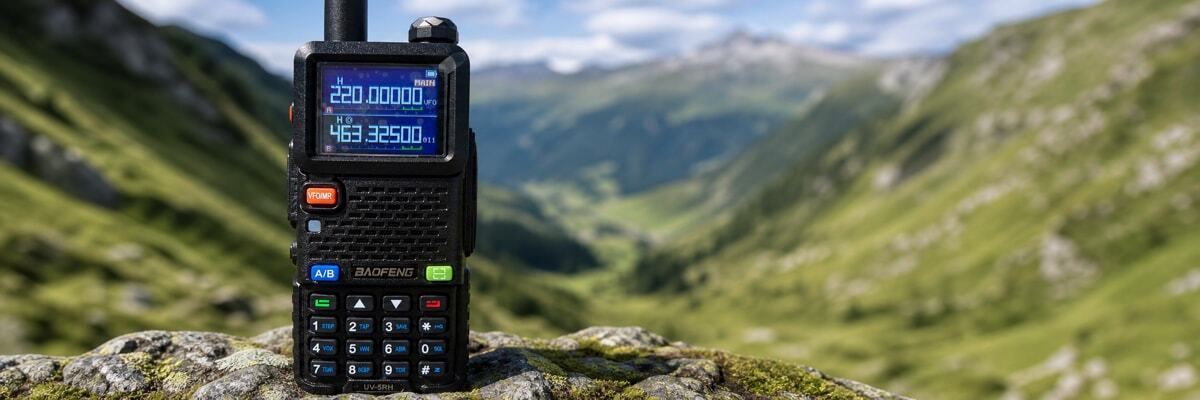
- Licenced Operation: For users requiring exceptional performance, higher wattage, and vast transmission distances, professional or Ham radios (like the Baofeng UV-5R series) are required. These cannot legally be used on PMR446 frequencies. To support users upgrading to high-tier equipment, Baofeng provides expert technical guidance, including technical insights and educational resources regarding UK Ham Radio Licence Guide requirements. Obtaining a licence grants you access to powerful frequencies and repeater networks, maximizing your off-grid range.
Ultimately, whether you are managing a massive construction project, exploring the wilderness, or simply keeping track of your family in the neighbourhood, two-way radios provide an unparalleled, independent communication lifeline. They stand as a testament to the fact that sometimes, the most reliable technology is the one that cuts out the middleman entirely.
Frequently Asked Questions (FAQs)
Do walkie talkies work anywhere in the world?
Technologically, yes. The radio waves generated by a walkie-talkie will propagate through the air anywhere on Earth, as they do not rely on local infrastructure. However, radio frequencies are governed by national laws. A PMR446 radio is perfectly legal in the UK and most of Europe without a licence, but operating that exact same radio in the United States or Australia is illegal, as those frequencies are reserved for other services.
How far can walkie talkies reach without a cellular signal?
Because walkie-talkies rely on peer-to-peer transmission, the range is dictated by the radio's power output (wattage), antenna quality, and the surrounding terrain. A licence-free 0.5-watt PMR446 radio typically achieves a range of 1 to 3 miles in open conditions, but this drops significantly in dense urban areas. High-powered, licenced radios (e.g., 5-watt or 8-watt models) can reach 5 to 30+ miles, especially when transmitting from a high elevation.
Do I need a SIM card to use a walkie talkie?
Traditional analogue and digital walkie-talkies (utilizing VHF/UHF) do not require a SIM card, a data plan, or a cellular contract. The only devices that require a SIM card are specialized "PoC" (Push-to-Talk over Cellular) radios. These are essentially ruggedized mobile phones that look like walkie-talkies but rely entirely on 4G/5G networks to transmit voice data.
Can walkie talkies be tracked if they are off the grid?
Standard walkie-talkies do not contain GPS chips and do not ping cellular towers, making them immune to the kind of location tracking used for smartphones. However, because they broadcast radio waves publicly, anyone with a radio scanner tuned to your frequency can intercept your audio. Furthermore, advanced radio direction-finding (RDF) equipment can be used to triangulate the physical source of a radio transmission.
How do walkie talkies work in basements or underground?
Radio waves can penetrate many non-conductive materials like wood and drywall, but earth, dense concrete, and metal severely degrade the signal. In a standard basement, a UHF radio can often penetrate the floorboards to communicate with someone on the ground level. However, deep underground (like in a mine or a deep subway tunnel), peer-to-peer radio waves will not reach the surface unless the facility is equipped with a specialized radio repeater system.