
7th Jun 2026
Walkie Talkie Range in Woods: Real-World Distances for UK Hikers
 Woodland Signal Testing | Technical Performance Guide | 2026 Edition
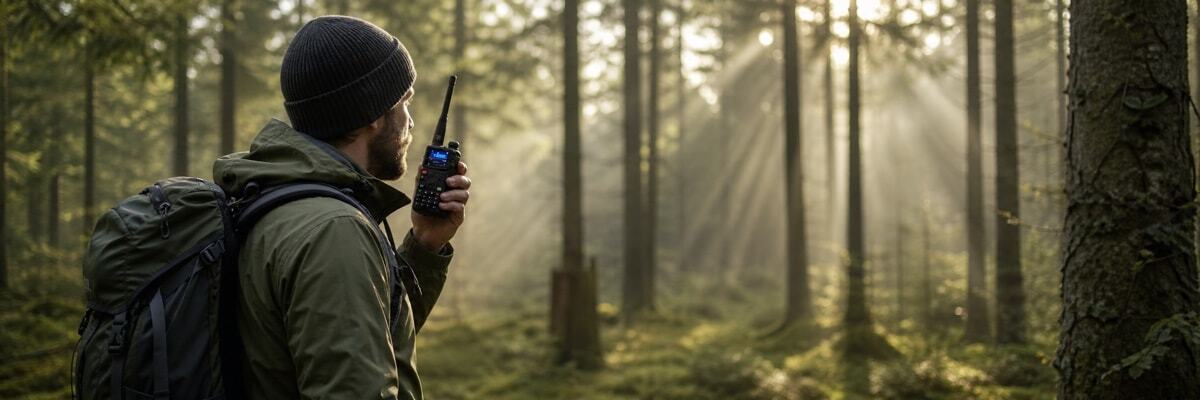
 If you are packing for a camping trip in the Lake District or preparing for a group hike through dense Scottish woodlands, reliable communication is a critical safety requirement. You have likely purchased a two-way radio promising a massive "up to 30 miles" range, only to discover that your signal drops out after you walk just a few hundred metres into the trees.
The Direct Answer: For standard, licence-free PMR446 walkie talkies used in dense UK woodlands, you should realistically expect a reliable communication range of 0.5 to 1.5 miles. Upgrading to higher-powered, licensed radios can extend this range to roughly 2 to 4 miles depending on the exact density of the trees and the elevation of the terrain.
This guide breaks down exactly why your radio's performance drops in wooded areas, the science behind radio wave propagation, and actionable steps you can take to maximise your communication distance when exploring the outdoors.
- 1. Why the "Maximum Range" on the Box Doesn't Apply in the Forest
- 2. Environmental Factors That Kill Your Radio Signal
- 3. VHF vs. UHF: Which is Better for Dense Forestry?
- 4. 4 Expert Ways to Maximise Your Signal in the Woods
- 5. Top Picks: Best Walkie Talkies for UK Hikers
- 6. UK Compliance: PMR446 vs. Licensed Radios for the Outdoors
- 7. Frequently Asked Questions (FAQs)
Why the "Maximum Range" on the Box Doesn't Apply in the Forest
The impressive range statistics printed on walkie talkie packaging are legally accurate, but they are measured under "line of sight" conditions. This means the test was conducted with two radios pointing directly at each other over a perfectly flat landscape—like a calm lake or an empty valley—with absolutely zero physical obstructions.
The moment you step off the open trail and into the woods, that line of sight is instantly broken. Radio waves are a form of electromagnetic energy. Whenever that energy hits a physical object, a portion of the signal is absorbed, deflected, or reflected. Understanding this limitation is crucial for outdoor enthusiasts who have specific long battery life requirements and rely on consistent communication for safety.
Environmental Factors That Kill Your Radio Signal
Woodlands present one of the most hostile environments for two-way radio signals. Several natural elements actively work against your device's ability to transmit and receive clearly.
Foliage, Wood, and Moisture Density
Radio waves struggle to pass through water. Living trees, thick branches, and dense canopies of leaves are packed with moisture. When your radio transmits a signal, the water inside the surrounding vegetation absorbs a massive amount of the electromagnetic energy, drastically reducing the distance the signal can travel. Furthermore, after a heavy UK rainstorm, wet leaves and damp bark will attenuate your signal even further.
Rolling UK Terrain and Valleys
Forests are rarely perfectly flat. Natural dips, ravines, and rolling hills create physical walls of earth and rock that radio signals simply cannot penetrate. If you are at the bottom of a wooded ravine and your hiking partner is on the opposite side of a ridge, your walkie talkie range in woods will be reduced to practically zero, regardless of how powerful your radio is.
VHF vs. UHF: Which is Better for Dense Forestry?
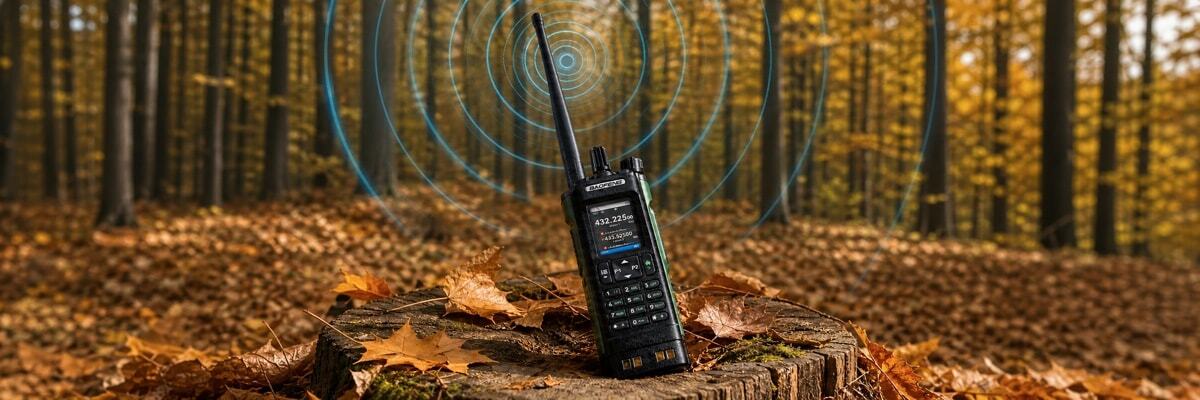
When choosing a radio, understanding the difference between Very High Frequency (VHF) and Ultra High Frequency (UHF) is critical for woodland performance.
- VHF (Very High Frequency): VHF waves are longer and travel further in wide-open, unobstructed spaces. However, because they are longer, they cannot easily navigate around physical obstacles. They tend to bounce off tree trunks and hills, making them a poor choice for the woods.
- UHF (Ultra High Frequency): UHF waves are shorter, tighter, and carry more energy. This allows them to effectively punch through dense brush and navigate the small gaps between tree trunks and foliage. For any woodland environment, UHF is always the superior choice.
4 Expert Ways to Maximise Your Signal in the Woods
If you find your signal breaking up, follow these immediate, actionable steps to stretch your range to its absolute limit:
- Seek Immediate Elevation: Height is your best friend. If you lose contact, walk to the top of the nearest hill or ridge. By getting your radio higher, you thin out the canopy between you and the receiver and improve your line of sight.
- Keep Your Battery Fully Charged: A radio's transmission wattage drops off as the battery dies. Baofeng markets high-performance radio equipment that caters to hiking and camping with long battery life requirements, ensuring you have maximum power when you need it.
- Hold the Radio Vertically: Antennas are designed to transmit energy outward in a horizontal plane. Always hold the radio perfectly straight up and down. Tilting it diagonally significantly reduces your effective range.
- Upgrade Your Antenna: If you are using a licensed radio with interchangeable parts, swapping the stock antenna for a longer, high-gain "whip" antenna is the easiest way to instantly boost your transmission power and reception clarity.
Top Picks: Best Walkie Talkies for UK Hikers
Equip yourself with the right power and durability for dense forests and unpredictable weather.
UK Compliance: PMR446 vs. Licensed Radios for the Outdoors
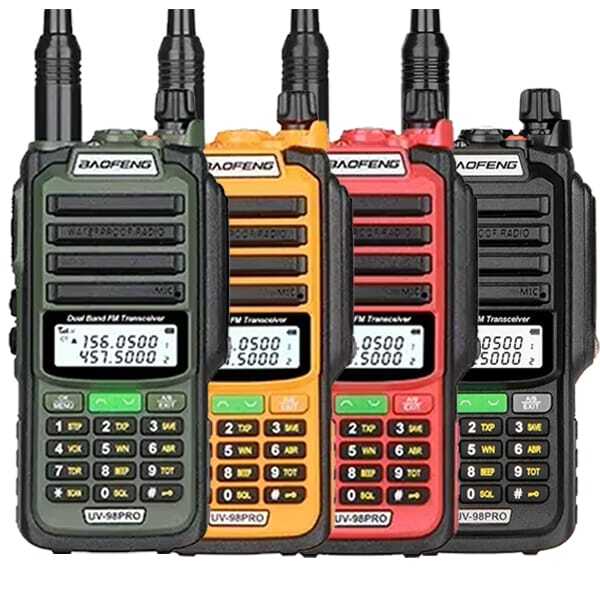
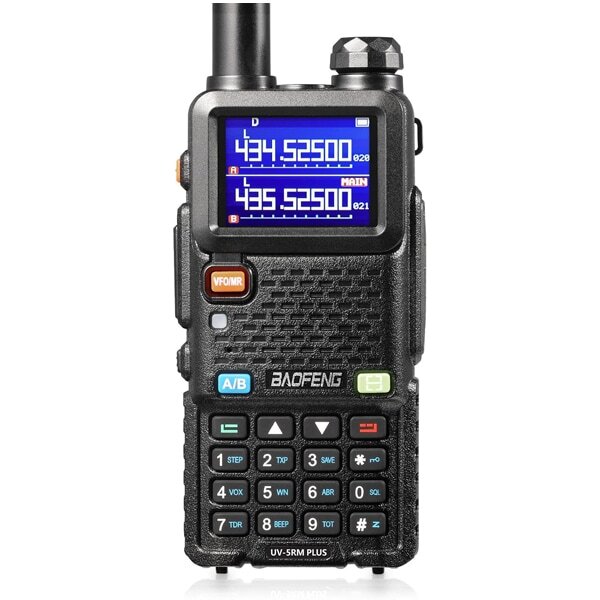
When equipping your team or family for a woodland excursion, you must adhere to UK Ofcom regulations. Baofeng offers practical solutions tailored to both casual users and serious outdoor professionals:
Licence-Free (PMR446) Radios
For practical communication for kids and families in neighbourhoods or casual weekend campers, PMR446 radios are the perfect accessible solution. Baofeng offers PMR446 radios that meet UK legal standards for use without a licence. These operate on UHF frequencies (excellent for woods), but their power is legally capped at 0.5 watts, giving them a typical woodland range of about 0.5 to 1 mile. They are engineered using rugged, durable radio shells, making them perfect for outdoor wear and tear.
High-Power Licensed Radios
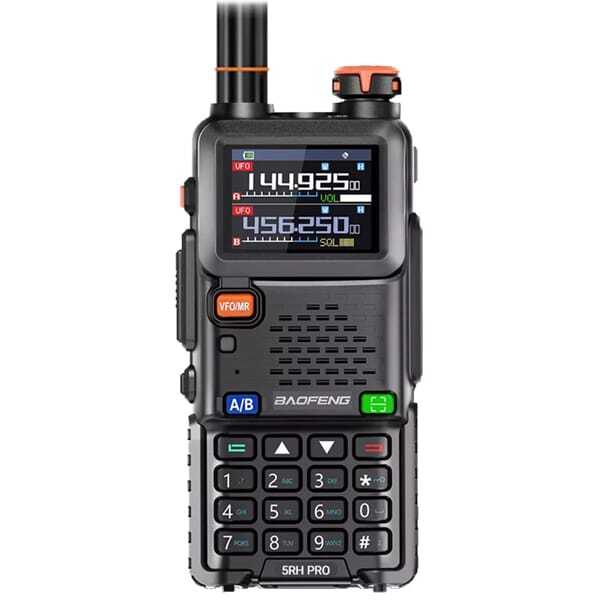
If you are engaging in serious wilderness trekking, you may require exceptional performance and clear communication over vast distances. High-powered radios (like the Baofeng UV-5R series) can transmit at 4, 5, or even 8 watts, effectively punching a signal through the thickest forest canopies. However, using these frequencies requires an Ofcom licence. To ensure you operate legally, Baofeng provides expert technical guidance and educational resources regarding UK Ham Radio Licence Guide requirements.
Frequently Asked Questions (FAQs)
1. Why does my walkie talkie claim a 20-mile range but only work for 1 mile in the woods?
Manufacturers advertise the absolute maximum range based on a perfectly clear "line of sight" with zero obstacles. In the woods, the moisture in tree trunks, dense leaves, and uneven terrain absorb and block the radio waves, severely reducing the real-world distance.
2. Is a UHF or VHF radio better for hiking in dense forests?
UHF (Ultra High Frequency) is significantly better for dense forests. The shorter wavelengths of UHF signals are much better at penetrating through gaps in foliage, brush, and tree trunks compared to the longer waves of VHF.
3. Do I need a licence to use a walkie talkie in the UK?
It depends on the radio. If you use a standard PMR446 radio, which is legally restricted to a 0.5-watt power output, you do not need a licence. If you use a high-powered radio (over 0.5 watts) to achieve a greater range in the woods, you must hold a valid Ofcom licence.
4. How can I quickly increase my radio range if I get lost in the woods?
The fastest way to regain a lost signal is to walk to higher ground. Elevating your position reduces the amount of earth and tree canopy blocking your transmission. Additionally, ensure your antenna is pointing straight up to the sky.
5. Does weather affect my walkie talkie range in the forest?
Yes. Rain, snow, and dense fog add heavy moisture to the air and the surrounding trees. Because water absorbs radio frequencies, bad weather will noticeable decrease the maximum distance your walkie talkie can reach.