
17th Jul 2026
Best Encrypted and Private Walkie Talkies for UK Event Security
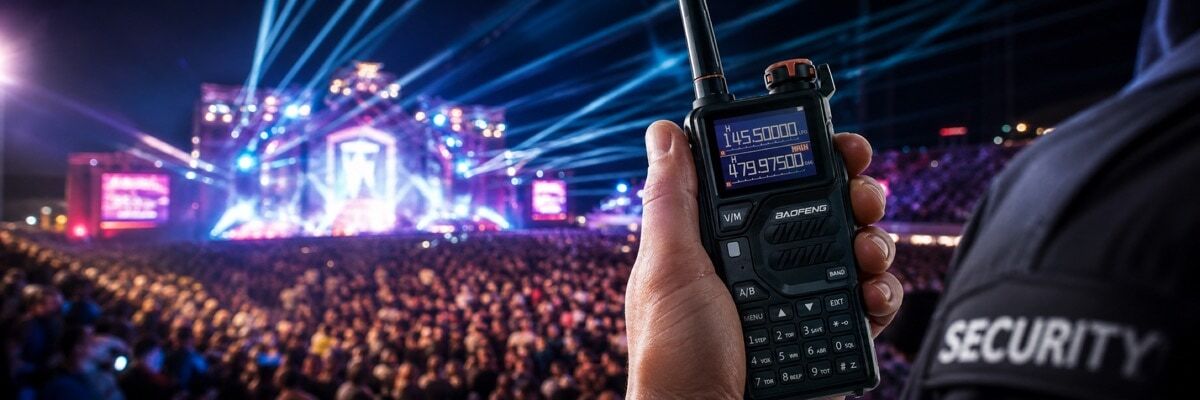
A busy event can turn chaotic in seconds.
A gate becomes overcrowded, a missing child is reported, an artist changes their arrival route or a medical team needs immediate access through a packed venue.
For security managers, door supervisors and event marshals, a delayed message is not a minor inconvenience. It can become a safety issue.
That is why choosing the right walkie talkies for event security involves more than looking for the longest advertised range. The radios must provide clear audio, dependable battery life, simple controls and an appropriate level of privacy while remaining lawful to operate in the UK.
⚡ The quick answer
- Small events may be adequately served by compliant PMR446 licence-free radios, especially when teams only need short-range communication around a hall, hotel or compact outdoor site.
- Larger festivals, concerts and high-security events should consider properly licensed digital radios. These can provide stronger coverage, separate talk groups, individual calling and genuine voice encryption where supported.
- Privacy codes alone are not encryption. CTCSS and DCS tones can reduce the amount of unwanted chatter heard through the speaker, but they do not prevent another radio user from listening to the transmission.
What "private" really means on a walkie talkie
The word "privacy" is used loosely in radio marketing.
Analogue radios often include privacy codes, sometimes advertised as providing hundreds of channel combinations. These codes simply tell the receiving radio to open its speaker when it detects a matching tone. Someone monitoring the same frequency without that filter may still hear the conversation.
True encryption works differently. A compatible digital radio scrambles the voice transmission so that another device requires the correct encryption key to understand it.
For an event team discussing routine matters such as queue movement or staff breaks, CTCSS and DCS privacy tones may be sufficient to reduce distractions. For VIP movements, cash handling, incident reports or safeguarding information, a licensed digital system with verified encryption is a more appropriate choice.
Even encrypted radios should not be used to broadcast unnecessary personal details. Good radio discipline remains part of event security.
Licence-free or licensed radios?
Ofcom describes PMR446 as a short-range, peer-to-peer service suitable for uses such as offices, factories and building sites. Compliant PMR446 licence-free radios may be operated without an individual radio licence.
This simplicity appeals to wedding venues, community events, school fairs and small hospitality teams. Staff can be issued radios without arranging a dedicated frequency licence.
The trade-off is that PMR446 channels are shared. Another nearby business or event may use the same channel, and privacy codes do not remove the underlying interference.
Licensed business radios are better suited to events where communication is operationally critical. They can provide greater transmit power, coordinated frequencies and more advanced features. Event organisers should confirm the correct Ofcom licence and frequency assignment for their proposed equipment rather than assuming that any programmable handheld can be used legally.
Amateur radios such as many UV-5R-style models are not automatically suitable for commercial event-security transmission. An amateur radio licence is intended for amateur-radio activity, not ordinary security operations.
Read the UK walkie-talkie licensing guidance before selecting radios for a working event team.
Features that matter during a live event
Digital encryption
Look for a digital radio that clearly states what encryption or privacy technology it supports. Avoid relying on vague descriptions such as "secure," "scrambled" or "military grade" without an identifiable technical specification.
All radios in the fleet must be compatible and programmed with the correct settings. A mixture of models may communicate normally while failing to share encrypted calls or advanced functions.
Clear audio and suitable earpieces
A radio can have impressive specifications and still be useless beside a loud stage.
Security staff need strong speaker output or a compatible acoustic-tube earpiece. Discreet earpieces also stop sensitive messages from being announced to visitors standing nearby.
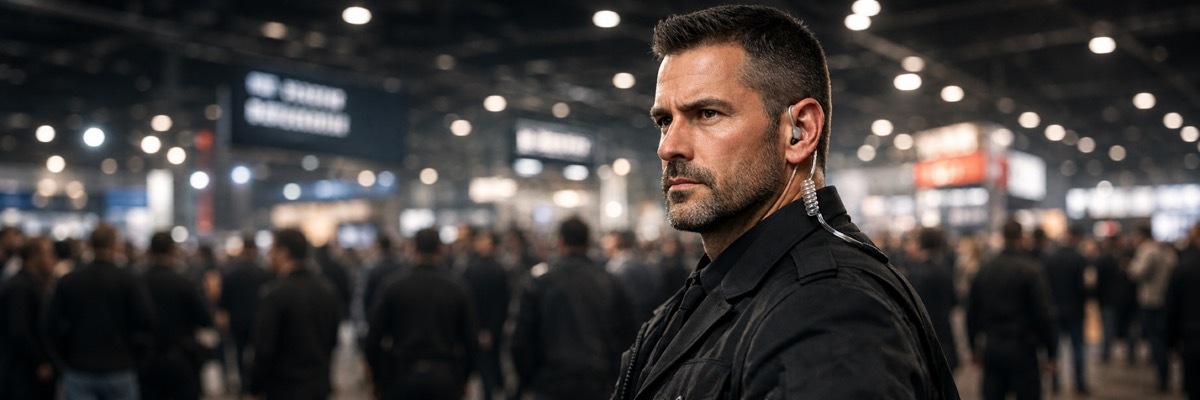
Explore available walkie-talkie earpieces and radio accessories when planning a complete staff kit rather than purchasing handsets alone.
Separate channels or talk groups
Putting every department on one channel quickly creates congestion. A practical event plan might allocate separate groups for entrances, backstage, parking, medical response and event control.
Supervisors may also need access to more than one group. Digital radios can make this easier through individual calling and structured talk groups, depending on the system.
Battery capacity
A radio that dies before the headline act leaves the stage is a liability.
Choose batteries that can comfortably cover the full shift, including briefing time and post-event dispersal. Keep charged spares at event control and label them so depleted batteries are not returned to service by mistake.
Multi-radio charging stations can simplify overnight preparation for recurring events.
Emergency controls and simple operation
An emergency button can help a team member alert control without delivering a long explanation. Keypad locking can also prevent accidental channel changes while staff are moving through crowds.
More functions are not always better. Temporary staff may perform more reliably with a simple, pre-programmed radio than with a feature-heavy handset that requires menu navigation.
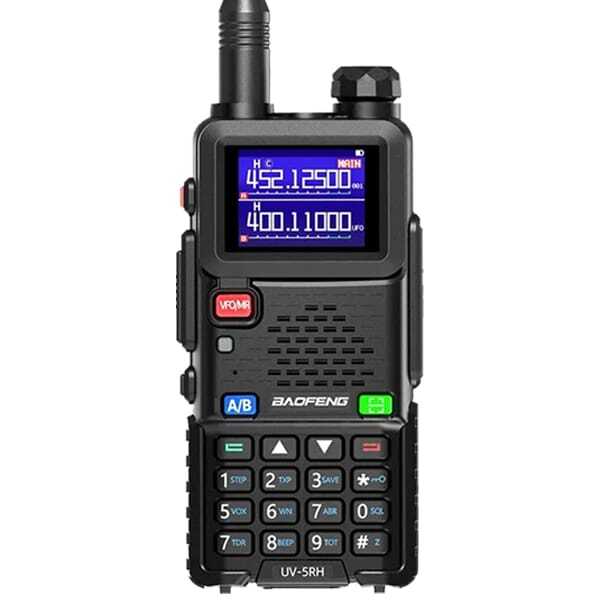
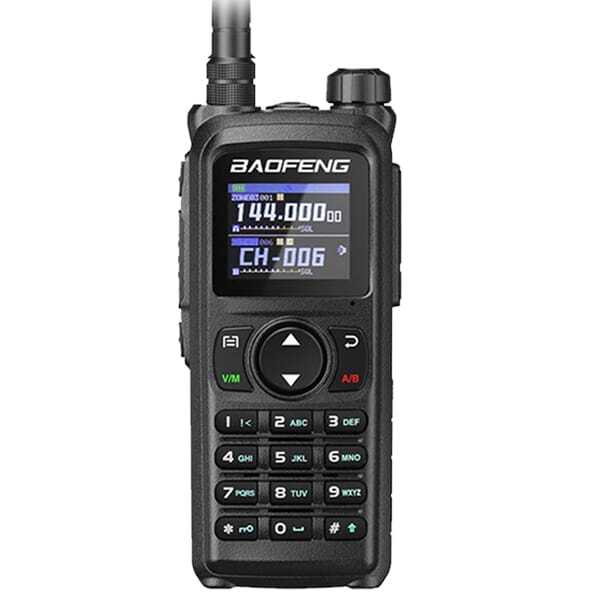
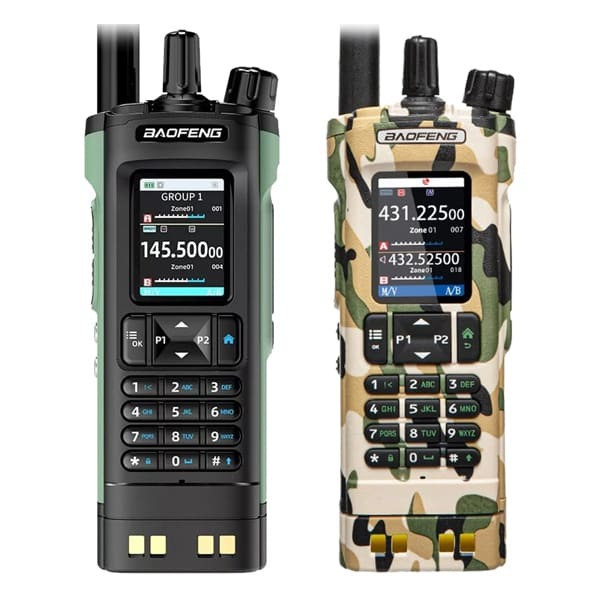
Recommended Commercial Radios
Matching the radio to the event
| Event type | Practical radio approach | Privacy requirement |
|---|---|---|
| Wedding or small indoor venue | Compliant PMR446 radios | Privacy tones may reduce unwanted chatter |
| Community event or school fair | Simple licence-free multi-packs | Use coded language for personal incidents |
| Medium concert or exhibition | Licensed business-radio fleet | Digital privacy or encryption preferred |
| Festival across multiple zones | Licensed digital radio system with tested coverage | Encrypted talk groups for sensitive operations |
| VIP or high-value event | Professionally configured digital radios | Verified encryption and controlled key access |
Coverage should always be tested at the actual venue. Concrete walls, steel structures, basements, temporary cabins, stages and dense crowds can all change performance. A claimed maximum range measured in ideal open conditions does not guarantee reliable communication from a basement control room to a distant car park.
A practical pre-event radio check
Run a full site test before staff arrive. Walk the routes used by entrance teams, mobile patrols, backstage security and medical responders. Mark any dead zones and decide whether staff should relocate, change channels or use supporting infrastructure.
Program and label every handset consistently. Test every earpiece, confirm spare batteries are charged and give staff a brief radio protocol. Messages should be short, location-specific and calm.
Avoid using real names or detailed personal information when a call sign or incident code will do. Encryption improves confidentiality, but disciplined communication reduces exposure even when equipment is lost or a channel is monitored.
Choosing with confidence
The best walkie talkies for event security are not necessarily the most powerful radios on the product page. They are the radios that fit the venue, licence arrangement, staff experience and level of communication risk.
For a small local event, straightforward PMR446 licence-free radios may offer the easiest solution. For a large or sensitive operation, choose a licensed digital fleet with tested encryption, structured talk groups and professional programming.
Browse the wider range of two-way radios and walkie talkies to compare equipment, multi-packs, batteries and accessories for your event team.