
5th Apr 2026
UHF vs. VHF Radios: Which Frequency is Best for Your Needs?

Expert Insight by The Baofeng UK Radio Experts | Technical Guide | Read time: 6 mins
Whether you are outfitting a security team for a massive indoor shopping centre, preparing for a cross-country 4x4 expedition, or managing staff across a sprawling agricultural farm, reliable communication is non-negotiable. But when you start shopping for professional two-way radios, you immediately hit a wall of technical jargon. The most common—and arguably the most important—decision you have to make is choosing between UHF vs VHF radios.
If you pick the wrong frequency for your environment, your radios will suffer from dead zones, static, and frustratingly short ranges. In this comprehensive guide, we will break down the exact differences between UHF and VHF, explain the physics behind how they work, and help you choose the perfect frequency for your specific needs.
Key Takeaways: UHF vs VHF Overview
- VHF: Best for open-air, rural, and marine environments where there are fewer physical obstructions.
- UHF: Superior for indoor, urban, and dense forest use due to better penetration through concrete and steel.
- Dual-Band: The most flexible option for users who move between indoor and outdoor locations.
The Great Debate: Why Choosing the Right Frequency Matters
Many first-time buyers assume that power (measured in Watts) is the only thing that dictates a walkie-talkie's range. While power is crucial, the frequency band your radio uses determines how well that signal navigates the physical world around you.
Radio waves do not travel in a vacuum. They have to deal with trees, concrete walls, steel girders, human bodies, and the curvature of the earth. We have previously explored VHF Vs UHF Which Is Better? in our deep-dive blog, but today we focus on frequency choice for specific UK needs.
Expert Insight: The Science of Wavelengths
To understand which to choose, you need a quick primer on how radio waves behave:
- VHF (Very High Frequency) operates between 136-174 MHz. These signals have a longer wavelength. Imagine a long, rolling ocean wave. It can travel vast distances smoothly, but if it hits a solid wall, it stops.
- UHF (Ultra High Frequency) operates between 400-520 MHz. These signals have a shorter wavelength. Imagine smaller, rapid, punchy waves. While they exhaust their energy faster over open distances, they are incredibly good at bouncing around obstacles and squeezing through windows, doors, and concrete hallways.
VHF (Very High Frequency): The Open-Air Champion

VHF is the absolute king of the great outdoors. Because VHF waves are longer, they remain closer to the surface of the earth, allowing them to travel significantly further than UHF waves—provided the line of sight is relatively clear.
The Strengths of VHF
VHF provides maximum range with minimal battery drain. In a completely flat, open environment (like a lake or a massive agricultural field), a 5-Watt VHF radio will drastically outperform a 5-Watt UHF radio in terms of sheer distance.
Best Use Cases for VHF Radios
- Marine & Boating: VHF is the global standard for marine communication because there are no buildings or trees on the open water.
- Agriculture & Farming: If you are coordinating tractors across hundreds of acres of flat, open farmland, VHF is your best friend.
- Aviation & Open-Air Festivals: Environments with clear lines of sight benefit massively from the long-reach capabilities of VHF.
UHF (Ultra High Frequency): The Urban & Indoor Warrior
While VHF rules the open plains, UHF is the undisputed champion of the modern, built-up world. Because UHF wavelengths are shorter, they can easily penetrate concrete, steel, wood, and brick. This is why UHF PMR446 radios are the go-to for UK businesses.
The Strengths of UHF
If you take a VHF radio inside a heavy concrete warehouse, the long waves will bounce off the walls and struggle to escape. Take a UHF radio into that same warehouse, and the shorter waves will penetrate the infrastructure, bounce around corners, and find their way out. UHF is also the frequency used by standard UK licence-free PMR446 radios, making it highly accessible.
Best Use Cases for UHF Radios
- Retail & Warehousing: From stockrooms to the shop floor, UHF easily penetrates heavy shelving and inventory.
- Security & Hospitality: If you need to communicate from a hotel basement to the 10th floor, UHF is mandatory.
- Woodlands & Dense Forests: Surprisingly, the thick trunks of trees block VHF waves. UHF waves are short enough to navigate through dense woodland canopies, making them ideal for airsoft, paintball, and woodland hiking.
Why Choose? The Power of Dual-Band Radios
What if your job requires you to work indoors one day and in an open field the next? Fortunately, you do not have to buy two separate sets of radios. Modern technology has given rise to Dual-Band and Tri-Band transceivers.
These long-range two-way radios allow you to switch seamlessly between VHF and UHF frequencies with the push of a button. It is worth noting that while anyone can use licence-free UHF PMR446 frequencies, transmitting on higher-powered VHF or UHF channels requires you to understand UK radio licensing requirements.
Top Baofeng Recommendations for Every Environment
At Baofeng UK, we supply radios for every type of environment. Here is what we recommend based on your frequency needs:
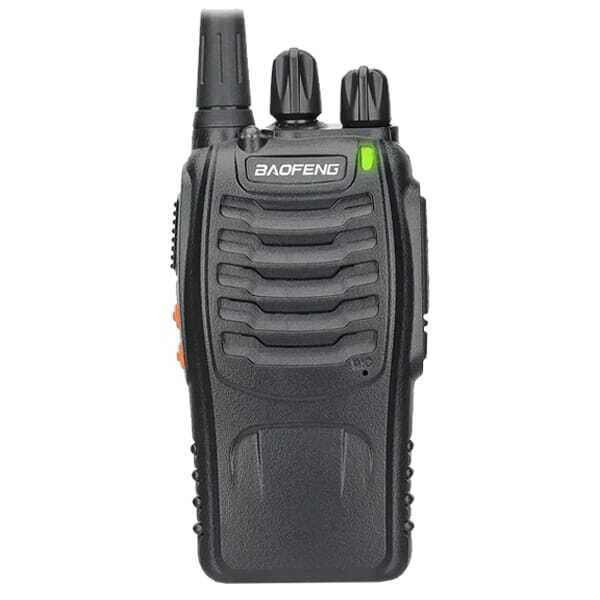
- Best for Pure UHF (Licence-Free): Baofeng BF-88E If you operate an indoor retail store, a cafe, or a small warehouse, the BF-88E operates exclusively on the UHF PMR446 band. It requires no setup, easily penetrates walls, and provides crystal-clear short-range indoor communication.
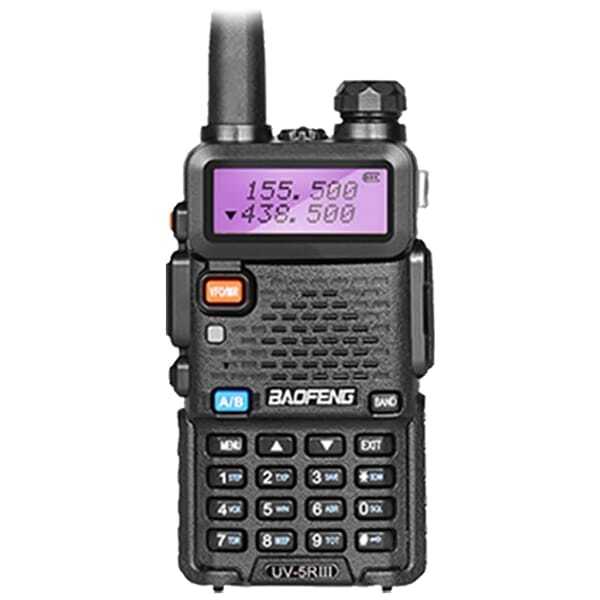
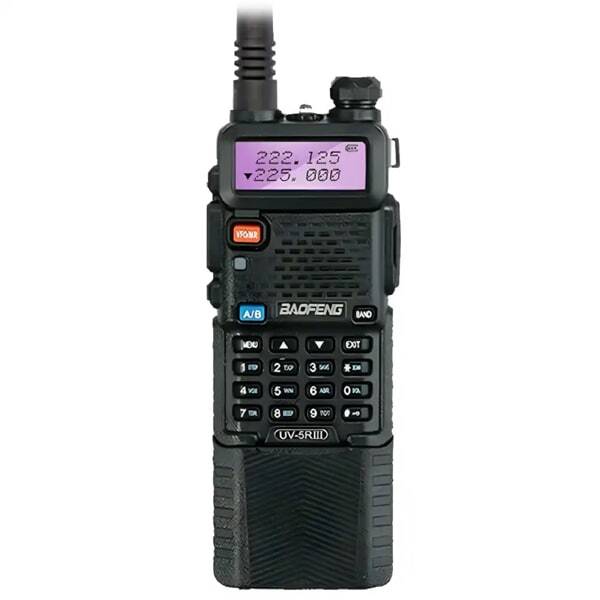
- Best for Versatility (VHF/UHF): Baofeng UV-5R III Tri-Band If you need the ultimate flexibility, the Baofeng UV-5R III Tri-Band is the industry standard. It allows you to program both VHF and UHF frequencies. Use the UHF band when you are inside a concrete structure, and switch over to the VHF band when you step out into the open fields for maximum distance.
Choosing between UHF and VHF doesn't have to be complicated. Just remember the golden rule: VHF for open spaces, UHF for indoor and obstructed places.
Frequently Asked Questions (FAQs)
1. Can a UHF radio talk to a VHF radio?
No. A radio operating on a UHF frequency (e.g., 446 MHz) cannot communicate with a radio operating on a VHF frequency (e.g., 150 MHz). They are entirely different bands. To communicate, both radios must be tuned to the exact same frequency.
2. Which frequency is better for thick forests and woods?
UHF is generally better for dense forests. The shorter wavelengths of UHF are able to navigate through the dense trunks, branches, and leaves. The longer waves of VHF tend to crash into the trees and degrade much faster in heavily wooded areas.
3. Do I need a licence to use VHF radios in the UK?
Yes. Unlike UHF, which has the designated licence-free PMR446 band for public use, there is no general licence-free VHF band for land use in the UK. Transmitting on VHF requires an appropriate Ofcom licence (such as a Simple UK Light or an Amateur Radio licence).
4. Does UHF or VHF drain the battery faster?
Battery drain is determined primarily by the transmission power (Watts), not the frequency band (UHF vs VHF). Transmitting at 5W on UHF will drain the battery at roughly the same rate as transmitting at 5W on VHF.
5. Which frequency should I choose for an indoor warehouse?
You should absolutely choose UHF for any indoor or built-up environment. The short radio waves of UHF are specifically capable of penetrating concrete, brick, steel shelving, and interior walls much better than VHF.