
2nd Jan 2026
How Does a Walkie Talkie Work? A Complete Guide to Two-Way Radio Technology
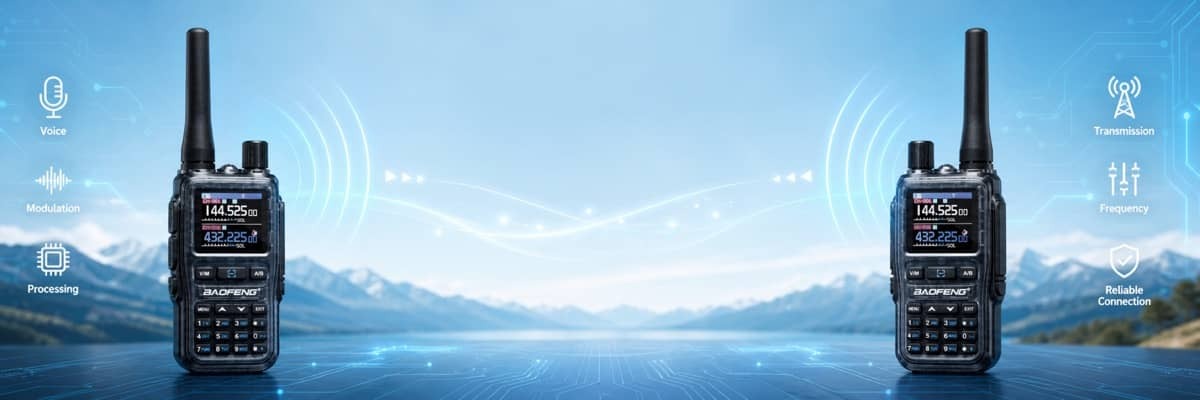
Walkie talkies — also known as handheld two-way radios or handheld transceivers — are portable devices that communicate wirelessly using radio waves. They have been a staple in communication for decades, used for everything from outdoor adventures to professional security operations.
But how do these devices actually work? What happens when you press the button and speak? In this guide, we explain the science behind walkie talkie communication, break down the key components, explore how frequency and range work, and cover the technology that makes modern two-way radios more capable than ever.
⚡ Quick Summary: How Walkie Talkies Work
- 📡 Core principle: your voice is converted into radio waves, transmitted through the air, and converted back into sound by another radio on the same frequency.
- 🎙️ Push-to-talk (PTT): press the button to transmit; release to listen. This is called half-duplex communication.
- 📻 Frequencies: VHF travels further outdoors; UHF penetrates buildings better. Most modern radios support both.
- 🔒 Privacy codes: CTCSS/DCS filter out unwanted users on shared channels — but they are not encryption.
- 🇬🇧 UK users: check if you need a licence before transmitting. PMR446 radios are licence-free.
📋 Table of Contents
- How Does a Walkie Talkie Work? Step by Step
- How Radio Waves Carry Your Voice
- Key Components of a Walkie Talkie
- VHF vs UHF: Which Frequency Is Better?
- Range and Limitations
- How Advanced Features Affect the Way Radios Work
- Where This Technology Is Used
- Recommended Walkie Talkies
- Important UK Buying Note
- Related Guides
- Frequently Asked Questions
How Does a Walkie Talkie Work? Step by Step
At their core, walkie talkies operate by transmitting and receiving radio waves. Each device functions as both a transmitter and a receiver, enabling two-way communication. Here is how the process works:
Step 1: You Press the PTT Button
When you press the push-to-talk (PTT) button, the walkie talkie switches from receive mode to transmit mode. This activates the internal transmitter circuit.
Step 2: Your Voice Becomes an Electrical Signal
The built-in microphone picks up your voice and converts the sound waves into an electrical signal. This electrical signal represents the pattern and frequency of your voice.
Step 3: The Signal Is Transmitted as Radio Waves
The transmitter takes the electrical signal and uses it to modulate (shape) a carrier radio wave at a specific frequency. This modulated radio wave is then broadcast outward through the antenna.
Step 4: The Radio Wave Travels Through the Air
The radio wave travels through the air at the speed of light. It does not need cables, Wi-Fi, mobile towers or any internet connection — it travels directly from one antenna to another.
Step 5: The Receiving Radio Captures the Signal
Another walkie talkie tuned to the same frequency captures the incoming radio wave through its antenna. The receiver's circuitry reverses the process — extracting the audio signal from the radio wave.
Step 6: The Signal Becomes Sound Again
The extracted audio signal is amplified and played through the speaker as recognisable sound — your voice, heard clearly by the other person.
Half-Duplex Communication
Most walkie talkies use half-duplex communication, meaning only one person can transmit at a time. When you press PTT to talk, you cannot hear incoming audio. When you release the button, your radio switches back to receive mode. This is why radio users say "over" when they finish speaking — to signal that the other person can now talk.
How Radio Waves Carry Your Voice
To truly understand how a walkie talkie works, it helps to understand the science behind radio waves.
What Are Radio Waves?
Radio waves are a type of electromagnetic radiation — the same family that includes visible light, microwaves and X-rays. They are invisible, travel at the speed of light, and can pass through walls, air and many solid objects depending on their frequency.
How Voice Becomes a Radio Signal
When you speak into a walkie talkie, your voice creates sound waves — vibrations in the air. The microphone converts these vibrations into a fluctuating electrical signal that mirrors the pattern of your voice.
The radio's transmitter then uses this electrical signal to modulate a carrier wave — essentially "stamping" your voice pattern onto a radio wave at a specific frequency. There are two main types of modulation used in two-way radios:
- FM (Frequency Modulation): the most common method in walkie talkies. The frequency of the carrier wave shifts slightly to represent your voice. FM provides clearer audio and better noise rejection.
- AM (Amplitude Modulation): the strength (amplitude) of the carrier wave changes to represent your voice. AM is used mainly in aviation and some specialised applications.
Why It Feels Instant
Because radio waves travel at the speed of light (approximately 300,000 km per second), the entire transmit-receive process happens almost instantly. This is why walkie talkie communication feels immediate — unlike phone calls that route through cell towers, switches and networks, a walkie talkie signal travels directly from one radio to another with no middleman.
Key Components of a Walkie Talkie
Understanding the main components helps you see how each part contributes to the overall communication process:
Antenna
The antenna is the gateway for radio signals. During transmission, it converts the electrical signal from the transmitter into radio waves that radiate outward. During reception, it captures incoming radio waves and converts them back into electrical signals for the receiver to process.
A longer or higher-quality antenna can improve both range and signal clarity. Baofeng offers a range of compatible antenna upgrades designed to enhance performance.
Microphone
The microphone captures your voice — converting sound waves into an electrical signal that the transmitter can process. Built-in microphones are standard, but many users add an external speaker mic for clearer audio and hands-free convenience.
Speaker
The speaker does the reverse of the microphone — it converts the incoming electrical signal back into audible sound so you can hear the other person's voice.
Transmitter
The transmitter is the circuit responsible for taking your voice signal, modulating it onto a carrier wave at the chosen frequency, and sending it to the antenna for broadcast.
Receiver
The receiver captures incoming radio waves from the antenna, demodulates them (extracts the audio from the carrier wave), amplifies the signal and sends it to the speaker.
Battery
All of these components need power. Walkie talkies use rechargeable batteries — typically lithium-ion. Battery capacity (measured in mAh) determines how long the radio can operate between charges.
VHF vs UHF: Which Frequency Is Better?
The frequency your walkie talkie operates on directly affects how the radio waves behave — and therefore how well the radio works in different environments.
| Feature | VHF (Very High Frequency) | UHF (Ultra High Frequency) |
|---|---|---|
| Frequency range | 30–300 MHz | 300 MHz – 3 GHz |
| Wave behaviour | Longer wavelength — travels further in open air but struggles with solid obstacles | Shorter wavelength — penetrates walls and buildings more effectively |
| Best environment | Open outdoor areas, rural terrain, farmland | Urban areas, indoors, warehouses, through buildings |
| Common use | Hiking, farming, marine, rural communication | Security, events, construction, indoor operations |
Most modern Baofeng radios are dual-band, meaning they operate on both VHF and UHF. This gives you the flexibility to choose the best band depending on your environment — open countryside or urban buildings.
Range and Limitations of Walkie Talkies
One of the most common questions about walkie talkies is "how far can they reach?" The answer depends on how the radio waves interact with the physical environment:
- Line of sight: radio waves travel in straight lines. Clear line of sight between two radios provides the best range and signal quality.
- Terrain and obstructions: hills, buildings, trees and walls absorb or block radio waves, reducing effective range. This is why a radio that works perfectly on a hilltop may struggle in a dense city.
- Frequency band: VHF waves travel further in open space, while UHF waves penetrate obstacles better — each has advantages depending on the environment.
- Power output (watts): higher wattage pushes the radio wave further, but also consumes more battery power.
- Antenna quality: a higher-gain antenna captures weaker signals more effectively, extending usable range.
- Weather and atmosphere: heavy rain, humidity and temperature inversions can all affect how far and how clearly radio waves travel.
Real-world range is almost always lower than the maximum figures advertised by manufacturers. For a deeper understanding, read our How to Choose Long Range Walkie Talkies | UK Buying Guide.
How Advanced Features Affect the Way Radios Work
Modern walkie talkies include features that change how the radio transmits, receives and processes signals. Understanding how these work helps you get more from your device:
Dual-Band / Multi-Band Operation
A dual-band radio contains two separate oscillator circuits — one for VHF and one for UHF. This allows the radio to switch between bands, choosing the best frequency for the current environment. Some advanced models add a third band (such as 220 MHz) or include airband receive capability.
Privacy Codes (CTCSS / DCS)
CTCSS and DCS embed a sub-audible tone or digital code into your transmission. The receiving radio checks for this tone before opening the speaker. If the code does not match, the audio stays muted — filtering out unwanted users on the same channel. Importantly, these are filters, not encryption — they stop you from hearing others, but do not stop others from hearing you.
Learn more in our CTCSS and DCS privacy codes guide.
VOX (Voice-Activated Transmission)
VOX changes how the radio triggers transmission. Instead of requiring you to press the PTT button, the radio continuously monitors audio input from the microphone. When it detects sound above a set threshold, it automatically switches to transmit mode. When you stop talking, it switches back to receive. This enables hands-free operation — useful when your hands are occupied.
Squelch
Squelch is a threshold control that mutes the speaker when no signal is being received. Without squelch, the radio would play constant static noise between transmissions. The squelch circuit monitors signal strength — when the incoming signal drops below a certain level, it cuts the audio, keeping things quiet until a proper signal arrives.
Bluetooth App Programming
Newer models like the UV-5R Mini allow you to programme frequencies, power levels and privacy codes via a smartphone Bluetooth app. This works by establishing a short-range Bluetooth connection between your phone and the radio, replacing the traditional method of manual keypad entry or PC-based cable programming.
GPS
Some advanced models include a built-in GPS module that receives satellite positioning data. This allows the radio to embed location coordinates into transmissions, enabling other compatible radios to see your position — useful for group coordination in outdoor activities.
Where This Technology Is Used
The core technology behind walkie talkies — direct radio wave communication without infrastructure — makes them useful across a wide range of real-world situations:
- Outdoor activities: hiking, camping, fishing and hunting in areas with no mobile coverage. See our outdoor radios.
- Security and events: instant coordination between team members without relying on phone networks. See our security radios.
- Construction, warehouses and industrial sites: communication across large areas where other methods may be impractical or unreliable.
- Family and recreation: keeping groups connected at theme parks, ski resorts or on camping trips.
In all of these cases, the fundamental principle is the same: press a button, speak, and your voice is carried by radio waves directly to another device — no middleman, no network dependency.
Recommended Walkie Talkies
Now that you understand how walkie talkies work, here are four recommended models that put this technology into practice — covering budget, licence-free, waterproof and modern options:
💰 Best Budget Starter
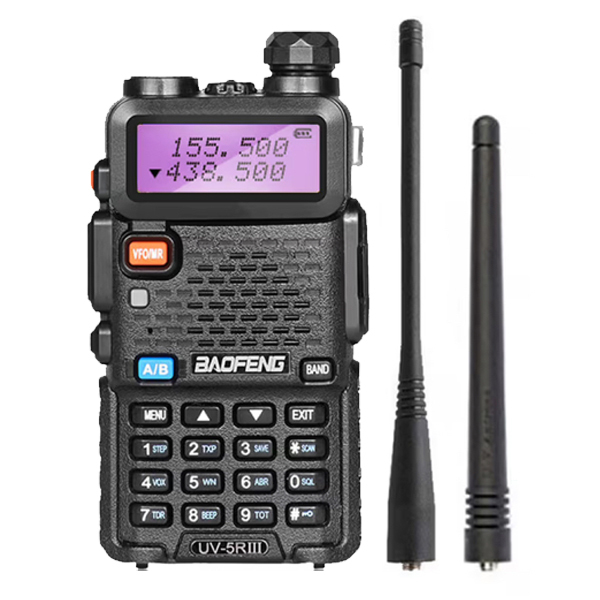
Tri-Band + Affordable
Baofeng UV-5R III
One of the most popular entry-level radios. Tri-band frequency coverage, built-in FM radio, LED torch and VOX — all at a budget-friendly price.
- Tri-band: VHF / 220 MHz / UHF
- 50 CTCSS / 104 DCS privacy codes
- LED torch and FM radio
- Compact and beginner-friendly
Best for: Beginners, budget buyers, general use
🇬🇧 Best Licence-Free
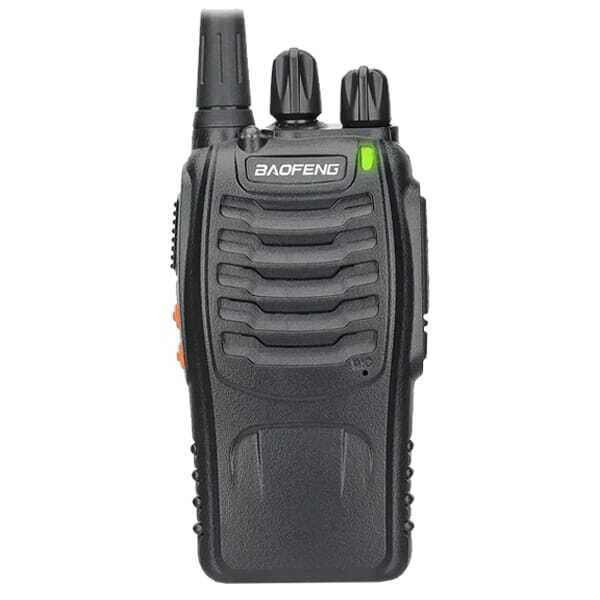
PMR446 — No Licence Needed
Baofeng BF-888S PMR446
The simplest option for UK buyers who want a walkie talkie they can use legally without any licence, exam or registration.
- Licence-free PMR446 operation in the UK
- Simple twist-and-go operation
- Affordable twin pack available
- Includes earpieces
Best for: Families, events, licence-free use
🏔️ Best Waterproof
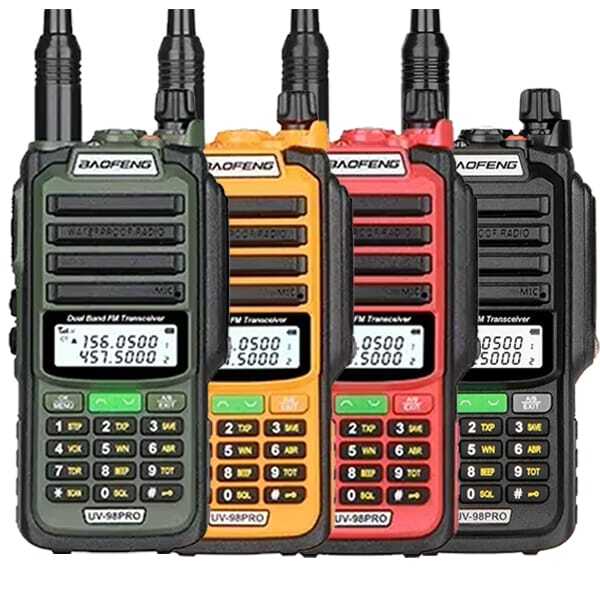
IP68 Waterproof + 8W
Baofeng UV-98 PRO
Built for harsh outdoor conditions. IP68-rated for dust and water protection, with 8W output for stronger signal reach in rural and hilly terrain.
- IP68 waterproof and dustproof
- 8W high-power output
- 2800mAh extended battery
- Dual-band VHF/UHF
Best for: Outdoor, hiking, wet conditions
📱 Best Modern Choice
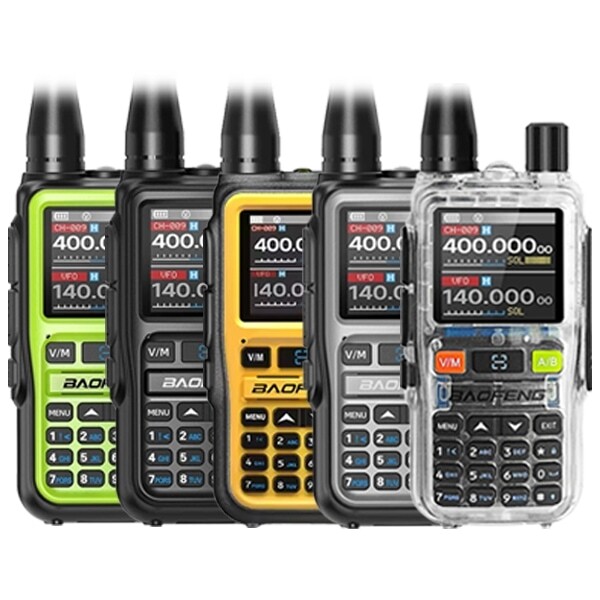
Bluetooth + USB-C
Baofeng UV-5R Mini
The most modern Baofeng handheld. Programme frequencies via smartphone Bluetooth app, charge via USB-C, and enjoy a compact pocket-friendly design.
- Bluetooth app programming
- USB-C charging
- Multi-band receive including airband
- 999 programmable channels
Best for: Tech-savvy beginners, modern setup
Important UK Buying Note: Licensed vs Licence-Free
⚠️ Important for UK buyers: radio legality in the UK depends on frequency, power output, antenna type and intended use.
- PMR446 models (like the BF-888S PMR446) are licence-free — no exam or registration needed.
- Amateur radio models (like the UV-5R III, UV-98 PRO and UV-5R Mini) require a valid Amateur Radio Licence from Ofcom before you can transmit.
- It is legal for anyone to buy and listen to these radios without a licence.
- Read our full guide: How to Get a UK Ham Radio Licence.
This article is a practical educational guide and is not legal advice. Always check the latest Ofcom regulations before transmitting.
Helpful Related Guides and Categories
- All Walkie Talkies
- PMR446 Licence-Free Radios
- Waterproof Walkie Talkies
- Long-Range Walkie Talkies
- Antennas
- Speaker Mics
- Chargers
- All Radio Accessories
- CTCSS and DCS Privacy Codes Guide
- Affordable Ham Radios for UK Beginners
- How to Choose Long Range Walkie Talkies | UK Buying Guide
- How to Get a UK Ham Radio Licence
Ready to Buy? Shop Our Most Popular Radios
Find the right walkie talkie for your needs:
Need accessories? Browse all radio accessories →
Frequently Asked Questions
How does a walkie talkie work?
A walkie talkie converts your voice into an electrical signal, modulates it onto a radio wave, and transmits it through the antenna. Another radio tuned to the same frequency captures the wave, demodulates it, and plays the audio through its speaker. The entire process happens almost instantly because radio waves travel at the speed of light.
What is the difference between VHF and UHF?
VHF (30–300 MHz) uses longer wavelengths that travel further in open outdoor areas. UHF (300 MHz–3 GHz) uses shorter wavelengths that penetrate buildings and obstacles more effectively. Most modern radios are dual-band, supporting both.
How far can a walkie talkie reach?
Range depends on power output, terrain, obstructions, antenna quality and weather. In a city, expect 1–3 miles. In open countryside, 3–5 miles is typical. From elevated positions like hilltops, 50+ miles is achievable with the right conditions and line of sight.
Do I need a licence to use a walkie talkie in the UK?
PMR446 radios (like the BF-888S PMR446) are licence-free for general public use. Higher-power or multi-band radios require an amateur radio licence from Ofcom. Read our UK Ham Radio Licence Guide for details.
What are CTCSS and DCS privacy codes?
CTCSS and DCS are sub-audible tone systems that filter out unwanted users on shared channels. They are not encryption — they prevent you from hearing others, but do not stop others from hearing you. Read our full CTCSS and DCS guide for more detail.
What does half-duplex mean?
Half-duplex means only one person can transmit at a time. When you press the PTT button to talk, you cannot hear incoming audio. When you release the button, your radio switches back to receive mode. This is why radio users say "over" when they finish speaking.
Can I upgrade the antenna on my walkie talkie?
Yes. Replacing the stock antenna with a higher-gain antenna is one of the most effective and affordable upgrades for improving range and signal quality. Browse our antenna range for compatible options.
What is FM modulation in a walkie talkie?
FM (Frequency Modulation) is the method most walkie talkies use to encode your voice onto a radio wave. The frequency of the carrier wave shifts slightly to represent your voice pattern. FM provides clearer audio and better noise rejection compared with AM (Amplitude Modulation).
Conclusion
At its core, a walkie talkie is beautifully simple: press a button, speak, and your voice rides a radio wave directly to another device — no towers, no internet, no network dependency. Understanding the science behind this process — from how radio waves carry sound, to how frequency choice affects performance, to how components like antennas and squelch circuits shape your experience — helps you choose the right radio and use it more effectively.
Whether you are an outdoor enthusiast, event coordinator, security professional or simply someone who wants a reliable backup communication tool, the technology behind walkie talkies remains one of the most practical and dependable forms of instant communication available.
Still deciding which radio is right for you? Read our How to Choose Long Range Walkie Talkies | UK Buying Guide for more help.